





What Tristan Harris’s reading list tells you about how he thinks
If you just scrolled through forty book covers, you probably noticed something odd. There are books about slot machines next to books about mindfulness meditation. A 777-page exploration of mathematical consciousness sits a few rows from a book about how to win friends. A dystopian novel from 1932 shares space with a modern guide to building habit-forming apps.
It looks scattered. It is not.
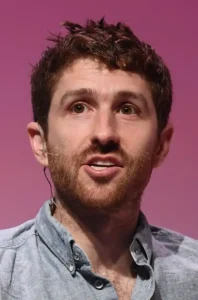
Tristan Harris started out as a magician. Literally. He grew up in the Bay Area performing magic tricks, which is a craft built on one skill: controlling where people look. You make the audience watch your right hand while your left hand does the work. Years later, he enrolled at Stanford to study computer science and landed in B.J. Fogg’s Persuasive Technology Lab, where the research question was basically the same thing but applied to screens. How do you get someone to tap, scroll, click, buy? Harris was classmates with one of Instagram’s co-founders. He watched these ideas turn into products used by billions of people.
He then spent three years as a design ethicist at Google, a role he created for himself after writing an internal memo that went viral among employees. The memo asked a question nobody at the company wanted to deal with: are we designing products that respect people’s time, or are we just getting better at wasting it? Google did not have a great answer. Harris left in 2015, co-founded the Center for Humane Technology, and became the most visible critic of the industry he came from. The Social Dilemma, his 2020 Netflix documentary, reached 38 million households in its first month.
All of that context matters when you look at the books he recommends, because they are not random picks. They are the curriculum for understanding the problem he has spent a decade trying to solve.
It starts with how easily we are fooled
The backbone of Harris’s reading list is a cluster of books about human psychology, and specifically about how bad we are at noticing when our decisions are being shaped by someone else.
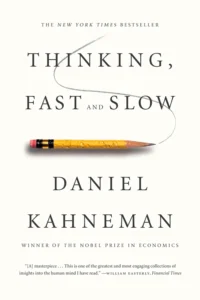
Thinking, Fast and Slow by Daniel Kahneman is the one that ties everything together. Kahneman splits the mind into two systems: one fast, automatic, and emotional, the other slow, deliberate, and logical. The entire business model of social media targets the fast system. Infinite scroll, autoplay, notification badges, pull-to-refresh. None of these features are designed for the part of your brain that makes careful choices. They are designed for the part that reacts before you have time to think. Harris has cited Kahneman on his podcast Your Undivided Attention more than almost any other author, and once you read this book, you start to see System 1 exploitation everywhere.
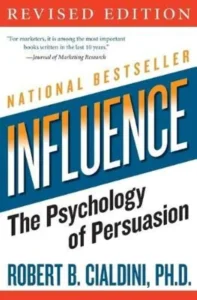
Influence by Robert Cialdini fits right next to it. Cialdini identified six levers of persuasion: reciprocity, commitment, social proof, authority, liking, and scarcity. Harris studied these at Stanford. He watched them get engineered into apps. When an app shows you that twelve of your friends already joined, that is social proof. When a banner says “offer expires in 2 hours” and you know it probably does not, that is artificial scarcity. Cialdini wrote the playbook in 1984. Tech companies just digitized it.
Then there is Predictably Irrational by Dan Ariely, which goes further into the specific ways we misjudge value, price, and fairness. And The Willpower Instinct by Kelly McGonigal, which explains why knowing about these biases does not actually protect you from them. Harris recommends both because they close an escape hatch people like to use: “Well, now that I know about it, I can just resist.” McGonigal’s research says no, you probably cannot, at least not consistently. That is why Harris argues for changing the design of technology rather than asking individuals to exercise more self-control.
Then he shows you the machine
Understanding human vulnerability is step one. Step two is seeing how that vulnerability gets industrialized.
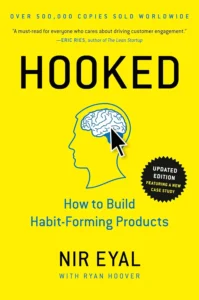
Hooked by Nir Eyal lays out the four-step loop that makes products habit-forming: trigger, action, variable reward, investment. Harris and Eyal have publicly disagreed about the ethics of this framework, which makes the recommendation more interesting, not less. Harris is not endorsing the approach. He is saying you need to understand the engineering before you can critique it. Hooked is honest about what it is. That honesty is useful.
Addiction by Design by Natasha Dow Schüll is the darker companion piece. Schüll spent fifteen years studying slot machine design in Las Vegas. She documented how casinos engineer what gamblers call “the zone,” a trance state where players lose track of time, money, and their own intentions. The parallels to app design are not metaphorical. They are mechanical. Variable reward schedules, near-miss feedback, elimination of natural stopping points. Harris has drawn this connection explicitly and often. The casino industry figured out how to hijack human attention decades before Silicon Valley did. Tech just scaled it to billions of users.
Read Hooked and Addiction by Design back to back and something clicks. One book explains how the hook works from the designer’s perspective. The other shows you what it looks like from the inside when someone is caught in it. That pairing is not an accident on Harris’s list.
The books that saw it coming before the internet existed
Some of the most interesting picks on this list were written decades before anyone had a smartphone.
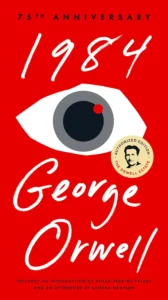
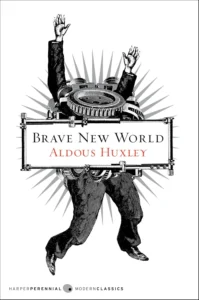
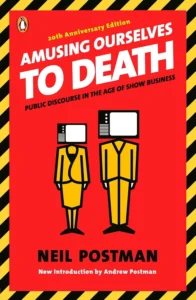
Amusing Ourselves to Death by Neil Postman came out in 1985. Postman argued that the real threat to public discourse was not government censorship but voluntary distraction. People would not be oppressed into ignorance. They would be entertained into it. He framed this as a contest between two dystopian novels: George Orwell’s 1984, where truth is suppressed by force, and Aldous Huxley’s Brave New World, where truth drowns in a sea of irrelevance because nobody cares enough to pay attention. Postman said Huxley was winning. Harris has called this one of the most important media criticism books ever written. And yes, both 1984 and Brave New World are also on this list. Harris wants you to hold both visions in your head, because we ended up getting elements of each.
Technopoly, also by Postman and published in 1992, takes the argument further. It describes a culture that has surrendered all of its values to technological efficiency. When the only question we ask about a new tool is “does it work?” and never “should we build it?”, we have entered technopoly. Harris used exactly this framing at TED in April 2025 when he talked about the AI race. Companies are asking “can we build AGI?” Nobody with enough power is asking “should we, and under what conditions?”
The fact that Harris recommends three books from before the internet era is itself a statement. The problems he works on are not new. The scale is new. The speed is new. But the underlying dynamic, technology outpacing human wisdom, has been playing out for a long time. These older books help you see the pattern instead of getting lost in the latest platform controversy.
Why the political and social books are here
The Righteous Mind by Jonathan Haidt explains why people across the political spectrum cannot seem to understand each other. Haidt’s argument is that moral reasoning is mostly post-hoc. We feel something is right or wrong first, then construct logical justifications afterward. Different political groups weight different moral foundations: fairness and care on the left, loyalty and authority on the right. Neither side is irrational. They are running different software.
Harris recommends this because social media did not create political polarization. It accelerated it by exploiting exactly the moral triggers Haidt describes. Outrage content spreads faster because it activates deep moral intuitions. If you do not understand Haidt’s framework, you will keep blaming the other side for being unreasonable instead of blaming the system that profits from making everyone feel attacked.
Winners Take All by Anand Giridharadas is a sharper pick. It is a critique of how wealthy elites, including tech founders, frame their profit-driven work as social good. “We’re connecting the world” sounds noble until you notice the business model requires keeping people addicted. Harris recommending this book is a form of self-awareness. He is a former tech insider turned reformer, and Giridharadas’s book questions whether that whole genre of criticism is sufficient or whether it lets the industry off too easy. Not many people recommend books that challenge their own position. Harris does.
The books about language, meaning, and paying attention
Metaphors We Live By by George Lakoff and Mark Johnson is a linguistics book that argues the metaphors embedded in everyday language shape thought in ways we do not notice. We say we “waste” time (treating it as a resource), we “attack” arguments (treating debate as war), we “scroll through” a feed (treating information as a physical space). Harris cares about this because the language we use to describe technology determines what solutions feel possible. Call it a “platform” and it sounds neutral. Call it an “attention economy” and suddenly regulation makes sense. Lakoff’s insight is that reframing is not spin. It is how cognition actually works.
Wherever You Go, There You Are by Jon Kabat-Zinn is about mindfulness meditation, and it might seem out of place until you think about what Harris actually does all day. He studies systems designed to fragment human attention. His professional life requires him to think clearly about things that are specifically engineered to prevent clear thinking. A meditation practice is not a wellness luxury in that context. It is a countermeasure.
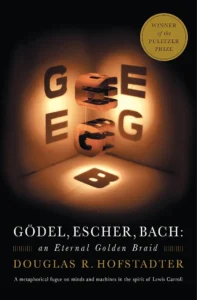
Godel, Escher, Bach by Douglas Hofstadter is the wildcard. It is 777 pages about self-reference, consciousness, recursion, and what it means for a system to become aware of itself. Published in 1979, it anticipated questions about machine intelligence that are now front-page news. Harris has expanded his work from social media to AI, and the central question of whether a language model “understands” anything or is just producing statistically likely outputs is a question Hofstadter was already wrestling with four decades ago. If you only read one unexpected book from this list, make it this one.
The thread that connects all forty books
Harris’s reading list is really about one thing: the gap between how powerful our tools have become and how well we understand what they are doing to us. Kahneman and Cialdini explain the vulnerabilities. Eyal and Schüll show how those vulnerabilities get exploited. Postman and Huxley warned us decades early. Haidt and Giridharadas show the political and social consequences. Lakoff explains why we struggle to even talk about it clearly. And Kabat-Zinn and Hofstadter point toward what it might take to stay human in the middle of all of it.
You do not need to read all forty. But if you pick five or six from different sections of this list and read them in sequence, you will start to see the connections Harris sees. And once you see them, you will not be able to unsee them. That is probably the point.
