
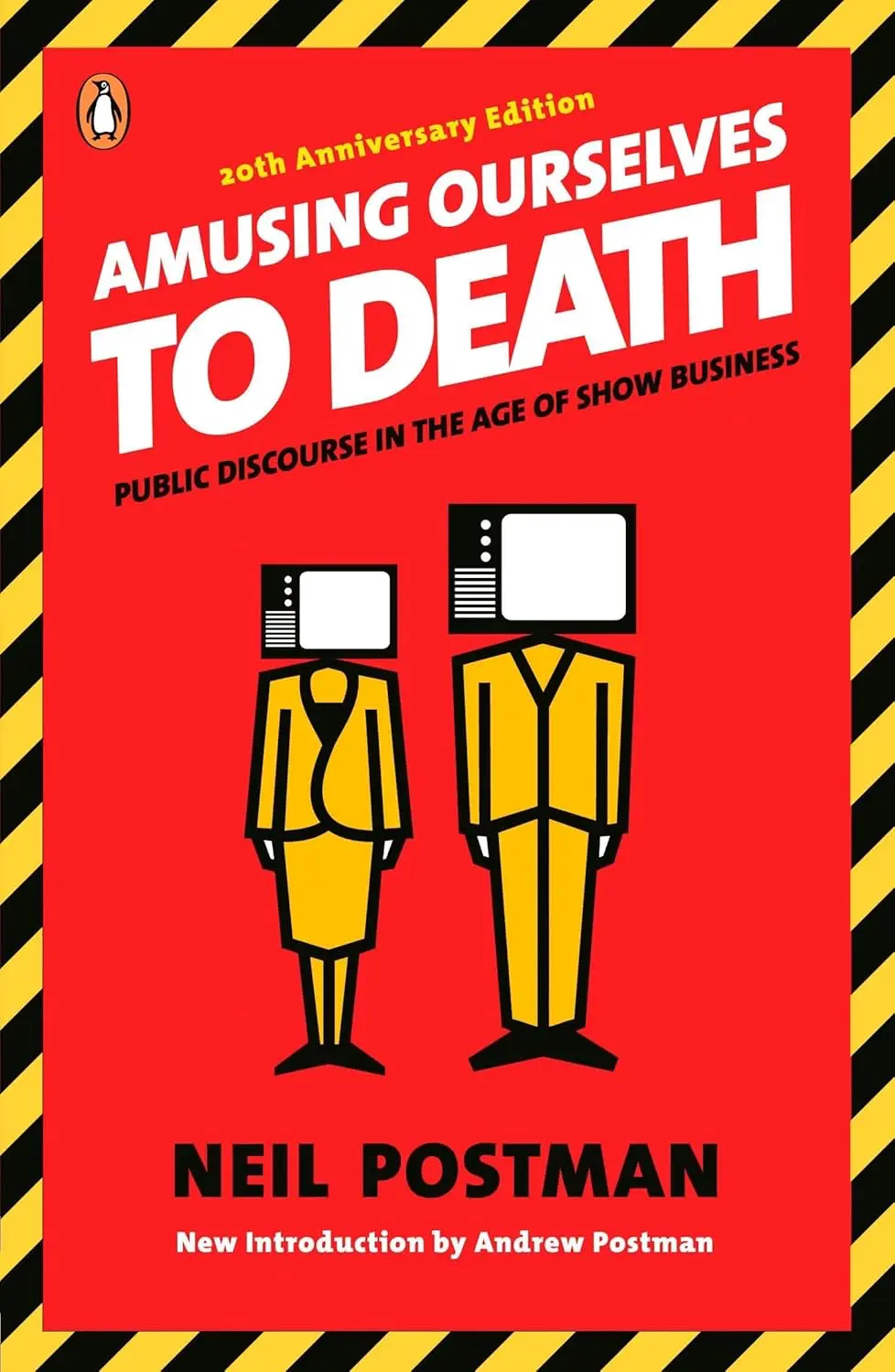
Neil Postman opens with a comparison between two dystopias. In George Orwell’s 1984, the government controls people by banning information. In Aldous Huxley’s Brave New World, nobody needs to ban anything because people are drowning in so much entertainment that they no longer care about information that matters. Postman’s argument is that Huxley was right.
The book was published in 1985, when television was the dominant medium. Postman, a media theorist and professor at NYU, argued that the shift from print to television had not merely changed how people received information. It had changed the kind of information that could exist in public life.
Print culture, Postman wrote, demanded sustained attention. Reading a political argument or a scientific paper required you to follow a chain of logic from beginning to end. Television demanded the opposite. It required you to absorb disconnected images and sounds in short bursts. As television became the dominant medium for news, politics, education, and even religion, these domains adapted to its format. Political debate became a contest of sound bites. News became a series of unrelated dramatic events. Education became edutainment.
Postman was not arguing that television was bad at delivering information. He was arguing something more subtle: that television’s bias toward entertainment reshaped the expectations of the audience. People began to expect all information to be entertaining, and information that was not entertaining began to disappear from public life.
Written four decades ago, the book reads today like a prediction that came true and then got worse. Social media, smartphones, and algorithmic feeds have accelerated every trend Postman identified. The demand for entertainment has intensified. The attention span for complex argument has shrunk further. The line between news and performance has all but dissolved.
For builders and entrepreneurs, the book raises questions about the attention economy that are worth sitting with. If you are building a product that competes for attention, you are operating inside the system Postman described. Understanding how that system shapes what people are willing to engage with, and what it quietly filters out, is useful whether or not you share his concerns.
Postman died in 2003. His book remains in print, widely assigned in university courses, and more frequently cited now than when it was published.
