
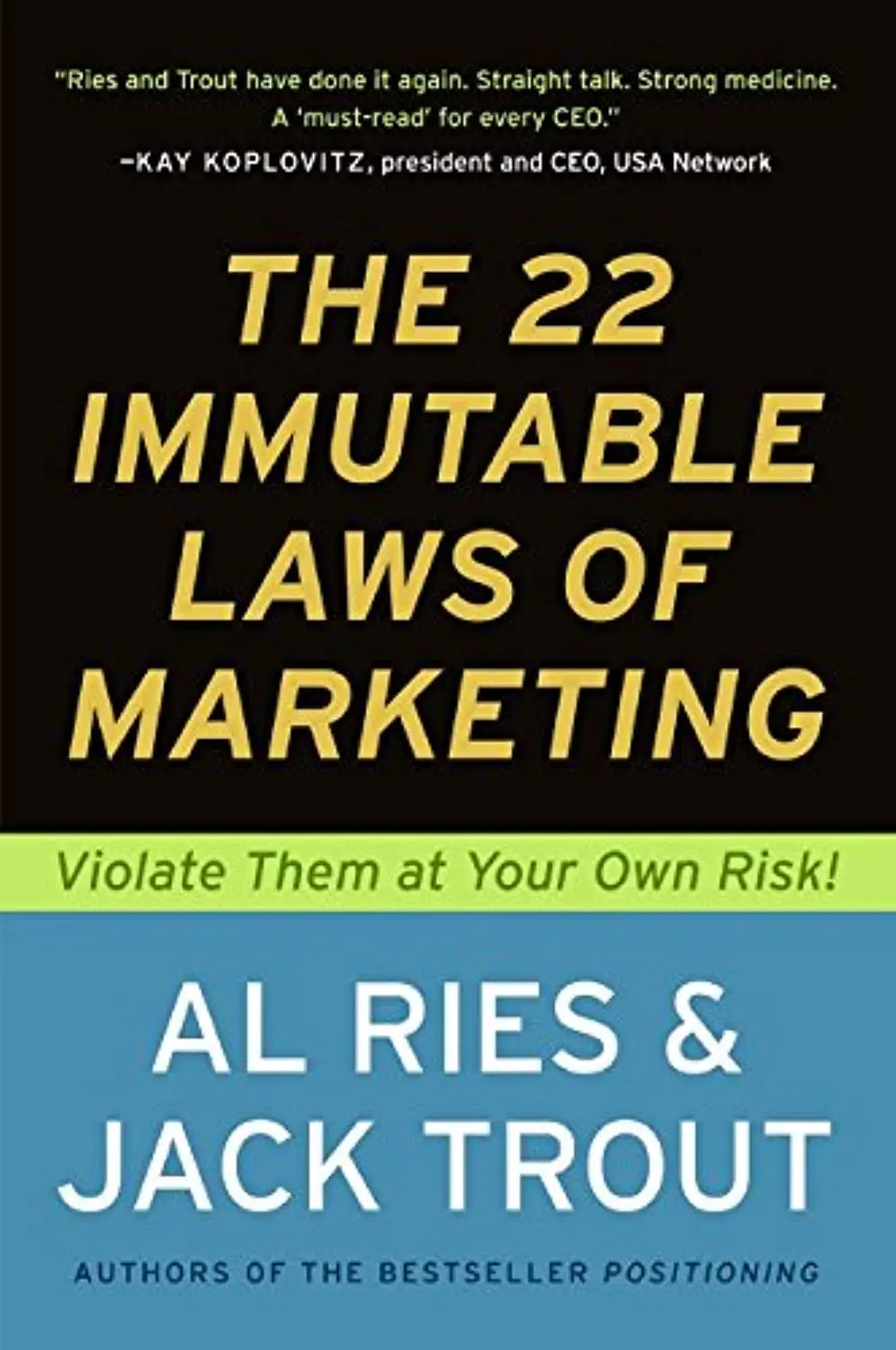
The 22 Immutable Laws of Marketing is Al Ries and Jack Trout’s attempt to compress everything they know about marketing into 22 principles, each explained in a few pages with real-world examples. The book is short, opinionated, and deliberately provocative. Ries and Trout believe most marketing failures happen because companies violate one or more of these laws, and they have no patience for the usual corporate excuses.
The most cited laws include the Law of Leadership (it’s better to be first than to be better), the Law of the Category (if you can’t be first in an existing category, create a new one), the Law of the Mind (it’s better to be first in the prospect’s mind than first in the marketplace), and the Law of Focus (the most powerful concept in marketing is owning a word in the prospect’s mind). Volvo owns “safety.” FedEx owns “overnight.” Once a brand owns a word, it’s nearly impossible for a competitor to take it away.
Some of the laws are less intuitive. The Law of the Opposite argues that if you’re in second place, your strategy should be the opposite of the leader’s, not a copy of it. The Law of Sacrifice says that you have to give something up (a product line, a target market, a constant change in strategy) to be successful. The Law of Unpredictability says that you can’t predict the future, so don’t build your marketing plan around predictions.
For founders, the book’s biggest contribution is the emphasis on positioning over product quality. Ries and Trout argue, sometimes controversially, that the best product doesn’t always win. The product that occupies the right position in the customer’s mind wins. This is a useful corrective for technical founders who believe that building a better product is sufficient.
The book was published in 1993, and some examples are dated (Xerox, Lotus, GM). Several of the “immutable” laws have been challenged by companies that violated them successfully. But the core principles about positioning, category creation, and the power of perception remain relevant. The short format makes it a book you can read in an afternoon and reference repeatedly.
