
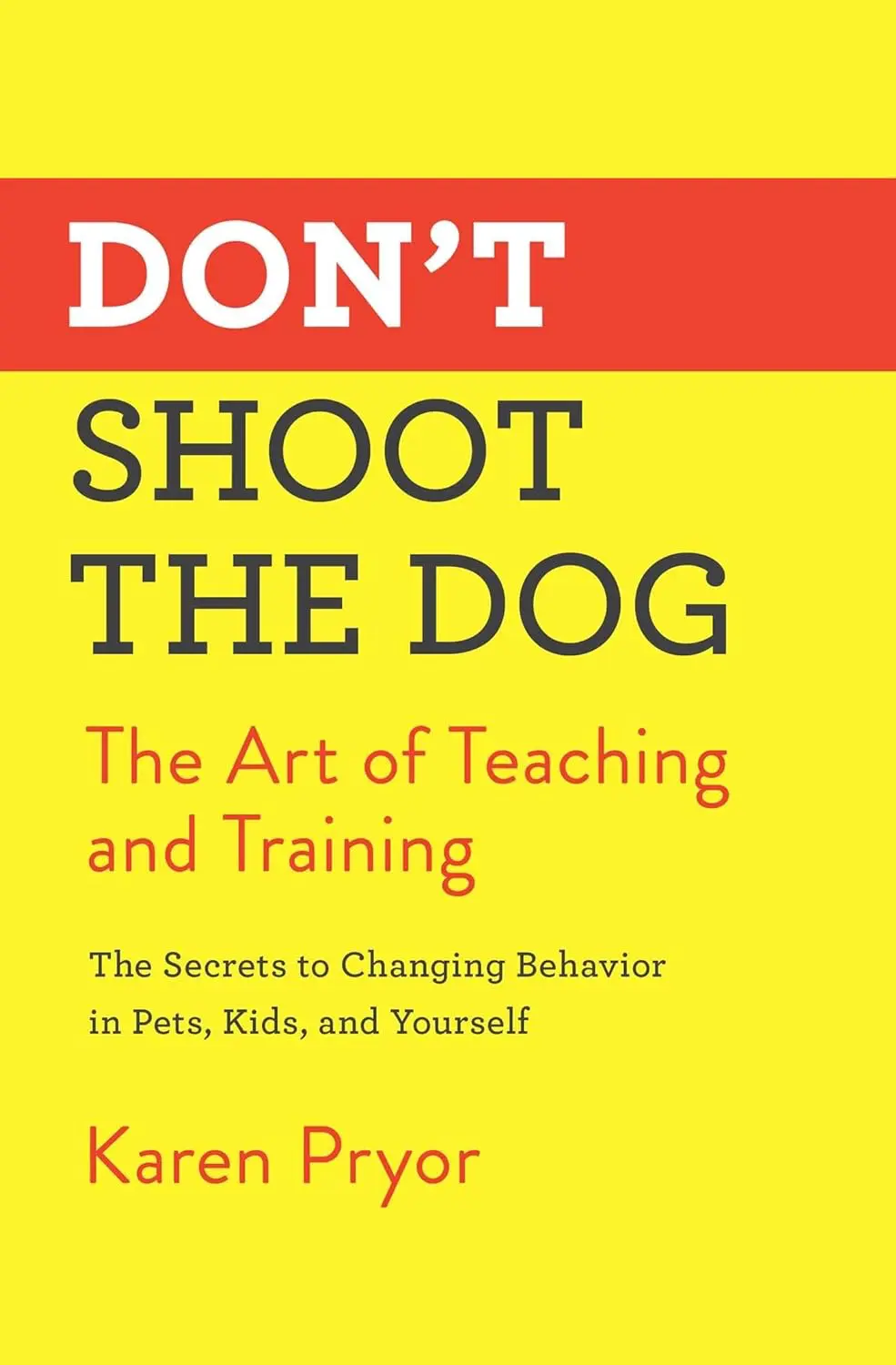
Karen Pryor was training dolphins at Sea Life Park in Hawaii when she discovered something that most people working with animals and people had been getting wrong. Punishment, yelling, and coercion might suppress behavior temporarily, but they do not teach. Positive reinforcement, delivered at the right moment and with the right timing, actually changes behavior, and it does so faster, more reliably, and without the side effects that punishment creates.
Don’t Shoot the Dog takes the science of operant conditioning, the branch of behavioral psychology associated with B.F. Skinner, and strips away the academic jargon to reveal a set of practical tools that can be applied to almost any training situation. Pryor organizes the book around two central frameworks: eight methods for eliminating undesirable behavior, and ten laws of “shaping,” the process of building new behaviors through successive reinforcement of closer and closer approximations.
The eight methods range from the obvious (train an incompatible behavior) to the counterintuitive (put the behavior on cue, then never give the cue). Pryor walks through each one with examples drawn from dog training, child-rearing, workplace management, athletic coaching, and her own experience with marine mammals. The ten laws of shaping are more technical but equally practical. They cover how to raise criteria in small increments, how to vary the reinforcement schedule, and why timing matters more than anything else.
What makes the book unusual is Pryor’s refusal to limit it to animal training. She applies the same principles to roommates who leave dishes in the sink, teenagers who will not clean their rooms, and her own attempts to break bad habits. The point is consistent throughout: behavior follows consequences, and if you want to change behavior, you change the consequences. Everything else is noise.
Pryor writes with humor and without condescension. She does not pretend that positive reinforcement is a magic trick. She acknowledges that it requires observation, patience, and skill. But she makes a strong case that it works better than the alternatives, which mostly come down to variations of punishment, and that the alternatives create problems of their own: resentment, avoidance, anxiety, and the desire to punish back.
The book was first published in 1984 and has been revised several times since. It has sold consistently for decades, which is unusual for a book rooted in behavioral science. Tristan Harris has cited it. Pryor went on to develop “clicker training,” a method now used worldwide for dogs, cats, horses, zoo animals, and increasingly for human applications including sports coaching and work with children on the autism spectrum.
Anyone who manages people, designs products, or tries to influence behavior in any context will find the underlying principles of this book directly applicable. Reinforcement is not manipulation. It is how learning works.
