
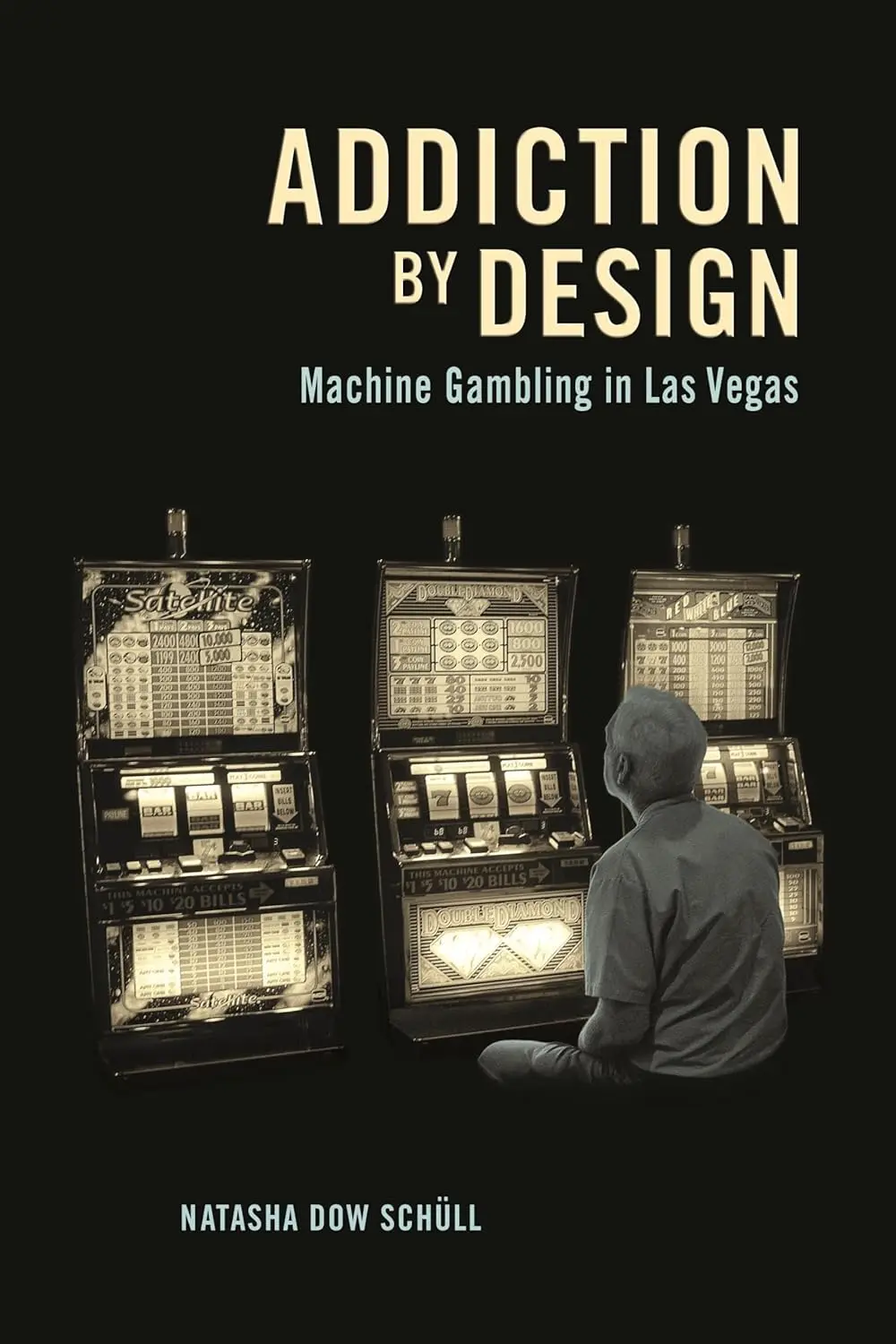
Machine gamblers do not play to win. They play to stay in the zone, a trance-like state where time, money, and the outside world disappear. Natasha Dow Schüll, an anthropologist at MIT, spent fifteen years in Las Vegas studying how the gambling industry engineers that zone and what happens to the people who get stuck in it.
The book examines both sides of the slot machine. On the industry side, Schüll documents the design decisions that go into modern electronic gambling machines: the algorithms that calibrate win frequency to keep players engaged, the ergonomic curves of the chairs that reduce physical fatigue, the lighting and sound design that insulates players from the outside world, the elimination of coins in favor of ticket-in, ticket-out systems that remove the tactile friction of spending real money. She attends industry conventions where developers compete to maximize “time on device,” the metric that matters more than any individual jackpot.
On the player side, Schüll interviews gambling addicts who describe the zone in remarkably consistent terms. They talk about losing track of hours, ignoring hunger and thirst, and playing until they physically cannot continue. Many of them are not chasing a big win. They are chasing the state of absorption itself, a state where the complexity and stress of their regular lives are temporarily replaced by a simple, rhythmic loop: press button, watch result, press button again.
The tension at the center of the book is a design ethics question. The gambling industry has gotten extraordinarily good at understanding human psychology and using that understanding to build products that are, by the industry’s own internal metrics, addictive. The machines are not broken. They are working exactly as designed. Schüll does not moralize about this, but the implications are hard to miss.
The book was published in 2012, right as Silicon Valley was beginning its own conversation about engagement metrics, dark patterns, and addictive design. The parallels are obvious and have been widely noted. Tristan Harris, the former Google design ethicist who went on to co-found the Center for Humane Technology, has cited Addiction by Design as an influence on his thinking. The “machine zone” that Schüll describes in the context of slot machines looks a lot like the infinite scroll of a social media feed or the autoplay loop of a streaming platform.
For anyone building digital products, the book is a case study in what happens when engagement optimization is pursued without constraint. The gambling industry figured out how to capture and hold human attention before the tech industry did, and the tools they developed, continuous variable-ratio reinforcement, removal of stopping cues, seamless payment systems, have since been adopted far beyond the casino floor.
