
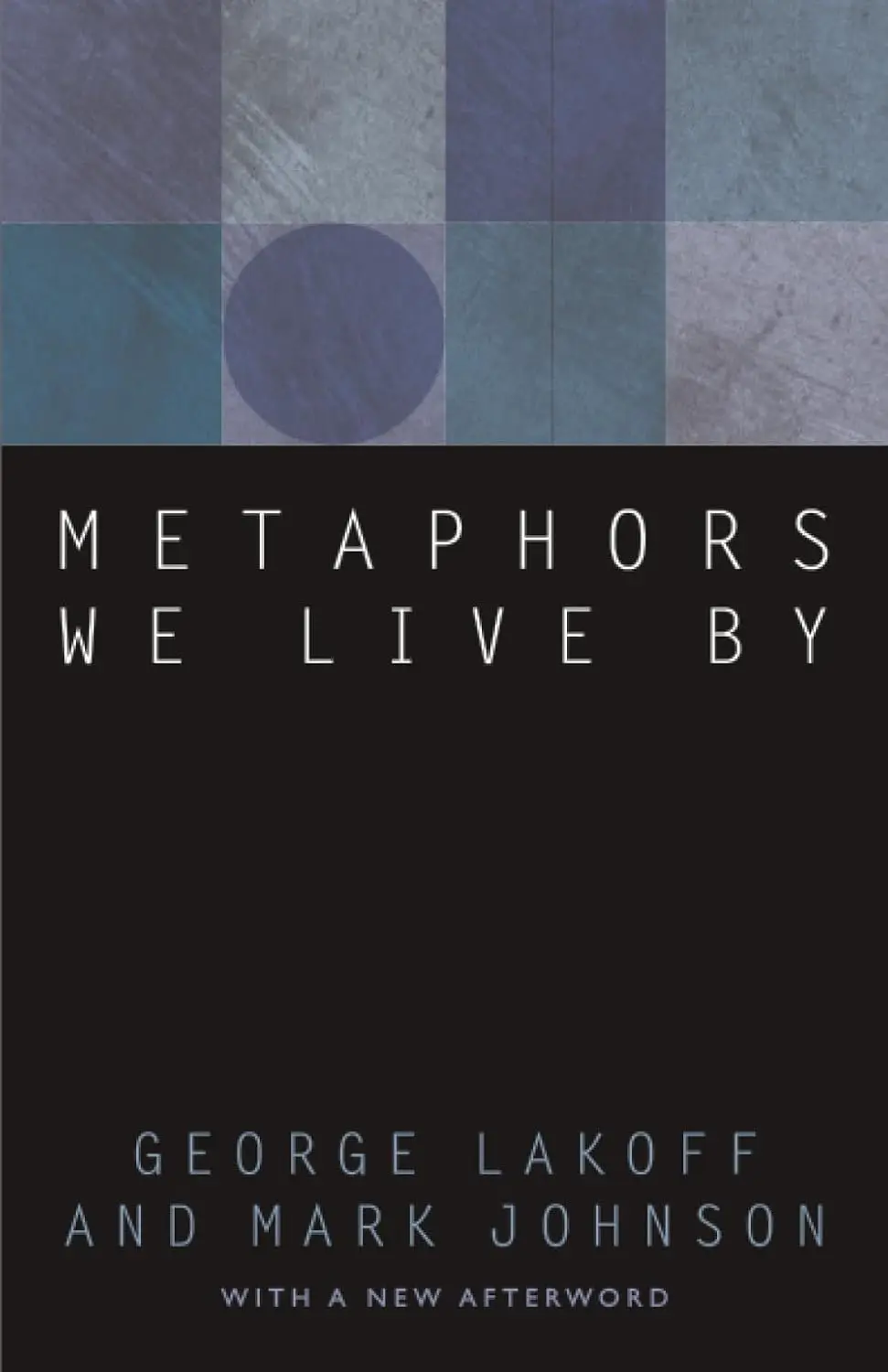
Most people think of metaphors as decoration, the kind of thing poets use. Lakoff and Johnson’s argument is that metaphor is not ornamental. It is how human beings think. We do not use metaphors to make our language colorful. We use them because we literally cannot think about abstract concepts without them.
The book opens with a simple example: “argument is war.” We talk about arguments using war language. We attack positions. We defend claims. We shoot down ideas. We win or lose debates. This is not just a manner of speaking. Lakoff and Johnson argue that the metaphor structures how we actually experience arguments. We treat them as battles to be won rather than as collaborative attempts to find truth. If our culture used a different metaphor, say “argument is dance,” the experience of disagreement would feel fundamentally different.
From there, the book catalogs dozens of conceptual metaphors that operate beneath everyday English. “Time is money” (we spend time, waste time, save time). “Understanding is seeing” (I see what you mean, that’s a clear explanation, let me shed some light on this). “Life is a journey” (she’s at a crossroads, he’s lost his way, they’re on the right track). Each metaphor highlights some aspects of the concept while hiding others, and the hidden aspects matter because they represent the things we systematically fail to notice.
The book is short and written for a general audience. Lakoff was a professor of linguistics at UC Berkeley, and Johnson was a philosopher at the University of Oregon. Their collaboration produced a work that crosses disciplinary boundaries: it is relevant to linguistics, philosophy, cognitive science, and, in practice, to anyone whose work involves communication, persuasion, or product design.
For people who write copy, build brands, pitch investors, or design user interfaces, the implications are direct. The metaphors embedded in your language shape how your audience thinks about your product. Calling something a “platform” versus a “tool” versus a “ecosystem” triggers different conceptual frameworks in the listener’s mind, and those frameworks influence expectations, evaluations, and decisions.
Tristan Harris has cited the book. First published in 1980, Metaphors We Live By has been continuously in print and remains the most accessible introduction to conceptual metaphor theory. A 2003 afterword by the authors addresses developments in the field since the original publication.
