
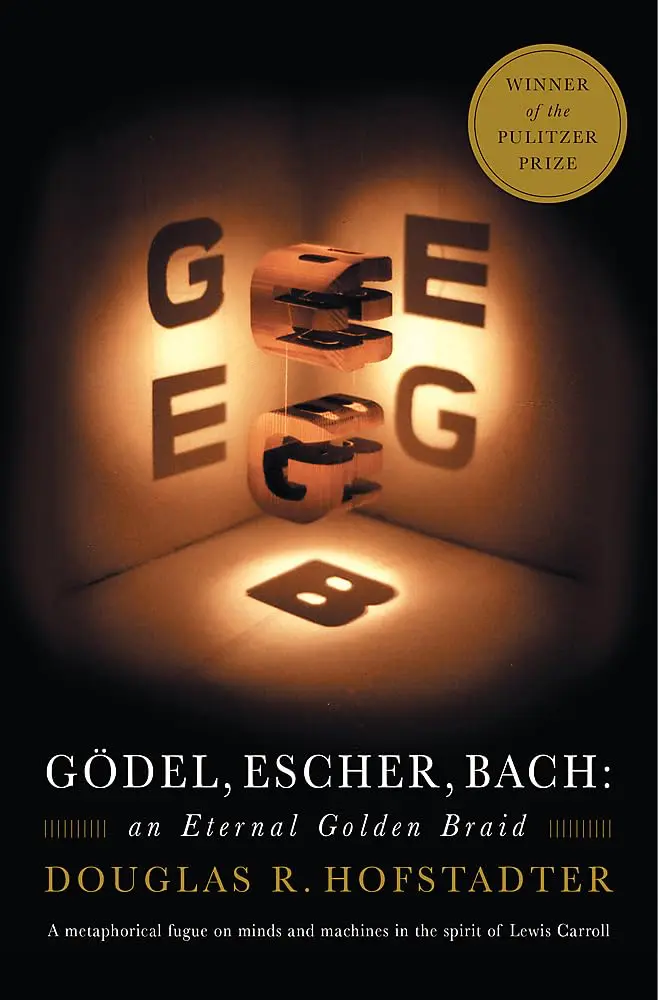
Godel, Escher, Bach is Douglas Hofstadter’s exploration of how meaning and consciousness emerge from formal systems. Published in 1979 and awarded the Pulitzer Prize, the book uses the work of mathematician Kurt Godel, artist M.C. Escher, and composer Johann Sebastian Bach as three lenses on a single question: how does a system of meaningless symbols (neurons, musical notes, mathematical axioms) give rise to meaning, self-awareness, and intelligence?
The book alternates between expository chapters and dialogues. The chapters explain concepts from mathematical logic, computer science, genetics, and cognitive science. The dialogues, written as conversations between Achilles and a Tortoise (borrowed from Lewis Carroll), illustrate the same concepts through playful storytelling. The dialogues are themselves examples of the formal patterns being discussed: some are structured as canons or fugues, mirroring Bach’s musical forms.
Godel’s incompleteness theorems are the book’s mathematical spine. Godel proved in 1931 that any consistent formal system powerful enough to describe arithmetic contains true statements that cannot be proven within the system. Hofstadter uses this result to argue that self-reference, the ability of a system to refer to itself, is the mechanism through which meaning and consciousness arise. A brain is a system that models the world, and part of what it models is itself. This self-referential loop, Hofstadter argues, is what creates the feeling of being a “self.”
For founders, the book is not directly practical. It won’t help you close a deal or manage a team. But it will change how you think about intelligence, systems, and what it means for a machine to “understand” something, which is relevant if you’re building or investing in AI products, or if you’re curious about the deepest questions underlying the technology industry.
The writing is playful, digressive, and densely packed with ideas. The book is over 700 pages and rewards slow, careful reading. Some chapters are accessible to anyone; others require comfort with mathematical logic. It is one of those rare books that changes your mental furniture permanently, introducing concepts and patterns of thinking that you’ll use for the rest of your life, even if you forget the specific details.
