
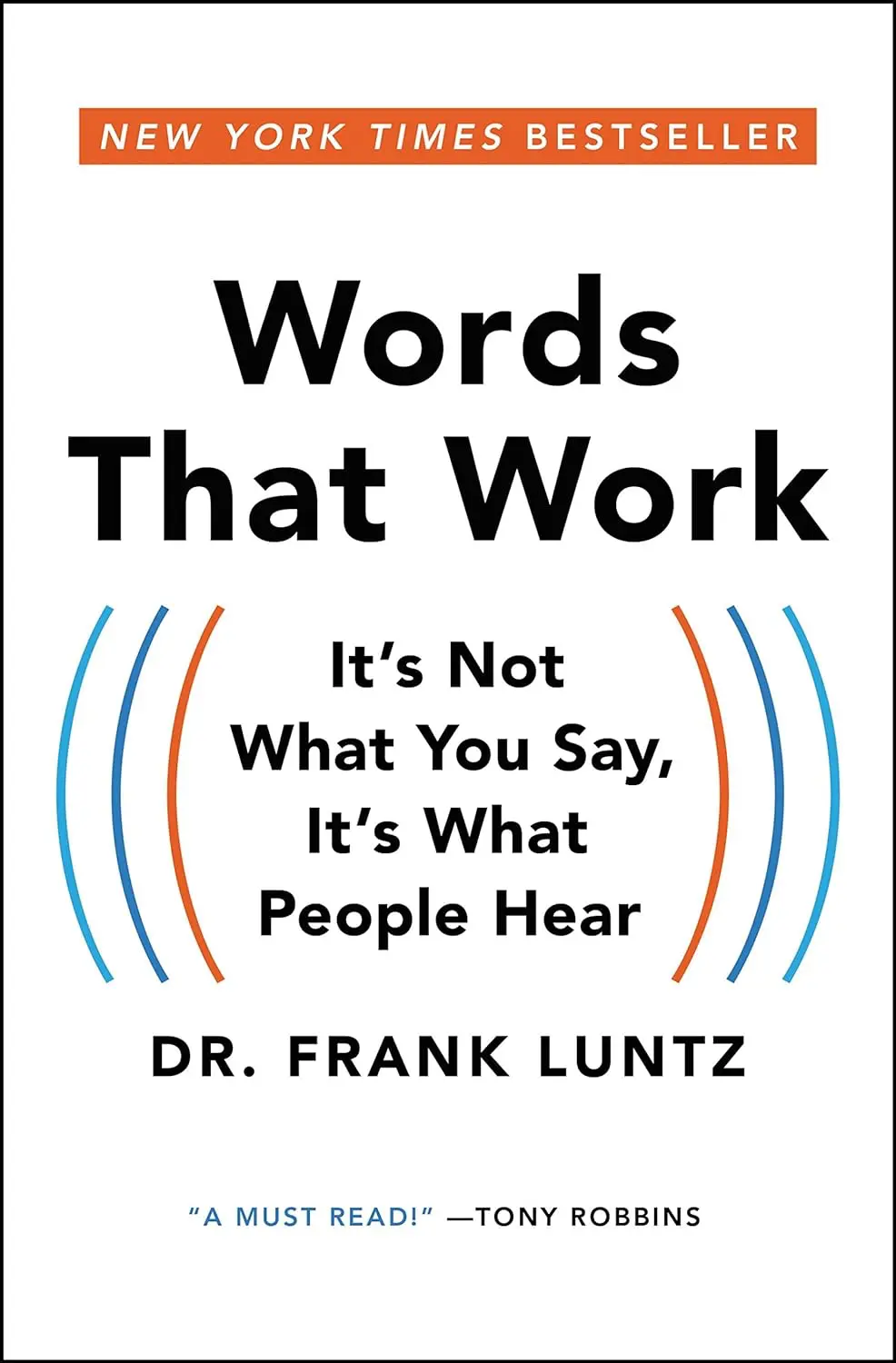
Frank Luntz has spent his career helping people choose the right words. Not the smartest words or the most accurate ones, but the ones that make people actually listen. He has run over 1,500 surveys and focus groups for Fortune 500 companies, political campaigns, and advocacy organizations. His specialty is testing language: putting two versions of the same message in front of real audiences and measuring which one gets through.
The book opens with ten rules of effective communication. Simplicity. Brevity. Credibility. Consistency. Novelty. Sound and texture. Aspiration. Visualization. Questioning. Context. Each rule is illustrated with examples from Luntz’s work. Some are from politics: he helped Republicans rebrand the “estate tax” as the “death tax,” a shift that moved public opinion on the issue by double digits. Others are from business: pharmaceutical companies saw better results when they talked about “prevention” and “wellness” instead of “treatment.”
The core argument is in the subtitle. What matters is not what you say but what your audience hears. Most communicators craft their message from their own perspective, using language that makes sense to them. Luntz argues that effective communicators reverse the process, starting with what the audience already believes, fears, or wants, then choosing words that connect to those existing mental frameworks.
The book covers corporate messaging, with case studies from companies that repositioned their products by changing nothing except the words they used to describe them. It covers political language, with examples from both parties and multiple election cycles. And it includes a chapter called “The 21 Words and Phrases for the 21st Century,” which catalogs the specific terms and frames that Luntz’s research found to be most persuasive at the time of writing.
Luntz is a polarizing figure in politics. His critics argue that his work amounts to manipulation, helping politicians sell policies by disguising what they actually are. He would counter that clarity is not deception, and that the same techniques he teaches to Republicans are available to anyone. The book does not shy away from this tension, but it does not resolve it either.
For founders, the relevance is direct. Every pitch deck, landing page, investor email, and customer conversation is an exercise in word choice. The difference between a message that converts and one that doesn’t often comes down to a few words. Luntz’s framework, test your language on real people and pay attention to what they hear rather than what you meant, is as useful in product marketing as it is in political campaigns.
The book has been recommended by Matt Mullenweg, the co-founder of WordPress, and by former Google design ethicist Tristan Harris. Published in 2007, some of the political examples feel dated, but the underlying method, rigorous audience testing applied to language, has not changed.
