




What Andrew Grove’s book recommendations tell you about the man who built Intel
There are twenty-five books on this list. Two of them are about surviving systems designed to destroy you. One is a novel set in a prisoner-of-war camp. Another is about the Underground Railroad. And one is Grove’s own memoir about fleeing Hungary at twenty with nothing.
You cannot separate Andrew Grove’s reading list from his biography, and his biography starts in Budapest in 1936. He was born András István Gróf into a middle-class Jewish family. At four, scarlet fever nearly killed him and left him partially deaf. At eight, the Nazis occupied Hungary and began deporting Jews to concentration camps. Grove and his mother survived by taking false identities and hiding with friends. His father was arrested and sent to a labor camp where he was tortured and forced into slave work. After the war came the Soviets, and after the Soviets came the 1956 revolution, which was crushed. Grove was twenty. He walked out of Hungary with two hundred thousand other refugees, arrived in New York unable to speak English, and got a job as a busboy.
Within seven years he had a PhD in chemical engineering from Berkeley. Within twelve he was running operations at Intel as its third employee. By 1997, Time named him Man of the Year. Steve Jobs called him for advice when he was deciding whether to return to Apple. When Grove died in 2016, he was considered one of the most consequential business leaders of the twentieth century.
That is the person who picked these twenty-five books. Keep it in mind as you read through them.
Andrew Grove’s books on management and leadership
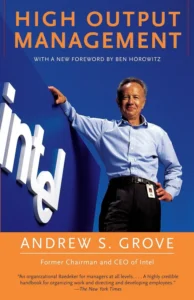
Two of Grove’s own books are on this list, which makes sense given that he wrote them. High Output Management, published in 1983, is the one Silicon Valley still passes around. It treats management as an engineering problem: what are the inputs, what are the outputs, where are the bottlenecks? Grove wrote it while running Intel’s manufacturing operations, and it reads like someone who thinks about human organizations the same way he thinks about chip fabrication. Meetings are processes. Decisions have throughput. A manager’s output is the output of the people who report to them, nothing more. Ben Horowitz has called it the best management book ever written. It is blunt, specific, and completely uninterested in making you feel good.
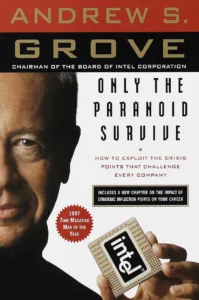
Only the Paranoid Survive came out in 1996 and introduced the concept of “strategic inflection points,” moments when something fundamental changes in your industry and the old playbook stops working. Grove lived through the biggest inflection point in Intel’s history when Japanese manufacturers started dumping memory chips at below-cost prices in the 1980s. Intel was a memory company. Grove decided it would become a microprocessor company instead. That decision saved the company and created the foundation for the entire PC era. The book is about how to recognize those moments before they destroy you, and why most leaders fail to act because they are too attached to what made them successful in the first place.
The Score Takes Care of Itself by Bill Walsh connects to Grove’s management philosophy in a less obvious way. Walsh coached the San Francisco 49ers and was obsessed with what he called the “Standard of Performance,” a set of behavioral expectations so detailed that they covered how the receptionist answered the phone. Walsh’s argument was that if you get the process right, the results follow. Grove ran Intel the same way. He sat in an open cubicle, not a corner office. He subjected every idea, including his own, to what he called “constructive confrontation,” a culture where anyone could challenge anyone else’s thinking as long as they brought data. Both Walsh and Grove believed that excellence is not a goal. It is a set of daily behaviors.
Measure What Matters by John Doerr describes the OKR framework that Doerr brought to Google, but Doerr learned about goal-setting while working at Intel under Grove. The book is, in a real sense, about Grove’s management system filtered through Doerr’s experience applying it elsewhere. Reading it alongside High Output Management gives you the theory from the source and the application from someone who carried it to the next generation of companies.
Books on survival, resilience, and Andrew Grove’s personal history
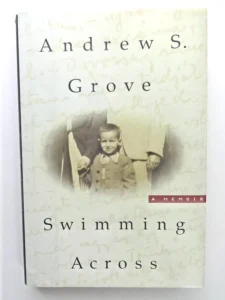
Swimming Across is Grove’s own memoir, and it covers only the first twenty years of his life. It ends when he arrives in the United States. There is no Intel in it. No Silicon Valley. It is entirely about surviving as a Jewish child in Nazi-occupied Hungary, growing up under Soviet communism, and making the decision to flee during the 1956 revolution. Grove wrote it late in life, after being diagnosed with both prostate cancer and Parkinson’s disease. It reads like someone who wanted to put the first chapter of his story on paper before he could no longer tell it.
The Autobiography of Malcolm X is another survival narrative, though from a completely different context. Malcolm X grew up in poverty, spent time in prison, educated himself, and rebuilt his entire worldview multiple times over the course of his life. The connection to Grove is not political. It is structural. Both men arrived at positions of enormous influence from starting points where the system was designed to exclude or eliminate them. Both valued education as the mechanism that made the crossing possible.
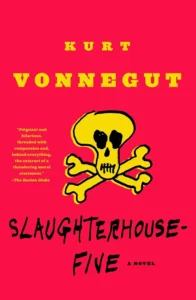
Slaughterhouse-Five by Kurt Vonnegut is set partly in a prisoner-of-war camp during the firebombing of Dresden. Vonnegut was actually there. He survived by hiding in an underground slaughterhouse. The novel deals with trauma by fracturing time, jumping between past and present in ways that mirror how traumatic memory actually works. Grove, who survived the siege of Budapest and spent his childhood hiding from Nazis, recommending a novel about surviving wartime destruction is not a literary preference. It is recognition.
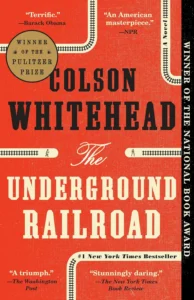
The Road by Cormac McCarthy and The Underground Railroad by Colson Whitehead are both novels about people moving through landscapes of extreme danger with no guarantee of safety on the other side. The Road is a father and son walking through a post-apocalyptic wasteland. The Underground Railroad reimagines the escape routes used by enslaved people as a literal underground train system. Both are about the decision to keep moving when stopping seems easier. Grove made that decision when he was twenty, crossing the border out of Hungary. These books are on this list because he knew what that decision felt like.
Andrew Grove’s recommended books on thinking and science
Godel, Escher, Bach by Douglas Hofstadter is the longest and strangest book on this list. It weaves together mathematics, visual art, and music to explore self-reference, consciousness, and what it means for a system to become complex enough to reflect on itself. Grove was a chemical engineer who thought in systems. Intel is, at its core, a company that builds systems for processing information. Hofstadter’s book asks what happens when information processing becomes sophisticated enough to produce something that looks like understanding. That question has only gotten more urgent since Grove’s death.
A Short History of Nearly Everything by Bill Bryson is the opposite kind of science book. It is breezy, funny, and covers everything from the Big Bang to the rise of civilization in a tone that makes particle physics feel like a conversation at a dinner party. Grove, who spent his professional life dealing with the extremely narrow and technical world of semiconductor manufacturing, recommending a book that takes the widest possible view of science suggests he valued perspective. Spending decades on chip architecture can make you forget that chemistry, biology, and geology are all connected. Bryson’s book is a reminder.
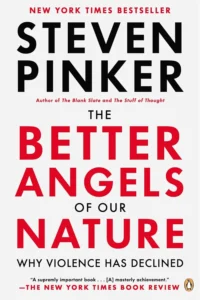
The Better Angels of Our Nature by Steven Pinker argues that violence has declined dramatically over the course of human history, even though it does not feel that way. For a man who survived the Holocaust, Soviet occupation, and a revolution before he turned twenty-one, this thesis is personal. Pinker is essentially telling Grove that the world he fled was the exception, not the rule, and that the long-term trend is toward less violence, not more. Whether Grove fully agreed with that argument or simply found it worth wrestling with, recommending it says something about his willingness to question his own experience.
The quieter picks on Andrew Grove’s reading list
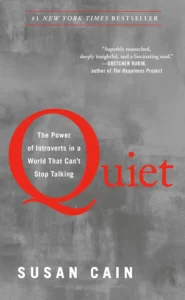
Quiet by Susan Cain is about the power of introverts in a culture that rewards loud extroverts. Grove had partial hearing loss for most of his life and had to lip-read his professors in college. Being quiet was not a personality choice for him. It was a physical reality he worked around. Cain’s book validates the idea that listening carefully and thinking before speaking is not a weakness, which Grove’s entire career demonstrated.
The Untethered Soul by Michael Singer is about letting go of the mental habits that keep you stuck: the inner critic, the fear of uncertainty, the attachment to outcomes. This is a surprising pick for someone famous for being relentlessly driven and strategically paranoid. But Grove was also a man who dealt with cancer and Parkinson’s disease in his later years. A book about releasing the need to control everything reads differently when you are facing things that cannot be controlled.
On the Shortness of Life by Seneca is a two-thousand-year-old essay arguing that life is not actually short. We just waste most of it. Seneca was writing to a Roman official who kept complaining about not having enough time, and his response was basically: you have plenty of time, you just spend it on things that do not matter. Grove, who accomplished more in one lifetime than most people could manage in three, recommending a book about not wasting time is either deeply ironic or completely sincere. Probably both.
How Andrew Grove’s reading list connects to his life
The thread through these twenty-five books is not management or technology or even survival. It is about what happens when the ground shifts under your feet and you have to decide what to do next. Grove lived through more ground-shifting moments than most people can imagine: the Nazi occupation, the Soviet takeover, fleeing Hungary, reinventing Intel, fighting cancer. Every book on this list is, in one way or another, about navigating change you did not choose.
The management books teach you to see inflection points coming. The survival narratives remind you that people have walked through worse and come out the other side. The science books say the universe is stranger and more interconnected than you think. And the quiet, philosophical picks at the end suggest that even the most driven, paranoid, relentless leader eventually has to make peace with what he cannot control.
Grove arrived in America at twenty with no money, no English, and partial hearing. He left behind everything he had ever known. He built one of the most important companies in human history. And his reading list says: keep moving, keep thinking, stay scared, and do not waste the time you have. Not a bad set of instructions from someone who knew what it meant to start over from nothing.
