
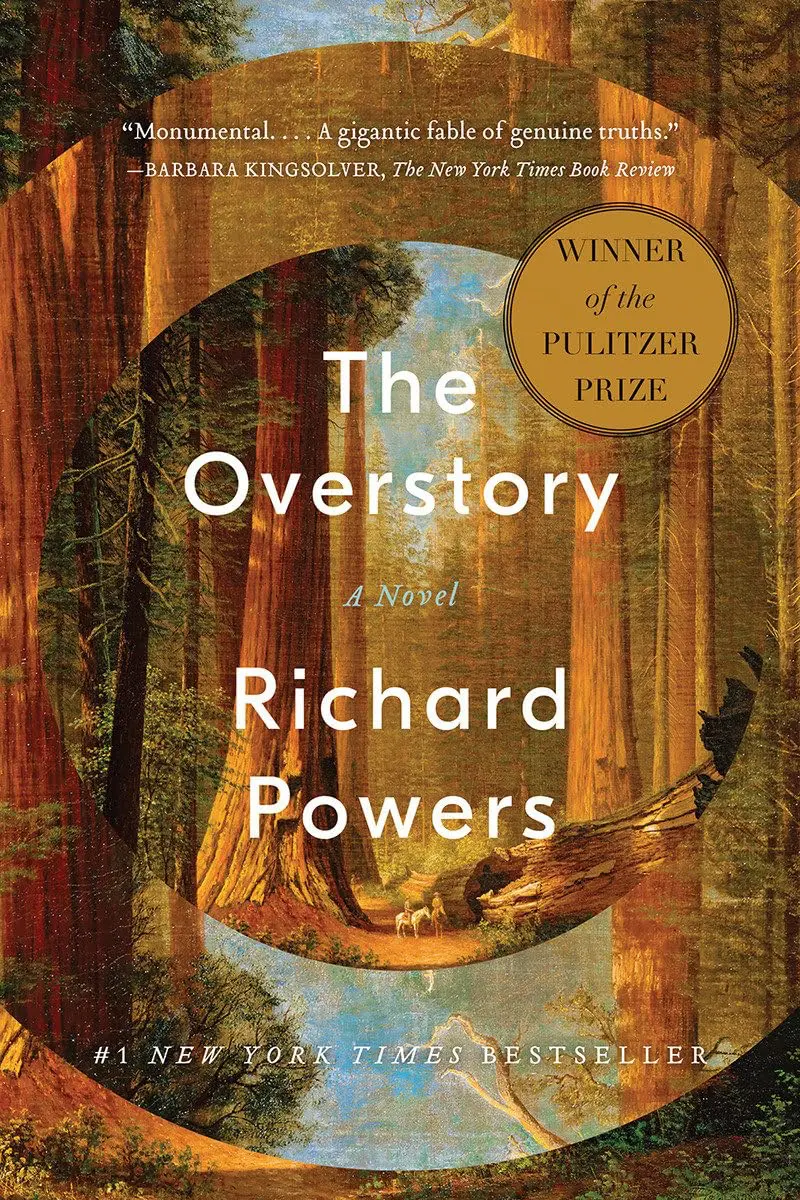
The Overstory is structured like a tree. It begins with roots: nine separate stories about nine separate people, each connected to a specific tree or forest. An artist inherits a hundred years of photographs of the same doomed American chestnut. A Vietnam veteran survives a crash by falling into a banyan. A college student electrocutes herself, dies briefly, and comes back believing she was sent by beings of light. A hearing-impaired scientist discovers that trees communicate with one another through underground fungal networks.
These stories are not connected at first. They unfold over decades and across the country, each one a small novel in its own right. Then, as the book moves from roots to trunk to branches, the characters begin to converge. Some meet in person. Others are linked by circumstance, by shared obsession, by the slow realization that the trees around them are not decoration but a parallel civilization operating on a timescale humans can barely perceive.
The novel’s second half becomes a story about activism and its costs. Several characters are drawn into the Timber Wars of the Pacific Northwest, where they risk their careers, freedom, and lives to protect old-growth forests. Powers does not romanticize this. People get hurt. Relationships fracture. One character turns informant. The moral clarity of the cause collides with the messiness of human behavior.
Powers writes with a density that some readers find overwhelming and others find hypnotic. His sentences can run long and his knowledge of botany, ecology, and forest science is deep enough to feel like a second narrative running alongside the human one. The trees in this novel are not metaphors. They are characters, with strategies, defenses, and a form of intelligence that the book makes you take seriously.
For business-minded readers, the appeal may not be obvious at first glance. But several founders and tech leaders have cited it as influential. Barack Obama listed it among the books that shaped his thinking. The reason tends to be the same: The Overstory forces you to consider timescales longer than a quarter or a fiscal year. It is a book about systems, interconnection, and the limits of human perception.
The novel won the 2019 Pulitzer Prize for Fiction, was shortlisted for the Man Booker Prize, and appeared on the New York Times list of the 100 best books of the 21st century.
