











What Vitalik Buterin’s book recommendations tell you about Ethereum’s creator
Most tech founders read business books and recommend them to other founders. Vitalik Buterin reads books about existential risk, memory palaces, banana empires, and the moral obligation to prevent human extinction. Then he writes four-thousand-word blog posts connecting them to cryptographic proof systems. His reading list does not look like a CEO’s bookshelf. It looks like the library of a very unusual graduate student who happens to control significant influence over a network worth hundreds of billions of dollars.
The backstory matters. Buterin was born in Kolomna, Russia, in 1994 and moved to Toronto with his family when he was six. He was placed in a gifted program almost immediately. By his teens he was winning medals at the International Olympiad in Informatics and spending a lot of time playing World of Warcraft. That second detail is important. When Blizzard, the game’s developer, nerfed one of his favorite character abilities in a patch, Buterin was furious. Not because the change was bad game design, but because a single centralized authority could unilaterally alter the rules of a world millions of people inhabited. He has described that moment as formative. It planted the idea that systems should not depend on a single entity’s decisions.
He dropped out of the University of Waterloo after winning a $100,000 Thiel Fellowship, proposed Ethereum in a white paper at age nineteen, and launched the network in 2015. Ethereum introduced smart contracts to blockchain technology and made decentralized applications possible. The entire DeFi ecosystem, NFTs, DAOs, prediction markets, all built on top of what a teenager wrote in a document before he could legally drink.
His reading list reflects the way that brain works: across fields, connecting ideas that seem unrelated until he shows you the seam.
Vitalik Buterin’s books on governance, sovereignty, and the future
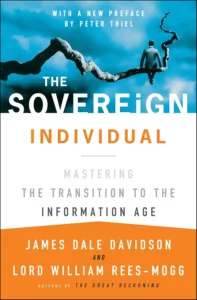
The Sovereign Individual by James Dale Davidson and Lord William Rees-Mogg, published in 1997, predicted that the internet and digital encryption would erode the power of nation-states by allowing individuals to move their wealth and identity beyond government control. It is one of the most cited books in the crypto world, and Buterin’s recommendation of it is almost expected. But he engages with it critically. On his blog he has pushed back against the libertarian framing, arguing that decentralized systems need some form of coordination and governance, just not the kind that concentrates power in one place. He takes the book’s predictions seriously while questioning its politics.
The Network State by Balaji Srinivasan extends the argument further, proposing that online communities organized around shared values could eventually achieve something resembling sovereignty. Buterin has written about this idea with interest and skepticism in roughly equal measure. He cares about governance design more than almost any other topic, and Srinivasan’s book provides a framework for thinking about what comes after the nation-state model, even if the answer is incomplete. For someone building infrastructure that DAOs, digital cities, and new forms of collective organization might run on, the question is practical, not abstract.
The Precipice by Toby Ord is about existential risk, the possibility that humanity could destroy itself through nuclear war, engineered pandemics, or misaligned artificial intelligence. Ord is a philosopher at Oxford associated with the effective altruism movement, which Buterin has supported with both money and public endorsement. This book is on the list because Buterin thinks about timeframes that most tech founders do not. He is not just asking whether Ethereum will work in five years. He is asking whether civilizational infrastructure will hold up over centuries, and whether decentralized systems might be part of what makes it more resilient.
Books on decision-making and clear thinking Vitalik Buterin recommends
The Scout Mindset by Julia Galef is probably the book that best represents how Buterin tries to think. Galef distinguishes between the “soldier mindset,” which defends existing beliefs against attack, and the “scout mindset,” which tries to build an accurate map of reality regardless of whether the findings are comfortable. Buterin is unusual among public figures in crypto because he regularly changes his mind in public, writes about why he was wrong, and updates his positions based on new evidence. In an industry where most leaders double down on their claims regardless of what happens, Buterin’s willingness to say “I was wrong about this” is distinctive, and Galef’s book is the philosophical justification for that approach.
The Checklist Manifesto by Atul Gawande argues that even experts make fewer errors when they use simple checklists. Gawande is a surgeon, but the principle applies to any complex system where small mistakes compound. Ethereum is exactly that kind of system. A bug in a smart contract can drain millions of dollars in minutes. Buterin’s push for protocol simplification, his recent argument that Ethereum should become “as simple as Bitcoin” by 2030, is essentially Gawande’s philosophy applied to software architecture. Reduce complexity, reduce failure modes.
Guns, Germs, and Steel by Jared Diamond asks why some civilizations developed faster than others. Diamond’s answer is geography, climate, and access to domesticable plants and animals, not inherent superiority of any group. Buterin thinks in systems, and Diamond’s book is a systems-level explanation of human history. The relevance to blockchain is indirect but real: if you are building infrastructure meant to work across cultures, borders, and political systems, you need a framework for understanding why different societies developed different institutions in the first place.
Vitalik Buterin’s books on human potential and longevity
Lifespan by David Sinclair argues that aging is a disease that can be treated. Buterin has donated significant amounts to longevity research, including a widely publicized donation to the SENS Research Foundation. He is one of the few people in tech who talks about life extension not as science fiction but as a near-term engineering challenge. Sinclair’s book provides the scientific framework for that conviction.
Moonwalking with Einstein by Joshua Foer is about the author’s journey from science journalist to US Memory Champion in one year, using ancient memory techniques like the memory palace. On the surface this has nothing to do with blockchain. But Buterin has an unusual relationship with memory and information processing. He is known for absorbing dense technical papers quickly and retaining obscure details across fields. Foer’s book is about the trainability of cognitive skills that most people assume are fixed, which connects to Buterin’s broader belief that human capacity is more expandable than we think.
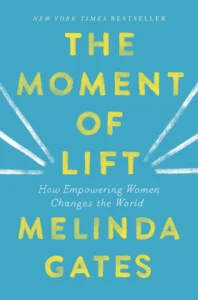
The Moment of Lift by Melinda Gates is about how empowering women and girls is the most effective lever for improving societies globally. This pick stands out on a list dominated by systems thinking and technical philosophy. Buterin has written about the importance of diversity in the Ethereum community and has been publicly critical of the crypto industry’s bro-culture tendencies. Recommending Gates’s book is consistent with his argument that technology alone does not solve problems. The social structures around the technology matter just as much.
The unexpected books on Vitalik Buterin’s reading list
The Fish That Ate the Whale by Rich Cohen is a biography of Samuel Zemurray, a Russian immigrant who arrived in America with nothing and built a banana empire that toppled governments in Central America. It is a wild story about ambition, power, and the gap between how people present their success and how they actually achieved it. Buterin recommending it is interesting because the banana trade is one of history’s clearest examples of what happens when a private entity accumulates enough power to override democratic governance, which is essentially the failure mode Ethereum is designed to prevent.
The Martian by Andy Weir is a survival novel about an astronaut stranded on Mars who has to engineer his way out of every problem using only what is available. It is a book about resourcefulness under extreme constraints, and about breaking impossible-seeming problems into solvable components. Buterin proposed Ethereum’s architecture at nineteen and spent the next decade solving problems that most computer scientists said could not be solved. The Martian’s approach, do not panic, figure out what you have, work the problem, is not a bad description of how Buterin operates in public.
The Catcher in the Rye by J.D. Salinger is the most personal-feeling pick. Holden Caulfield is a teenager who sees phoniness everywhere and cannot figure out where he fits in the adult world. Buterin was nineteen when he proposed a system designed to eliminate the need to trust institutions he considered unreliable. There is something of Holden’s frustration in that decision, channeled into something constructive rather than self-destructive.
How Vitalik Buterin’s reading list connects to Ethereum’s philosophy
Buterin’s reading list maps directly onto Ethereum’s design philosophy if you know where to look. The governance books explain why he built a system without a central authority. The decision-making books explain why he values intellectual honesty over tribal loyalty. The longevity and existential risk books explain why he thinks in centuries rather than quarters. The history books explain why he believes geography and institutions, not individual genius, determine outcomes. And the unexpected picks, the banana empire and the stranded astronaut, explain the improvisational, first-principles approach he brings to problems that do not have textbook solutions.
What is most unusual about this list is what is missing. There are no books about getting rich. No books about scaling a startup. No books about personal branding or growth hacking. Buterin became a billionaire before he turned thirty, and his reading list reads like he barely noticed. The books are about understanding the world clearly, building systems that survive their creators, and making sure the future is worth living in. For the person who built the infrastructure that an enormous amount of decentralized technology runs on, those priorities make more sense than any business book would.
