


What Mike Cannon-Brookes’ book recommendations reveal about Atlassian’s co-founder
In 2017, Mike Cannon-Brookes got into a Twitter exchange with Elon Musk about whether Tesla could build the world’s biggest lithium-ion battery in South Australia within 100 days. Musk said yes. Cannon-Brookes said prove it. The battery got built. It stabilized the state’s energy grid and became a landmark moment for renewable energy in Australia.
That story tells you almost everything about how Cannon-Brookes operates. He sees a problem, makes a public bet, and then pushes until it happens. His reading list has the same energy: a mix of books about thinking clearly under uncertainty, building organizations that survive, understanding the long arc of human progress, and a few picks that are just about being a person trying to figure things out.
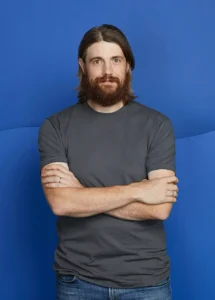
Some background. Cannon-Brookes was born in Connecticut in 1979 to a British banking executive and grew up across three continents. Taiwan at six months, Hong Kong at three, boarding school in England as a teenager, then Sydney for university. He studied information systems at the University of New South Wales, where he met Scott Farquhar. In 2002, the two of them started Atlassian with $10,000 in credit card debt and a straightforward goal: earn the equivalent of a graduate starting salary without working for someone else. They built Jira, a bug-tracking tool for software developers, and decided not to hire salespeople. They spent the money on the product instead and sold it online at a lower price than competitors. That worked. Atlassian went public on the Nasdaq in 2015 with a valuation north of four billion dollars. It now serves over 300,000 organizations globally.
Since September 2024, Cannon-Brookes has been sole CEO after Farquhar stepped down from the co-CEO arrangement they had run for over twenty years. Outside Atlassian, he has become one of Australia’s most visible climate activists, investing billions through his family office Grok Ventures into solar energy, battery storage, and the Sun Cable project, which aims to export Australian solar power to Singapore via undersea cable. He became the largest shareholder in AGL, Australia’s biggest polluter, specifically to force the company to shut down its coal plants faster.
Mike Cannon-Brookes’ books on leadership and building companies
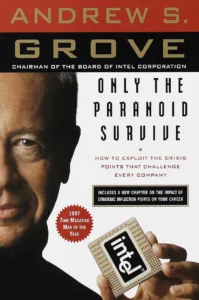
Only the Paranoid Survive by Andrew Grove is the book on this list that most directly maps to how Cannon-Brookes runs Atlassian. Grove’s concept of strategic inflection points, moments when a fundamental shift makes your current approach obsolete, is the framework Cannon-Brookes used when he pushed Atlassian from selling packaged software to a cloud-first subscription model. That transition was painful and expensive. It required convincing customers, investors, and employees that the future of the business looked completely different from its past. Grove’s book is about having the discipline to make that call before the crisis forces your hand.
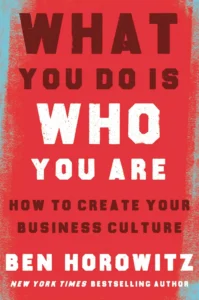
What You Do Is Who You Are by Ben Horowitz is about company culture, and specifically about the argument that culture is not what you say in a mission statement. It is what happens when nobody is watching. Horowitz draws on examples ranging from samurai codes to prison gangs to make the point that culture is built through specific, consistent actions, not through slogans. Atlassian has a notably distinct internal culture: open by default, radical transparency in decision-making, and a policy of giving employees dedicated time to work on whatever they want. That culture did not happen by accident, and Horowitz’s book is about why deliberate culture-building matters more than most founders realize.
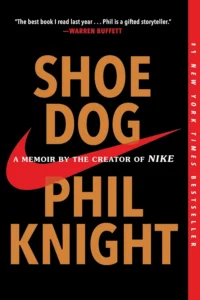
Shoe Dog by Phil Knight is the Nike founder’s memoir, and it reads less like a business book than a survival story. Knight writes about years of near-bankruptcy, lawsuits, manufacturing disasters, and partnerships that almost fell apart. Cannon-Brookes and Farquhar bootstrapped Atlassian on credit cards. They did not take venture capital. They did not have a safety net. Knight’s story of building something from nothing while constantly being one bad quarter away from failure is the kind of narrative that founders who actually lived through the early stage recognize as true rather than inspirational.
Books on decision-making and thinking that Mike Cannon-Brookes recommends
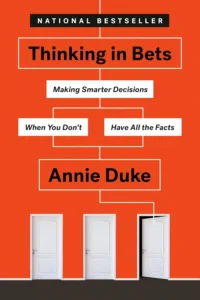
Thinking in Bets by Annie Duke is the most Cannon-Brookes book on this list. Duke is a former professional poker player who argues that good decision-making is about separating the quality of a decision from the quality of its outcome. You can make the right call and lose. You can make a terrible call and win. The goal is to get better at evaluating decisions based on the information available at the time, not based on what happened afterward. Cannon-Brookes makes large, public bets: the Tesla battery challenge, the AGL takeover bid, the Sun Cable investment. Some have worked out. Some are still in progress. Duke’s framework is about being comfortable with uncertainty while still committing fully, which is exactly how Cannon-Brookes operates.
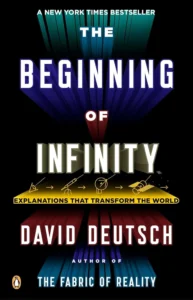
The Beginning of Infinity by David Deutsch argues that all problems are solvable given the right knowledge, and that progress is not guaranteed but is always possible. Deutsch is a physicist, and the book ranges across science, philosophy, and epistemology. For someone who is betting billions on the idea that Australia can become a renewable energy superpower, the belief that hard problems have solutions if you approach them correctly is not optimism. It is an operating assumption.
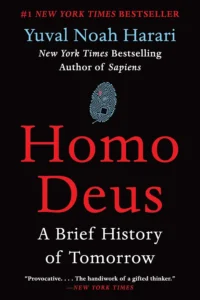
Homo Deus by Yuval Noah Harari looks at where humanity might be heading now that the old problems of famine, plague, and war are (in aggregate) declining. Harari argues that the next challenges are about what humans choose to do with increasing power over biology, technology, and information. Cannon-Brookes is making choices right now about energy infrastructure that will shape how millions of people live for decades. Harari’s book is about taking the long view on those kinds of decisions, and about the responsibility that comes with having the resources to actually act on them.
Mike Cannon-Brookes’ books on history, philosophy, and meaning
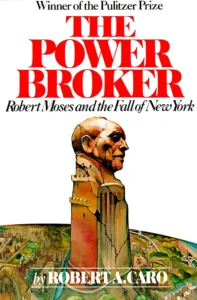
The Power Broker by Robert Caro is the 1,200-page biography of Robert Moses, the man who reshaped New York City through sheer institutional power. Moses was never elected to anything. He accumulated influence through bureaucratic positions and wielded it to build highways, bridges, and parks while displacing hundreds of thousands of people. Cannon-Brookes became AGL’s largest shareholder specifically to change the company’s direction on coal. That is a form of power-brokering: using ownership and economic leverage to force institutional change from the outside. Caro’s book is the definitive study of how that kind of power works, who benefits, and what it costs.
Man’s Search for Meaning by Viktor Frankl is the most personal book on this list. Frankl survived the Nazi concentration camps and wrote about how the prisoners who maintained a sense of purpose were more likely to survive than those who lost it. His conclusion was that meaning is not something you find. It is something you create through your response to whatever situation you are in. Cannon-Brookes has talked about the climate crisis in terms that echo this philosophy: the problem exists, it is severe, and the only question is whether you choose to act or not. Frankl’s book provides the philosophical foundation for that kind of commitment.
The Autobiography of Benjamin Franklin is about a self-taught polymath who was simultaneously a printer, scientist, diplomat, inventor, and political leader. Franklin did not specialize. He moved between fields and applied what he learned in one domain to problems in another. Cannon-Brookes runs a software company, invests in solar farms, bought a stake in an NBA team, tried to take over Australia’s largest energy utility, and sits on the board of a children’s literacy nonprofit. Franklin’s autobiography is the reading choice of someone who does not see any reason to limit himself to one thing.
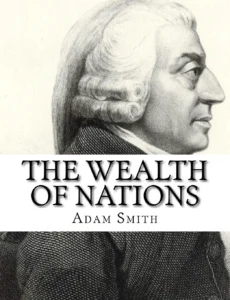
The Wealth of Nations by Adam Smith is here as a reminder that Cannon-Brookes is, underneath the climate activism and the public bets, fundamentally a capitalist. Smith’s argument that markets, properly structured, allocate resources more efficiently than central planning is the intellectual foundation for Cannon-Brookes’ approach to climate: he is not asking governments to solve the problem. He is using markets, ownership stakes, and investment capital to redirect corporate behavior. Whether you call that activism or capitalism depends on your perspective. Smith would probably call it both.
The unexpected picks on Mike Cannon-Brookes’ reading list
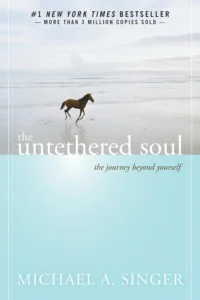
The Untethered Soul by Michael Singer is about letting go of the mental patterns that keep you anxious, reactive, and stuck. It is a spiritual book, closer to meditation practice than business strategy. Cannon-Brookes operates at a speed and scale that would burn most people out. A book about quieting the internal noise is the kind of counterbalance that makes long-term intensity sustainable.
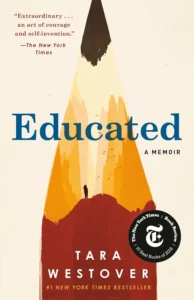
Educated by Tara Westover is a memoir about a woman who grew up in an isolated survivalist family, never attended school, and educated herself all the way to a PhD from Cambridge. Cannon-Brookes grew up on three continents in a family that valued education. Westover grew up in a junkyard in Idaho. The distance between those starting points makes her achievement even more striking, and the book’s core argument, that education is the single most powerful force for personal transformation, resonates with someone who sits on the board of Room to Read, a nonprofit that builds libraries and schools in developing countries.
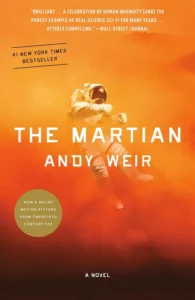
The Martian by Andy Weir keeps showing up on tech founder reading lists, and the reason is always the same. It is about solving problems with whatever you have available, staying calm when everything goes wrong, and taking the next logical step instead of panicking. Cannon-Brookes challenged Elon Musk on Twitter, funded the world’s biggest battery, and tried to decarbonize Australia’s largest polluter from the inside. All of those projects required the same skill: break the impossible-looking problem into a sequence of possible steps, then start.
How Mike Cannon-Brookes’ reading list connects to his two careers
Cannon-Brookes is essentially living two careers at the same time. One is running a global software company. The other is trying to rewire Australia’s energy infrastructure. His reading list serves both. The business books give him the frameworks for navigating Atlassian through market shifts. The decision-making books give him the mental tools for placing large bets under uncertainty. The history and philosophy books give him the long-term perspective that climate action requires. And the personal books, Frankl and Singer and Westover, give him the internal architecture to keep going when the problems are bigger than any one person can solve.
The connecting thread is agency. Every book on this list is, in some way, about the belief that individuals can change systems, whether those systems are corporations, energy grids, or their own minds. Cannon-Brookes is not the kind of person who waits for someone else to act. He tweets at Elon Musk and builds a battery. He buys stock in a coal company and forces it to shut down plants. He reads a book about thinking in bets and then makes bets that cost billions of dollars. The reading list is the theory. The career is the practice.
