

Most affiliate recruitment emails get ignored. Not because the programs behind them are bad, but because the emails themselves read like impersonal mass blasts that give the recipient no reason to care. Potential affiliates receive these pitches regularly, and generic messages end up deleted within seconds.
The emails that actually get responses share a few common traits: they are personalized, they lead with value to the affiliate, they are concise, and they make the next step easy. This guide breaks down the anatomy of an effective recruitment email, provides templates for different scenarios, and covers the follow-up strategy that turns silence into replies.
Why Most Recruitment Emails Fail
Before looking at what works, it helps to understand what does not. Here are the most common reasons affiliate recruitment emails get ignored:
→ No personalization. Opening with “Dear Website Owner” or “Hi there” signals that you sent the same email to hundreds of people without knowing who any of them are.
→ Leading with your company story. Affiliates do not care about your founding story or your mission statement. They care about what they will earn and whether the product is worth promoting to their audience.
→ Too long. Anything over 200 words significantly reduces the chance of getting read. Busy creators skim emails and will abandon long messages before reaching the value proposition.
→ Vague or missing financial details. If the email does not mention the commission rate, cookie duration, or payout terms, the affiliate has to work to find out what the opportunity is actually worth. Most will not bother.
→ No clear next step. Emails that end without a specific call to action leave the recipient unsure of what to do, so they do nothing.
The Anatomy of an Effective Recruitment Email
Every high-performing recruitment email follows the same five-part structure. Master this framework and you can adapt it for any type of affiliate prospect.
1. Personalized opening (1 to 2 sentences). Reference something specific about their content. Mention a blog post they wrote, a video they published, a product they reviewed, or a topic they cover regularly. This proves you did your homework and have a genuine reason for reaching out.
2. Who you are (1 sentence). Introduce yourself and your company in a single sentence. No more. The focus of the email should be on them, not on you.
3. The offer (2 to 3 sentences). State what you are proposing clearly: commission rate, cookie duration, and any standout benefits (high conversion rate, exclusive discount codes, premium creative assets). This is the section that determines whether they keep reading or move on.
4. Why their audience fits (1 to 2 sentences). Explain the connection between your product and their audience. Do not be generic. If they write about productivity tools and you sell a project management app, make that link explicitly.
5. Clear call to action (1 sentence). End with a specific, low-commitment ask. “Would you be open to learning more?” or “Here is the signup page if you would like to check it out: [link].” Make it easy to say yes without pressure.
The entire email should be under 150 words. Yes, that is short. It needs to be. The goal of the first email is not to close the deal. It is to start a conversation.
Email Templates for Common Scenarios
Use these templates as starting points. Always customize the personalized elements (shown in brackets) for each recipient.
Template 1: Outreach to a Blogger or Content Creator
Subject: Partnership idea for [their site name]
Hi [Name],
I came across your article on [specific article topic] and thought it was a great breakdown, especially the section on [specific detail]. Your readers clearly trust your recommendations.
I’m [Your Name], founder of [Company]. We make [one-sentence product description]. We run an affiliate program that pays [X]% commission with a [X]-day cookie and monthly PayPal payouts.
Given that your audience is interested in [their niche], I think [your product] would be a natural fit. Would you be open to checking it out? Here’s the program page: [link]
No pressure either way. Happy to answer any questions.
Best,
[Your Name]
Template 2: Outreach to a YouTuber or Video Creator
Subject: Quick collab idea
Hi [Name],
Watched your video on [specific video topic] and really liked your take on [specific point]. I’ve been following your channel for a while.
I run [Company], and we make [one-sentence product description]. I noticed you review [product category] regularly, and I’d love to send you one of our products to try. We also have an affiliate program ([X]% commission, [X]-day cookie) if you’d like to include a link for your viewers.
Would that interest you?
Best,
[Your Name]
Template 3: Outreach to Someone Promoting a Competitor
Subject: Another option for your [product category] roundup
Hi [Name],
I read your article on [article title] and noticed you featured [competitor name]. Great piece. I wanted to introduce [Company] as another option your readers might find valuable.
We offer [key differentiator from competitor: lower price, different feature, better for a specific use case]. Our affiliate program pays [X]% with a [X]-day cookie.
Would you be interested in trying the product and considering adding it to your coverage? Happy to set you up with a free account.
Best,
[Your Name]
For more research methods to build your prospect list before sending these emails, our guide on finding affiliate partners in your niche covers the discovery process in detail.
Personalization That Actually Works
Personalization is the single most important factor in outreach performance, but it does not mean just inserting someone’s first name. Effective personalization demonstrates that you have spent time understanding who the recipient is and why the partnership makes sense for them specifically.
Here are personalization elements ranked by impact, from most effective to least:
→ Referencing a specific piece of content they created (highest impact). Shows you actually consumed their work.
→ Explaining why their specific audience fits your product. Connects the partnership to their niche, not just yours.
→ Mentioning a competitor they already promote. Signals you understand their monetization model and are offering a complementary option.
→ Using their name and website name. Basic but necessary. Emails that skip even this level of personalization feel robotic.
→ Just using their first name. Lowest impact. Better than nothing, but alone it does not signal genuine interest.
The investment in personalization is worth it. A personalized email takes three to five minutes longer to write than a template blast, but it can triple your response rate. Over the course of a year of weekly outreach, that difference translates into dozens more active affiliates in your program.
Subject Lines That Get Opened
The subject line determines whether your email gets opened at all. Keep it short, specific, and free of spam trigger words like “earn money” or “amazing opportunity.” The most effective subject lines feel conversational and personalized.
Subject Line Examples
→ “Partnership idea for [their site name]”
→ “Quick collab idea”
→ “Another option for your [product category] roundup”
→ “Loved your article on [topic]”
→ “[Name], quick question about your [product category] content”
Avoid all-caps, excessive punctuation, and anything that sounds like a marketing email. Your subject line should feel like a message from one professional to another, not an advertisement.
The Follow-Up Strategy
A significant percentage of your replies will come from follow-up emails, not the initial outreach. People miss emails, get busy, or intend to reply later and forget. One polite follow-up five to seven days after your first email is expected and professional.
Follow-Up Template
Subject: Re: [original subject line]
Hi [Name],
Just wanted to follow up on my note from last week about a potential affiliate partnership. Totally understand if the timing isn’t right. If you’re interested, here’s the quick overview: [X]% commission, [X]-day cookie, monthly payouts. Program page: [link]
Happy to answer any questions if it’s worth exploring.
Best,
[Your Name]
Two follow-ups is the absolute maximum. After that, move on. Persistence is professional; pestering is not. If someone has not responded after three touchpoints, they are either not interested or not ready. You can always try again in six months with a fresh angle.
When They Reply: What to Do Next
Getting a positive response is just the beginning. How you handle the conversation from here determines whether the affiliate actually joins and becomes active. Respond within 24 hours to maintain momentum. Thank them for their interest and provide a clear next step.
If they have questions, answer them directly and thoroughly. Common questions include how the tracking works, what creative assets are available, how and when payouts happen, and whether there are any restrictions on promotional methods. Having a FAQ document or a link to your program page that addresses these questions saves time for both sides.
If they are ready to join, send them a direct link to your affiliate signup page with brief instructions on how to get started. Offer to walk them through the dashboard if they are new to affiliate marketing. Some programs also send a free product sample so the affiliate can experience what they will be promoting firsthand. This investment pays for itself many times over in the quality and authenticity of the content they create.
Tracking and Improving Your Outreach Performance
Treat your outreach like a marketing channel with measurable performance metrics. Track every email you send in a spreadsheet or CRM with the following data points: recipient name, email address, date sent, whether they opened (if you use an email tracking tool), whether they replied, and their current status (prospect, contacted, replied, applied, active affiliate).
Review your metrics monthly. If your response rate is below 5%, either your targeting is too broad or your message is not compelling enough. If responses are strong but few convert to active affiliates, the issue may be with your program’s offer or onboarding process rather than the email itself.
Benchmarks to Aim For
→ Open rate: 30% to 50% (well-crafted subject lines with personalization)
→ Reply rate: 8% to 15% for cold outreach (higher for warm leads from competitor research)
→ Application rate: 40% to 60% of positive replies should convert to actual program applications
→ Activation rate: 30% to 50% of approved affiliates should generate at least one click within their first 30 days
Test different subject lines, opening hooks, and call-to-action phrases over time. Small improvements in response rate compound into significantly more affiliates when you are sending outreach consistently every week. For the complete recruitment strategy that these emails plug into, our guide on how to recruit affiliates covers every channel and method available.
And once your new affiliates respond positively, the next step is turning them into active, engaged partners. Our guide on turning customers into affiliates covers one of the most effective sources for finding partners who already know and trust your product.
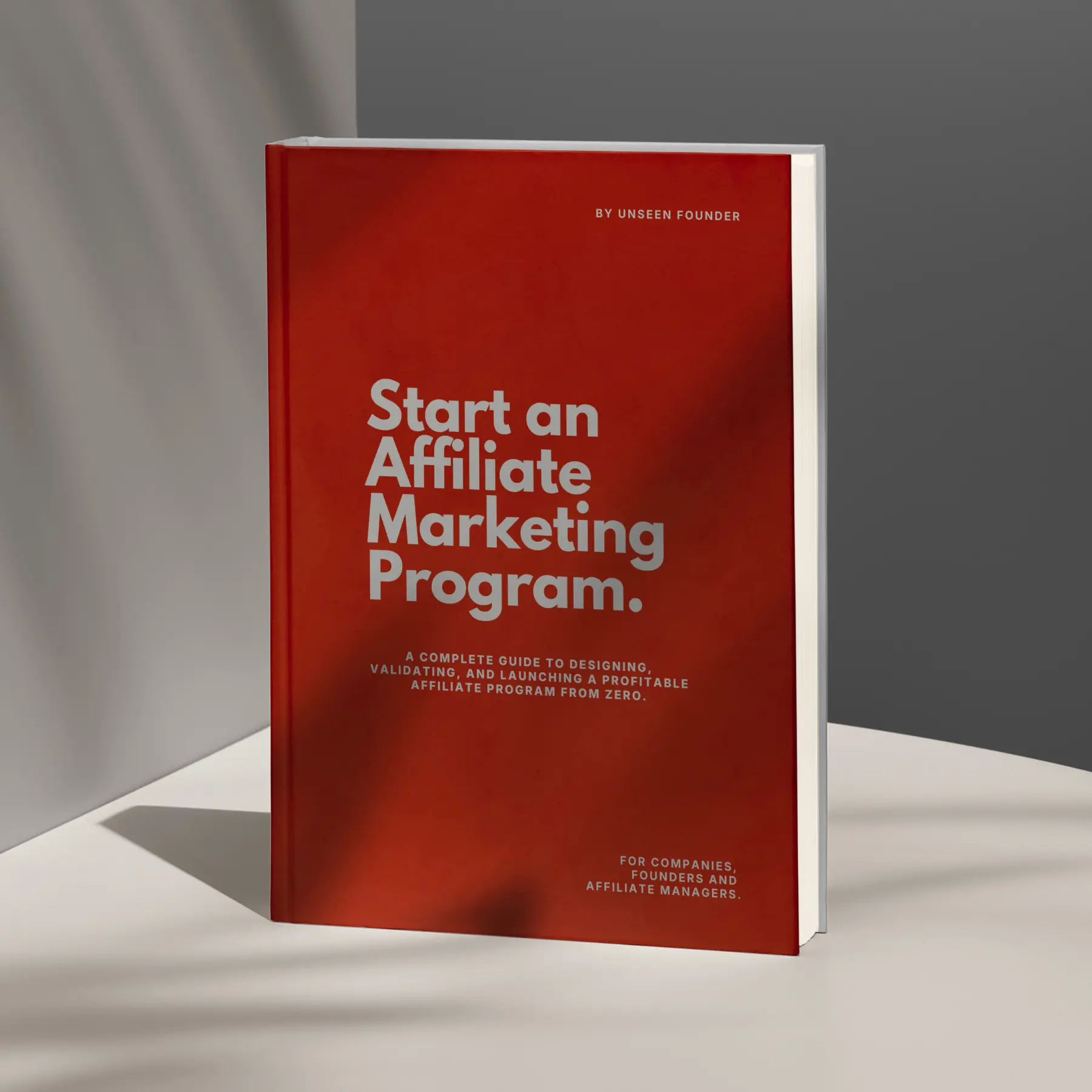
How To Start Affiliate Marketing Program
The Complete Launch Framework
eBook by Unseen Founder
How to Start an Affiliate Marketing Program is a structured, no-fluff framework for companies that want to design, validate, and launch a profitable affiliate program from scratch. It is not a collection of tips.
It is a complete operational blueprint built for founders, marketing leaders, and affiliate managers to launch a profitable affiliate program from zero.
