
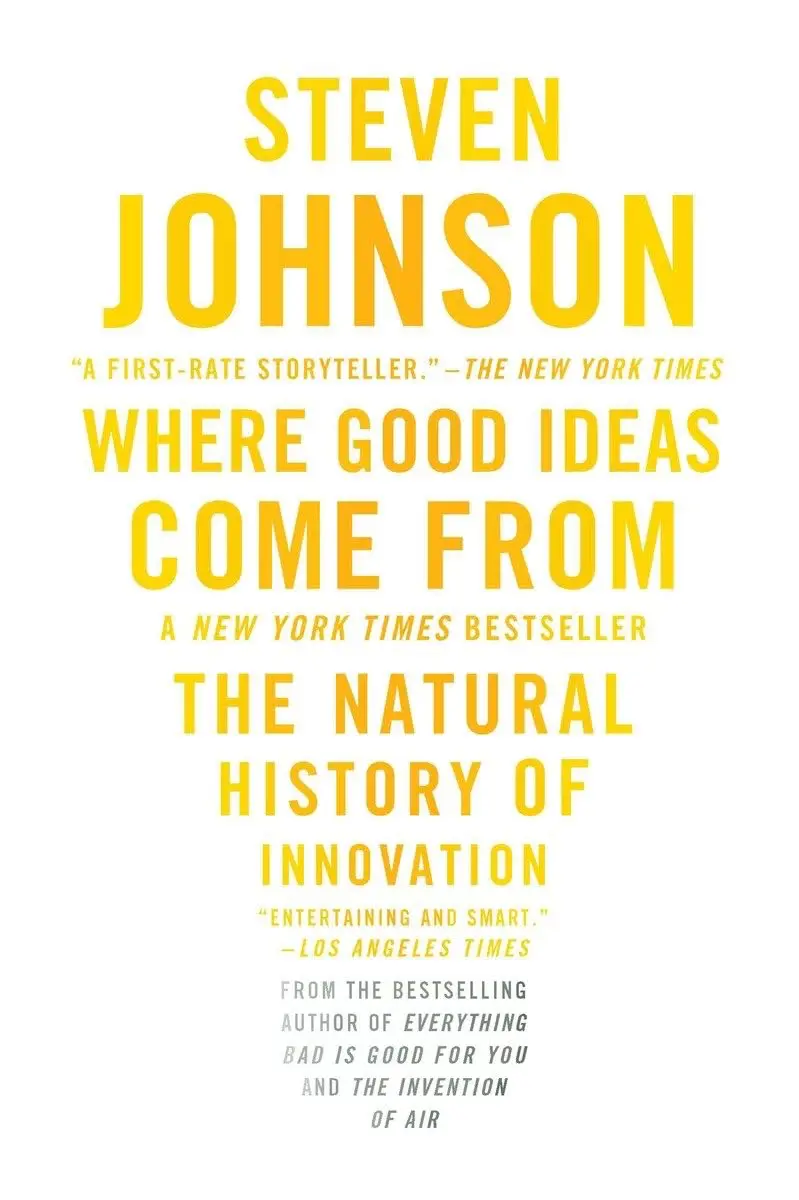
Where Good Ideas Come From is Steven Johnson’s investigation into the conditions that produce innovation. Rather than studying individual inventors, Johnson looks for recurring patterns across the history of science, technology, and culture. His conclusion is that good ideas don’t emerge from solitary genius in a flash of inspiration. They grow in specific environments that share a set of common features.
Johnson identifies seven patterns. The adjacent possible: innovation happens at the edges of what’s already known, where existing ideas can be recombined into new ones. Liquid networks: ideas flow best in environments where different people with different knowledge interact frequently and informally, like coffeehouses, university campuses, or dense urban neighborhoods. The slow hunch: most good ideas are not eureka moments but slow accumulations of partial insights that eventually click together. Serendipity: accidental discoveries happen more often in environments designed for them. Error: many breakthroughs came from mistakes or failed experiments that led somewhere unexpected. Exaptation: taking an idea developed for one purpose and applying it to a completely different one. Platforms: environments that allow other people to build on what already exists tend to produce more innovation than closed systems.
Each pattern gets its own chapter with historical examples. The printing press, coral reefs, Charles Darwin’s notebooks, the development of GPS, and the history of YouTube all illustrate different aspects of the framework. Johnson connects these examples across centuries and disciplines, showing that the same patterns recur regardless of the specific technology or era.
For founders, the practical takeaway is about environment design. If you want your team to be more innovative, Johnson’s research suggests you should create conditions for serendipity (open spaces, cross-functional collaboration), allow ideas to develop slowly (don’t demand finished concepts), and build platforms that let people combine and remix each other’s work. The adjacent possible concept is especially useful for product strategy: the best opportunities are usually one step away from what already exists, not giant leaps.
The writing is polished and the examples are well-chosen. Johnson is one of the better popular nonfiction writers, and the book moves briskly despite covering a lot of ground. Some readers will want more depth on individual patterns; others will appreciate the panoramic view.
