
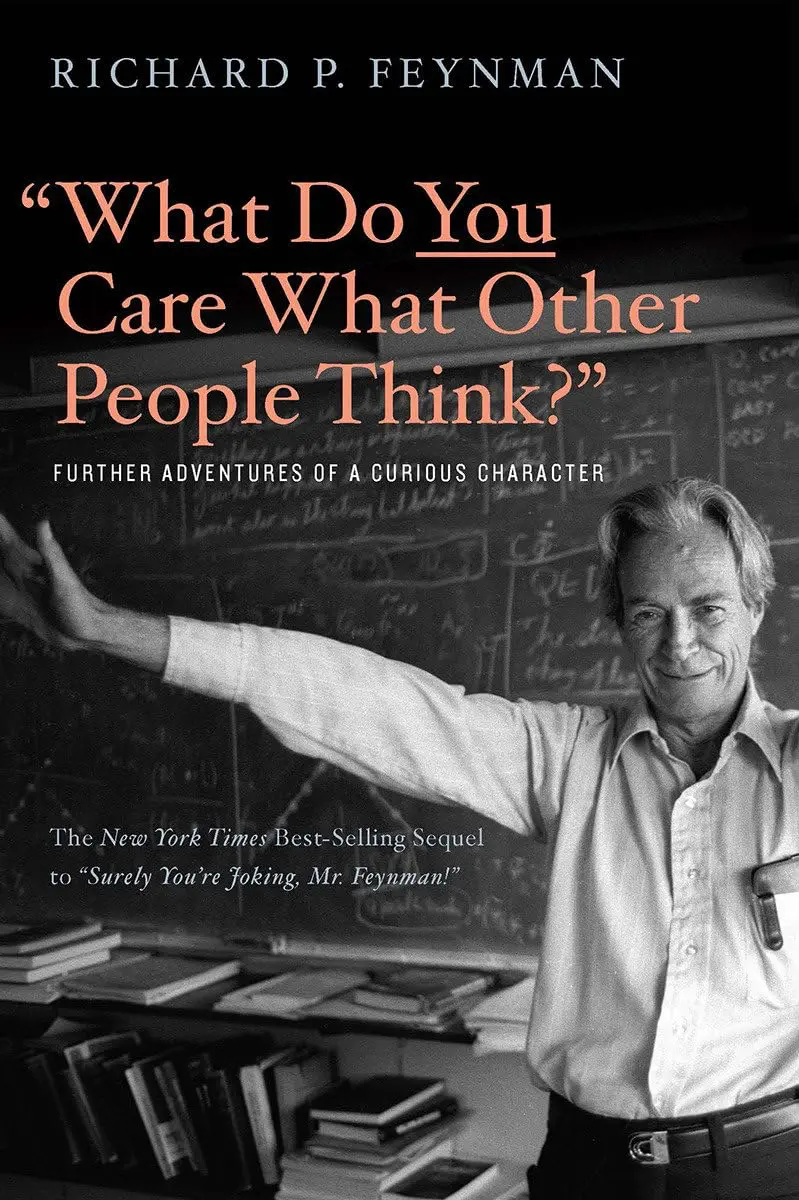
What Do You Care What Other People Think? is Richard Feynman’s second memoir, following Surely You’re Joking, Mr. Feynman! The book is divided into two parts, and they are quite different in tone. The first part is a collection of personal stories, the most moving of which center on Feynman’s relationship with his first wife, Arlene, who died of tuberculosis while he was working on the Manhattan Project at Los Alamos. These stories are tender and surprisingly emotional for a book by a physicist famous for his irreverence.
The second and longer part covers Feynman’s work on the Rogers Commission investigating the 1986 Challenger space shuttle disaster. Feynman was invited to join the commission and quickly became its most independent-minded member. While the rest of the commission followed the official process, Feynman conducted his own investigation, talking directly to engineers and technicians rather than relying on management presentations. His famous demonstration of the O-ring failure, dunking a piece of rubber in ice water during a televised hearing to show that it lost flexibility in cold temperatures, became one of the most iconic moments in the history of science communication.
The Challenger investigation chapters read like a detective story. Feynman traces the decision-making failures that led to the disaster, showing how NASA’s management had gradually accepted increasing levels of risk while the engineers who knew better were systematically overruled or ignored. His appendix to the commission’s final report, which NASA initially tried to suppress, is a masterclass in clear, direct writing about institutional failure.
For founders and business leaders, the Challenger section is directly relevant. The pattern Feynman identified, where management optimism overrides technical reality, where uncomfortable data gets filtered on its way up the chain, and where the desire to maintain a schedule overrides safety concerns, shows up in companies of every size. Reading Feynman’s investigation is a useful inoculation against the same mistakes.
The book is accessible and engaging throughout. The personal sections add depth to Feynman as a character, and the investigation sections are both educational and genuinely gripping.
