
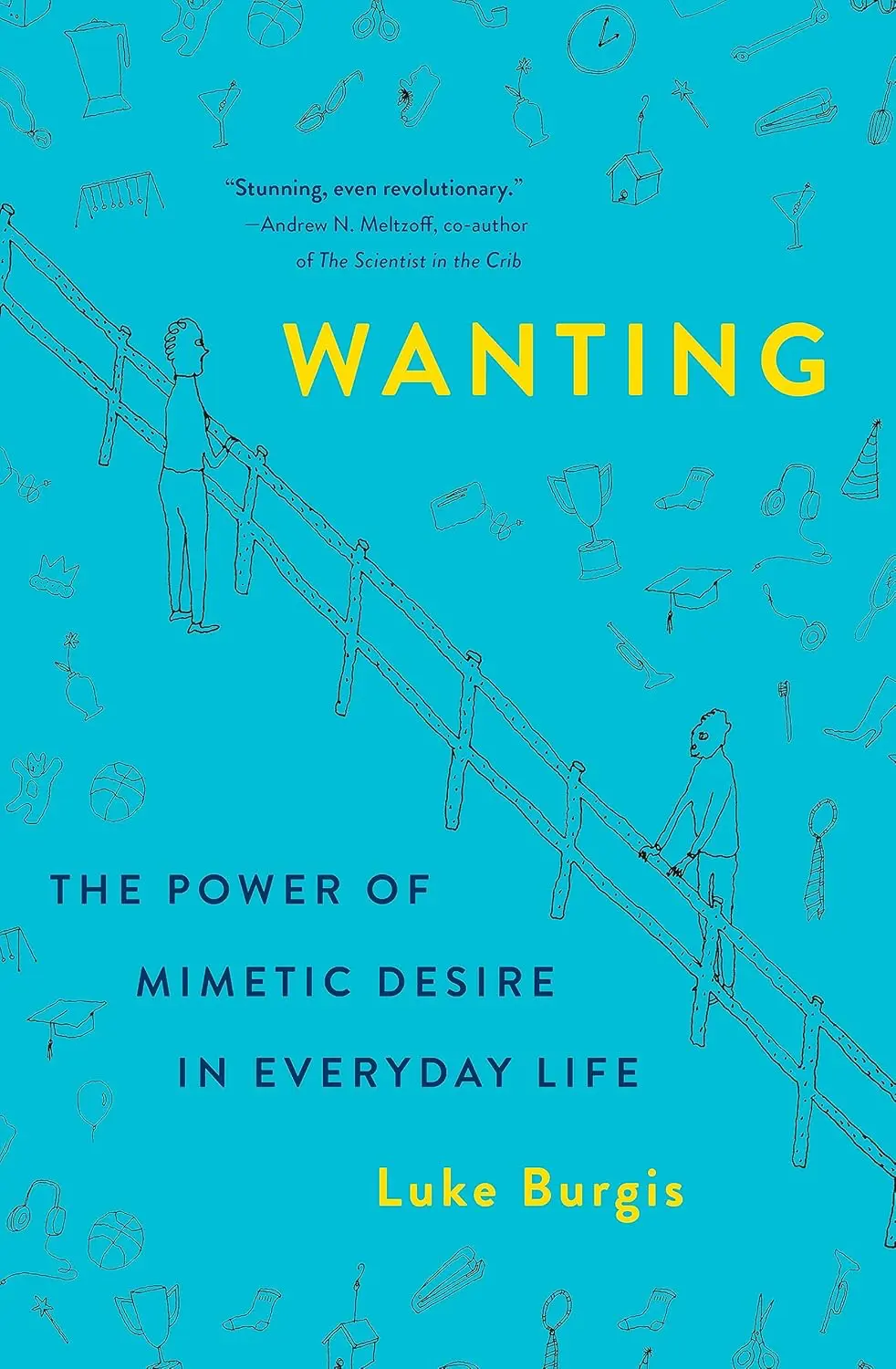
You think you want what you want because you chose it. Rene Girard, a French literary theorist who spent most of his career at Stanford, argued that you are wrong. You want it because you saw someone else want it. Desire is not generated internally. It is borrowed, copied, transmitted from person to person like a virus. Girard called this mimetic desire, and it is the idea at the center of Luke Burgis’s book.
Burgis, a serial entrepreneur and professor at the Catholic University of America, takes Girard’s academic theory and applies it to the situations that people actually encounter. Why do you want a promotion? Because your colleague got one. Why do you want to live in that neighborhood? Because people you admire live there. Why do you want that particular car, job, relationship, or life? Trace the desire back far enough and you will usually find a model, someone whose desire you are unconsciously imitating.
Girard distinguished between external models and internal models. External models are distant enough that they do not feel like rivals: you can admire a celebrity without competing with them. Internal models are close: a colleague, a sibling, a classmate. These are the dangerous ones, because when you and your model want the same thing, the shared desire produces rivalry, and the rivalry intensifies the desire. This is why office politics are so bitter, why sibling relationships can be so fraught, and why startup ecosystems, where everyone is close and everyone wants similar things, generate so much conflict.
Burgis covers Girard’s ideas about scapegoating and social violence, which are darker and more complex than the desire theory, but the book’s practical value is in the earlier chapters where he applies mimetic theory to career decisions, relationship choices, and the question of what to do with your life. The exercise he recommends is deceptively simple: for each of your goals, ask who your model is. Whose life are you imitating? Did you choose this desire, or was it chosen for you?
The writing is clear and well-organized. Burgis uses examples from business, technology, and culture. Peter Thiel, who was a student of Girard’s at Stanford and has credited mimetic theory as a major influence on his thinking, appears frequently. The connection between Girard’s ideas and Thiel’s contrarian investment philosophy (invest where no one else is looking, because competition destroys profits) is one of the book’s sharpest threads.
Wanting was published in 2021 and has been widely discussed in business and self-development circles. It sits in a rare space: a book that is intellectually rigorous, practically useful, and genuinely unsettling.
