
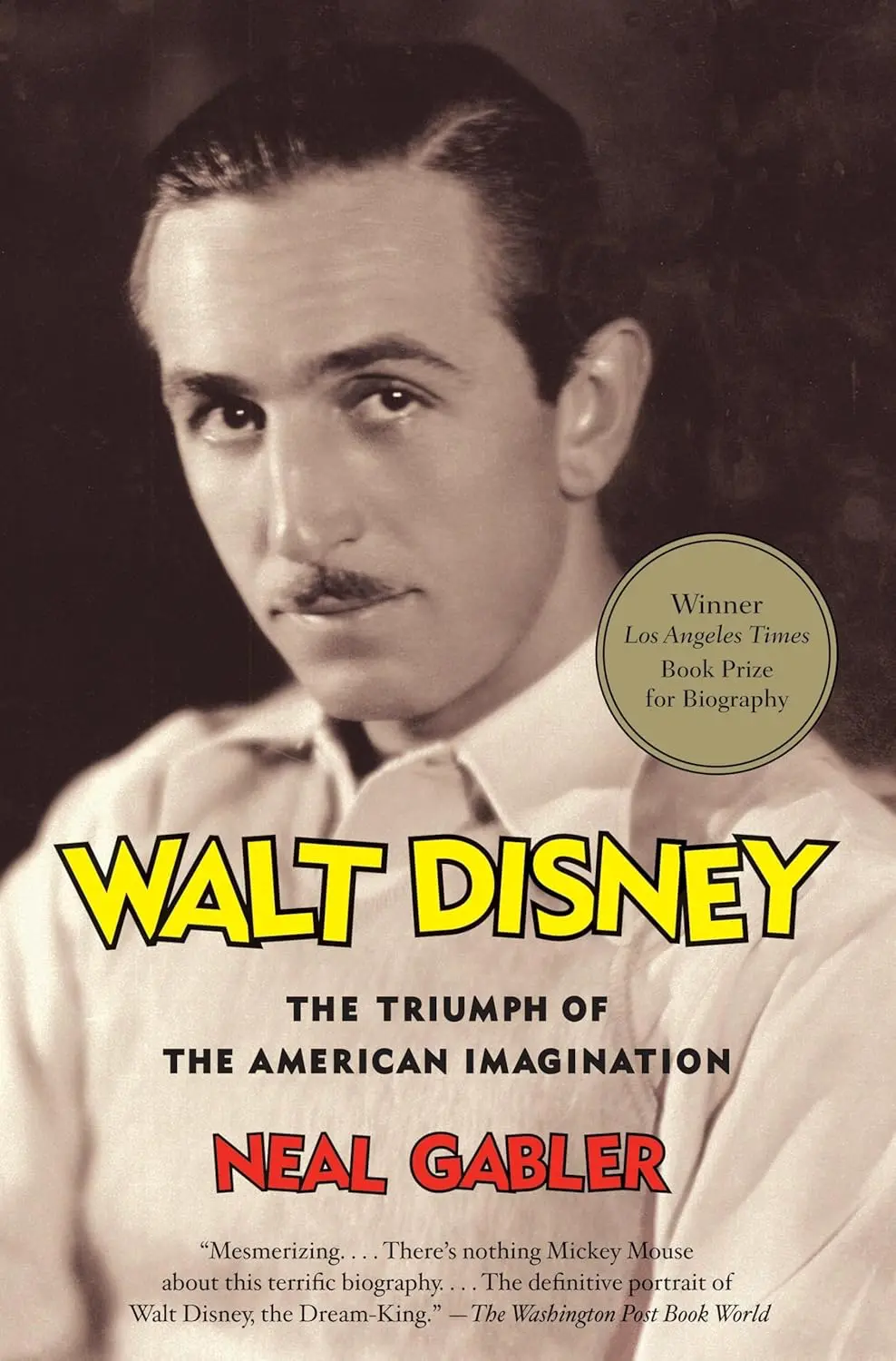
Walt Disney went bankrupt or nearly bankrupt so many times that the pattern starts to feel intentional. Snow White and the Seven Dwarfs, the first full-length animated feature film, cost so much to produce that the studio would have closed if it had failed. Fantasia was a commercial disaster on release. The construction of Disneyland required Disney to borrow against his life insurance and mortgage his house. Each time, he bet everything on an idea that everyone around him said was impossible, and each time, he was either right or stubborn enough that the world eventually agreed with him.
Neal Gabler’s biography, published in 2006, is the most comprehensive account of Disney’s life. Gabler had access to the Walt Disney Archives, including correspondence, memos, and financial records that had not been available to previous biographers. The result is over 800 pages of detailed, deeply reported narrative.
The early chapters trace Disney’s childhood in Missouri and Kansas City, his first animation studio (Laugh-O-Gram Films, which failed), and his move to Hollywood in 1923 with forty dollars and a suitcase. The creation of Mickey Mouse, Steamboat Willie, and the transition to sound and then to color animation are covered in technical and business detail. Disney was not a great animator himself. His gift was in story, in pushing his animators to do things they thought were impossible, and in understanding what audiences wanted before they knew they wanted it.
Gabler does not soften the less appealing aspects. Disney was a control freak who micromanaged every frame of his films. He was terrible with money, not because he spent lavishly on himself but because he spent without limit on his projects. The 1941 animators’ strike, which Disney experienced as a personal betrayal, revealed a man who could not understand why his employees did not share his willingness to sacrifice everything for the work. His cooperation with the House Un-American Activities Committee during the Red Scare is covered without excuse.
The Disneyland and Disney World chapters are among the best. Disney’s obsession with creating a controlled environment, a place where every sight line, every sound, and every experience was designed, anticipated the tech industry’s focus on user experience by decades. He was building an operating system for reality, and the scale of the ambition was matched by the scale of the debt required to fund it.
Disney died in 1966 at age sixty-five. Gabler’s biography has been widely praised as the definitive account and remains the essential book on one of the twentieth century’s most influential and most contradictory Americans.
