
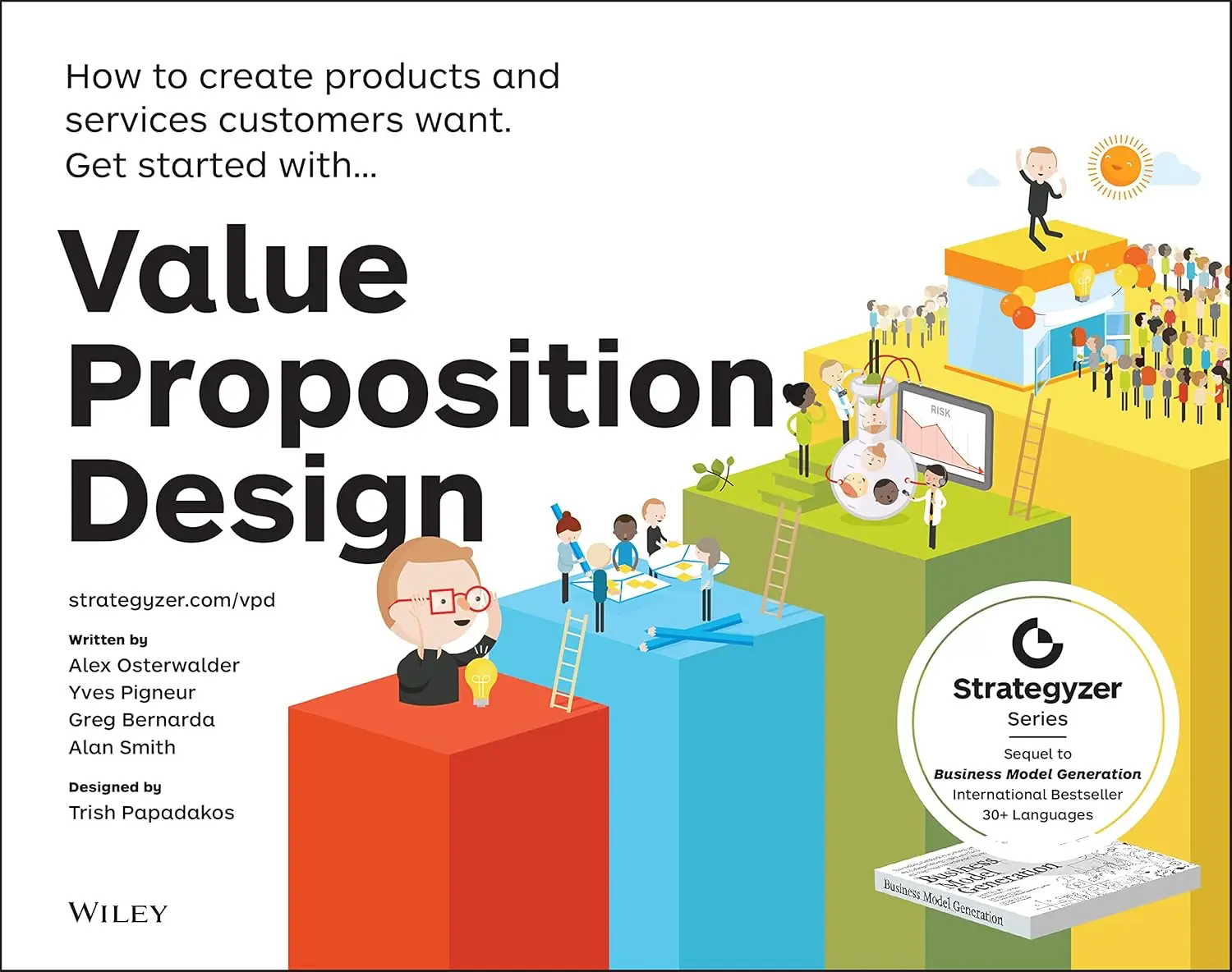
Value Proposition Design picks up where Business Model Generation’s customer segments and value proposition boxes left off. The book introduces the Value Proposition Canvas, a two-sided tool that maps customer jobs (what they’re trying to accomplish), pains (what frustrates them), and gains (what they’d love to have) on one side, and your product’s pain relievers, gain creators, and features on the other. The exercise is about finding the overlap and, more importantly, spotting the gaps.
The “customer jobs” framework is the most useful conceptual contribution. Osterwalder breaks jobs into functional jobs (tasks people are trying to complete), social jobs (how people want to be perceived), and emotional jobs (how people want to feel). This distinction helps founders see beyond the obvious use case and understand the deeper motivations behind purchasing decisions. A project management tool, for example, has functional jobs (track tasks) but also social jobs (look organized in front of colleagues) and emotional jobs (reduce anxiety about deadlines).
The process sections walk through how to use the canvas in practice: how to conduct customer interviews, how to identify which pains and gains matter most, how to prototype value propositions, and how to test them before investing in full development. The book connects directly to Testing Business Ideas for the experimentation phase.
For founders, the Value Proposition Canvas is a quick exercise that can expose blind spots in your thinking. Most founders can describe what their product does, but fewer can clearly articulate which specific customer pains it addresses and whether those pains are severe enough for someone to pay to fix them. Working through the canvas forces that clarity.
The book shares the same visual, workshop-friendly format as Osterwalder’s other work. It is designed to be used with sticky notes and a whiteboard as much as to be read linearly. Some readers will appreciate this practical orientation; others will want more narrative depth. It pairs well with the Jobs to Be Done framework from Clayton Christensen’s Competing Against Luck, which covers similar territory from a different angle.
