
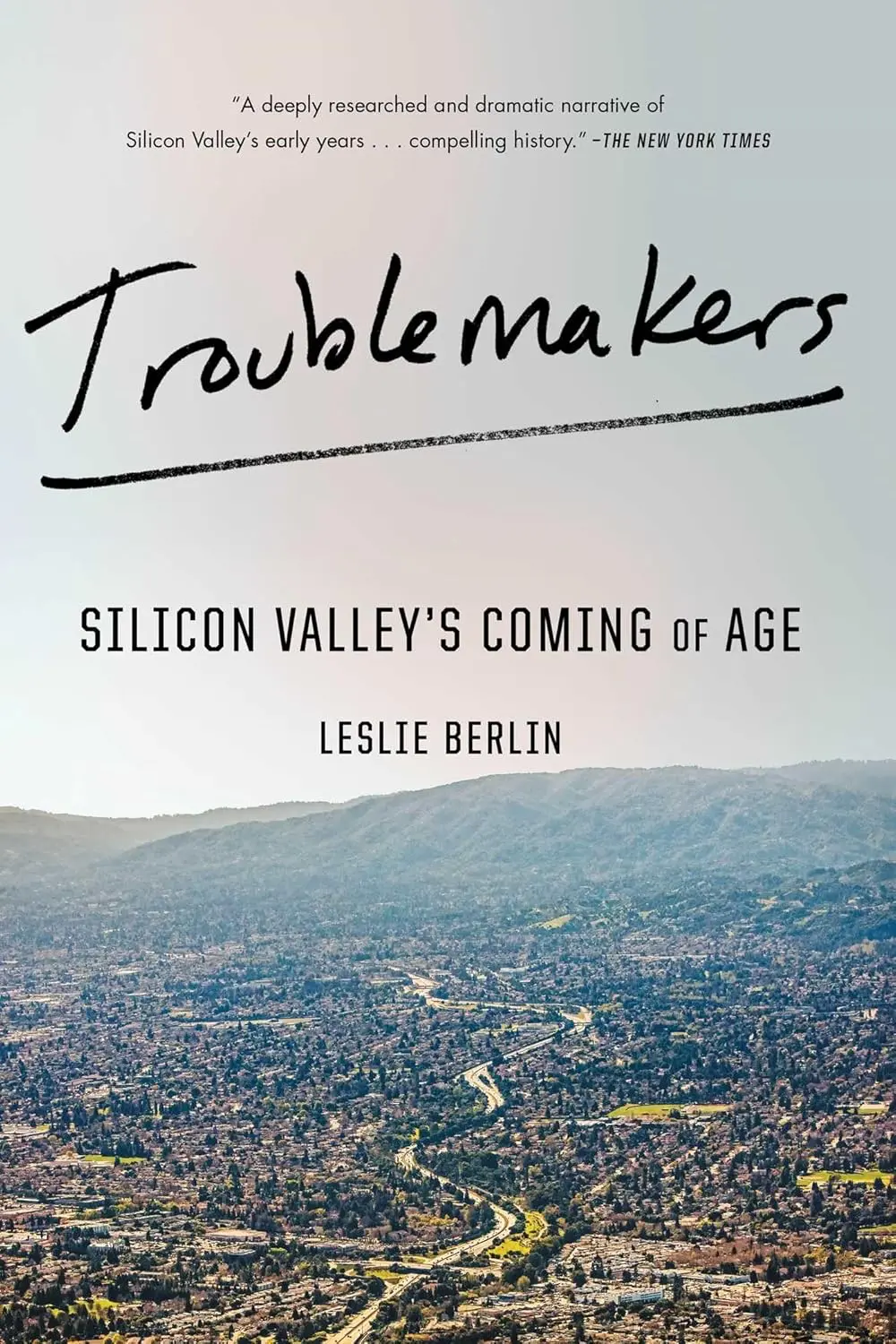
Most histories of Silicon Valley focus on the famous names: Hewlett and Packard, Noyce and Moore, Jobs and Wozniak. Leslie Berlin, the historian of Silicon Valley at Stanford University, tells the story through seven people who were essential to the region’s development but who never became household names.
The seven: Mike Markkula, who bankrolled Apple and served as its first chairman. Fawn Alvarez, one of the first female vice presidents at a major semiconductor company. Bob Taylor, who managed the research group at Xerox PARC that invented the personal computer, the graphical user interface, and Ethernet, none of which Xerox managed to commercialize. Al Alcorn, who designed Pong at Atari and helped birth the video game industry. Niels Reimers, who created Stanford’s technology licensing office and established the model for how universities commercialize research. Sandy Kurtzig, who founded ASK Computer Systems, one of the first successful software companies run by a woman. Bob Swanson, who co-founded Genentech and launched the biotech industry.
Berlin covers the period from roughly 1969 to 1976, which she identifies as Silicon Valley’s true coming-of-age: the years when the semiconductor industry matured, the personal computer was invented, venture capital became professionalized, and the cultural norms that still define the region, including tolerance for failure, casual hierarchies, and the expectation that employees would leave to start their own companies, took hold.
The research is deep. Berlin had access to Stanford’s Silicon Valley Archives and conducted extensive original interviews. The level of detail about specific meetings, specific phone calls, and specific decisions gives the book a texture that broader histories lack. You learn not just what happened but how it felt to be in the room.
The choice to focus on lesser-known figures is deliberate. Berlin argues that Silicon Valley was built by hundreds of people, not by a handful of geniuses, and that the mythology around a few famous founders distorts the history. The most interesting chapters cover the people who made things possible without getting credit: Reimers, whose licensing model generated billions of dollars for universities; Alvarez, who navigated a male-dominated industry with skill and persistence; Taylor, whose management of PARC’s computer science lab was a masterclass in research leadership.
The book was published in 2017 and has been praised by historians and tech industry veterans. It is the rare Silicon Valley history that treats the region as a complex social system rather than a collection of hero stories.
