
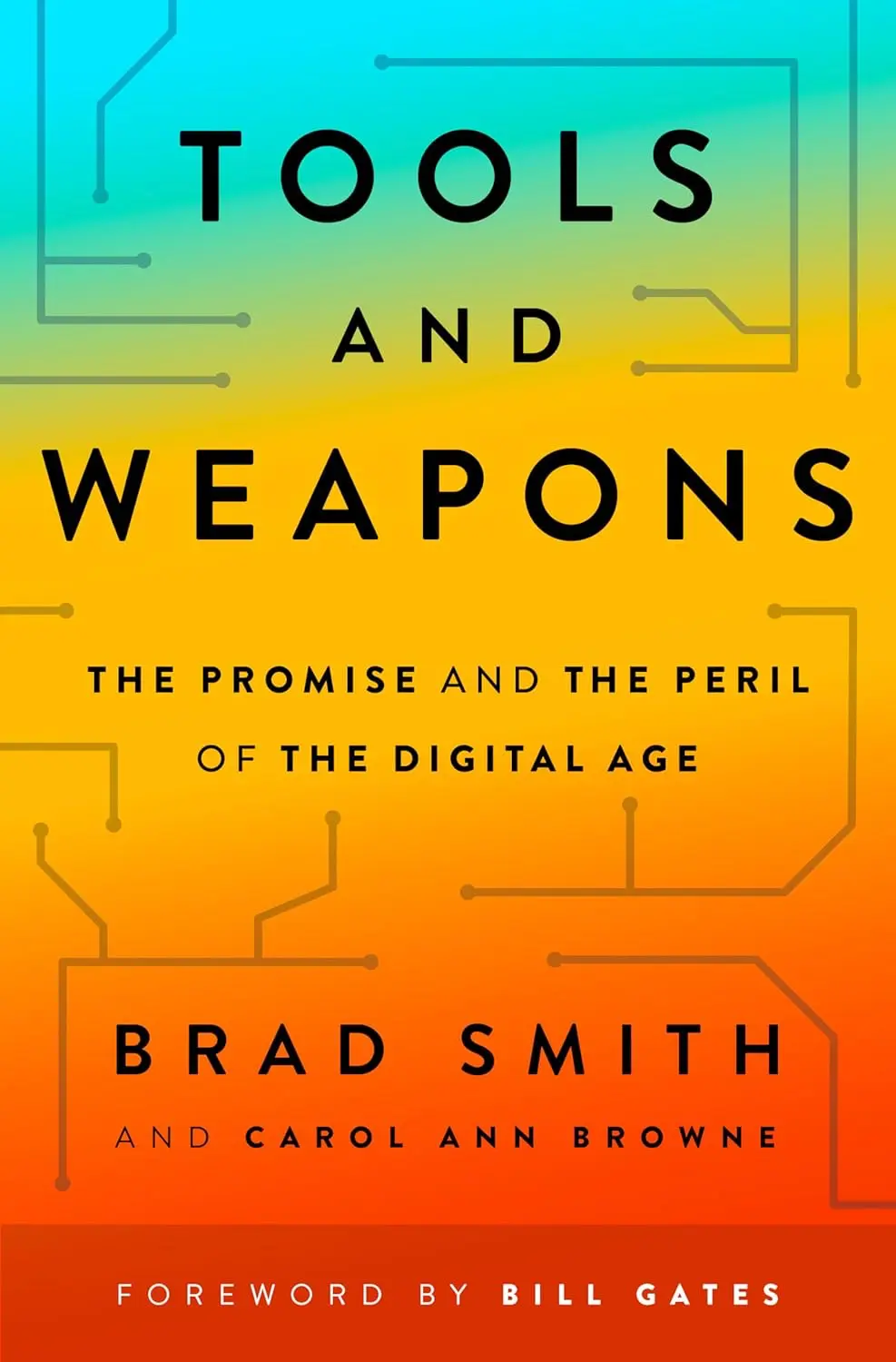
Brad Smith has been Microsoft’s president and chief legal officer for over two decades. He has spent that time in the middle of the tech industry’s most consequential fights: the antitrust case against Microsoft in the late 1990s, the battle over government surveillance after the Snowden revelations, the company’s negotiations with China, and the rise of AI as a force that no one fully controls.
Tools and Weapons, co-written with Microsoft’s chief communications officer Carol Ann Browne, is structured around these conflicts. Each chapter takes a specific issue, cybersecurity attacks, facial recognition technology, rural broadband access, immigration policy, data privacy, and tells the story of how Microsoft engaged with it. The approach is narrative rather than argumentative. You get meeting transcripts, internal emails, and accounts of conversations with world leaders and intelligence officials.
The book’s central argument is contained in its title. Every new technology is simultaneously a tool and a weapon. The same facial recognition software that helps find missing children can also enable authoritarian surveillance. The same cloud infrastructure that powers small businesses can host cyberattacks. The same AI that diagnoses diseases can be weaponized for disinformation. Smith argues that the tech industry cannot wash its hands of these trade-offs by claiming it only builds tools. It has a responsibility to shape how its tools are used.
This is not an abstract argument for Smith. He pushed Microsoft to take positions that annoyed both governments and other tech companies. He refused to hand over customer emails to the U.S. government without proper legal process. He called for regulation of facial recognition technology when most of the industry wanted none. He publicly supported immigration policies that conflicted with the sitting administration.
For founders and builders, the book offers a perspective that most startup-focused literature avoids. When you are building something, the temptation is to focus on growth and product-market fit and worry about consequences later. Smith’s argument, backed by decades of hard-won experience, is that later arrives faster than you think, and that the companies that think about responsibility early tend to fare better than those forced into it by scandal or regulation.
The writing is clear and readable, though the narrative occasionally reads like corporate diplomacy. The sections on cybersecurity and the WannaCry attacks are particularly gripping.
