
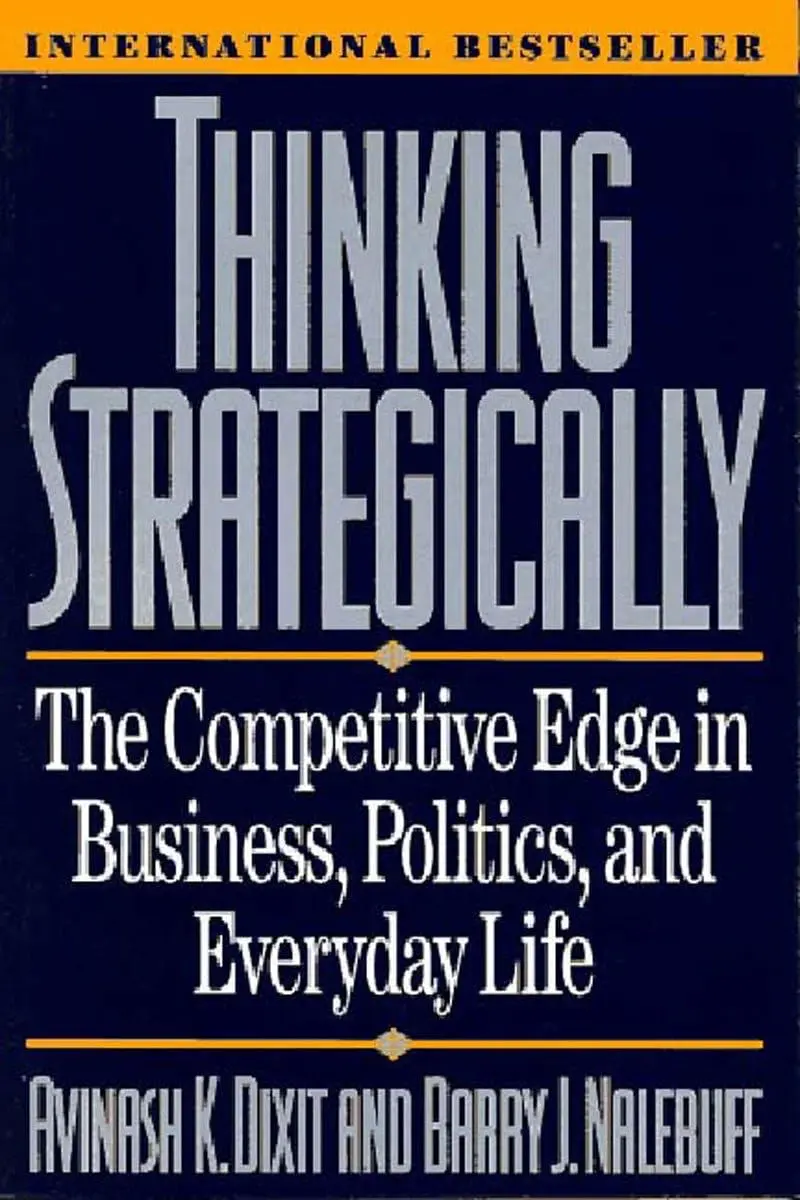
Thinking Strategically is the original version of what later became The Art of Strategy. Published in 1991, it was one of the first books to translate academic game theory into language that business professionals and general readers could use.
The book covers how to think about situations where your success depends on the decisions of others. The basic approach: put yourself in the other player’s position, figure out what they will do, and then decide what you should do given their likely response. This sounds simple, but most people skip this step. They decide what they want to do and assume the other side will cooperate.
Dixit and Nalebuff cover specific strategic situations. How to make a threat credible (a threat that you would not actually carry out is not a threat; it is a bluff, and smart opponents will call it). How to use commitment devices to lock yourself into a strategy (which can be an advantage when it convinces the other side you cannot back down). How to cooperate in repeated interactions (the strategy that performs best in repeated prisoner’s dilemma games is “tit for tat”: cooperate first, then do whatever the other side did last round).
The examples range from the Cuban Missile Crisis to tennis strategy to salary negotiations. Each example illustrates a specific game-theory principle, and the authors connect the principle to situations the reader is likely to encounter.
For founders, the most useful sections cover negotiation strategy, competitive pricing, and the dynamics of cooperation and defection in business relationships. Understanding when a partnership is stable (because both sides benefit from continuing) versus when it is unstable (because one side has an incentive to defect) helps you structure agreements that actually hold.
At about 390 pages, the book is thorough. If you are choosing between this and The Art of Strategy, the latter is the updated version and generally recommended. But Thinking Strategically remains a solid introduction if you find it at a used bookstore or already own it.
