
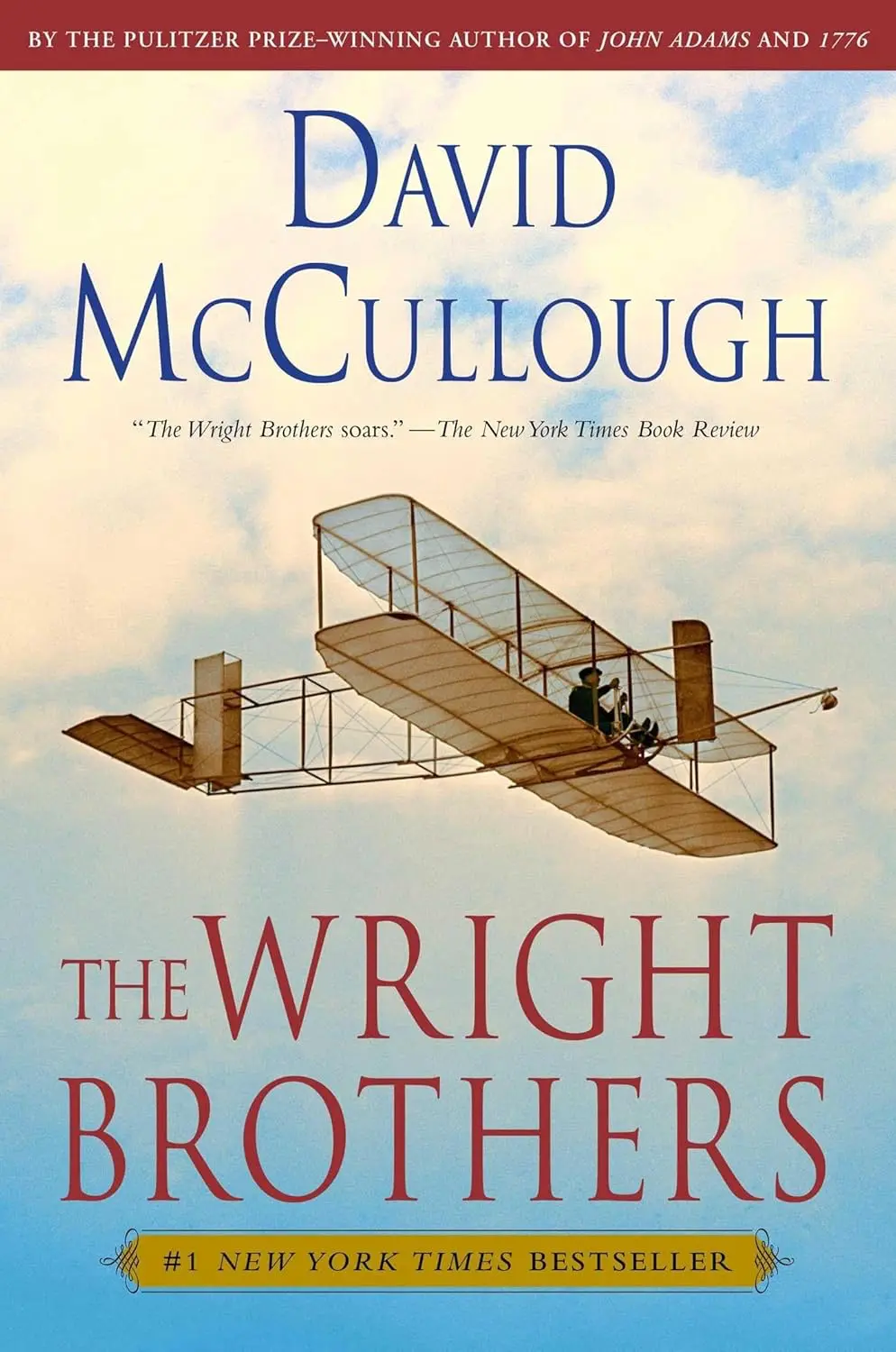
Wilbur and Orville Wright had no college degrees, no funding, no institutional support, and no training in engineering or physics. What they had was a bicycle shop, a systematic approach to experimentation, and the belief that the experts who said powered flight was impossible were wrong.
McCullough traces their process in detail. The Wrights started by studying birds. They built a wind tunnel in their shop and tested over 200 wing shapes. They traveled to Kitty Hawk, North Carolina, for its consistent winds and soft sand. They crashed repeatedly. They redesigned after every failure. When existing data on air pressure and lift turned out to be wrong (published by the Smithsonian’s Samuel Langley, who had millions in government funding), they generated their own data.
The contrast with Langley is one of the book’s recurring themes. Langley had money, institutional backing, media attention, and a team of engineers. The Wrights had almost nothing. Langley’s flying machines crashed into the Potomac River. The Wrights flew at Kitty Hawk. McCullough does not belabor the point, but the implication is clear: resources and credentials are not the same as competence.
The book also covers the years after the first flight, when the Wrights had to fight patent battles, negotiate with governments, and deal with competitors who claimed credit for their work. Success created a different set of problems than failure had.
For founders, the Wright Brothers story is about methodical iteration in the face of expert skepticism. The Wrights did not have a breakthrough insight. They had a process: test, fail, analyze, adjust, test again. The process was not glamorous. It was bicycle mechanics in a cold wind tunnel, running numbers and building models. But it worked.
Bill Gates has recommended it. At about 320 pages, the book is one of McCullough’s shorter works. His writing is warm, precise, and old-fashioned in a good way. The story moves at a measured pace that matches the Wrights’ own methodical approach.
