
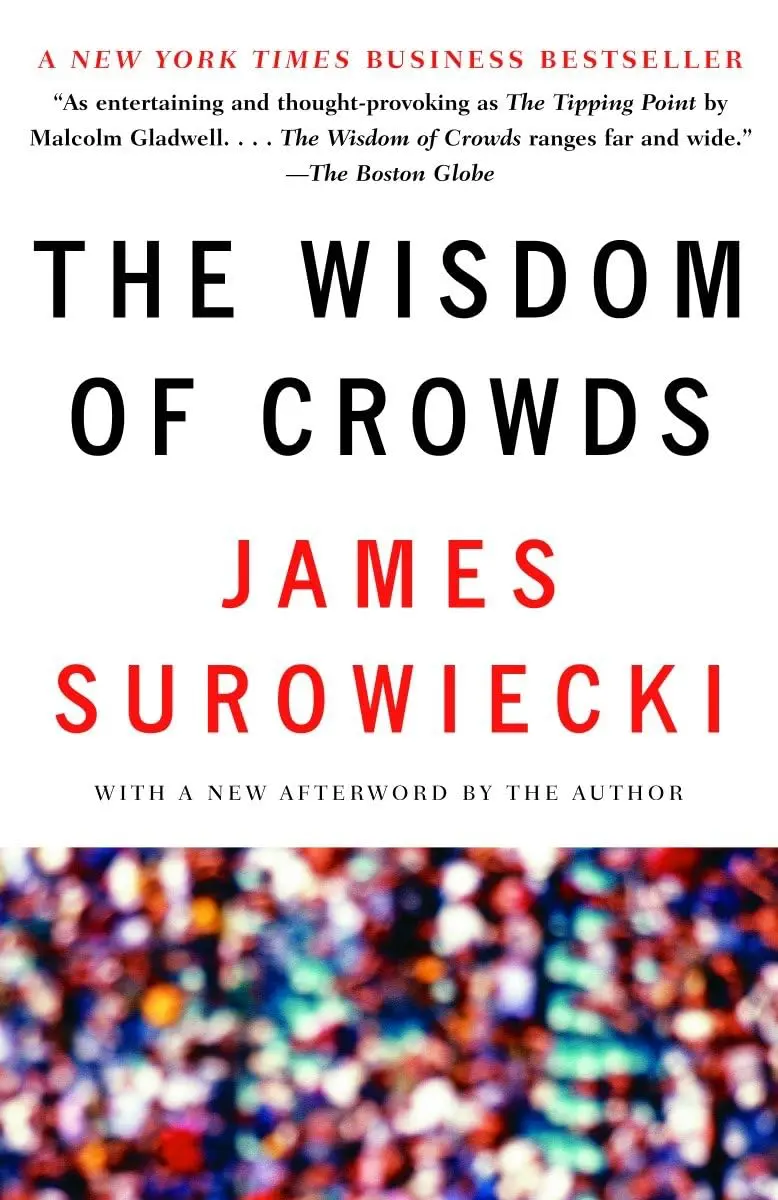
The Wisdom of Crowds starts with a well-known anecdote: at a county fair, a crowd’s average guess about the weight of an ox was more accurate than any individual expert’s estimate. James Surowiecki uses this as the launching point for an investigation into when and why groups make better decisions than individuals.
Surowiecki identifies four conditions for a crowd to be wise. First, diversity of opinion: each person should have some private information or interpretation. Second, independence: people’s opinions should not be determined by those around them. Third, decentralization: people should be able to draw on local knowledge. Fourth, aggregation: there must be a mechanism for turning individual judgments into a collective decision. When these conditions hold, the group’s aggregated judgment tends to beat even the best individual expert.
The book covers examples across business, politics, and science. Stock markets, when functioning properly, aggregate the knowledge of millions of participants into prices that are hard to beat. Google’s PageRank algorithm works by treating links as votes and aggregating them. Betting markets have consistently outperformed polls in predicting election outcomes. But Surowiecki also covers the failures: bubbles, panics, and groupthink, all of which occur when one or more of the four conditions breaks down.
For founders, the book has direct implications for how you make decisions within your company. If you want your team to make good collective decisions, you need to ensure that people form their opinions independently before sharing them, that diverse perspectives are represented, and that there’s a clear mechanism for combining inputs. Many meeting structures violate these principles by having the most senior person speak first, which destroys independence.
The writing is journalistic and engaging. Surowiecki, a New Yorker columnist, structures the book around compelling stories and keeps the argument moving. Some critics argue he is too optimistic about crowd wisdom and underplays the conditions required for it to work. That’s a reasonable concern, but the framework itself, with its four specific conditions, gives you a practical tool for evaluating when to trust the group and when not to.
