
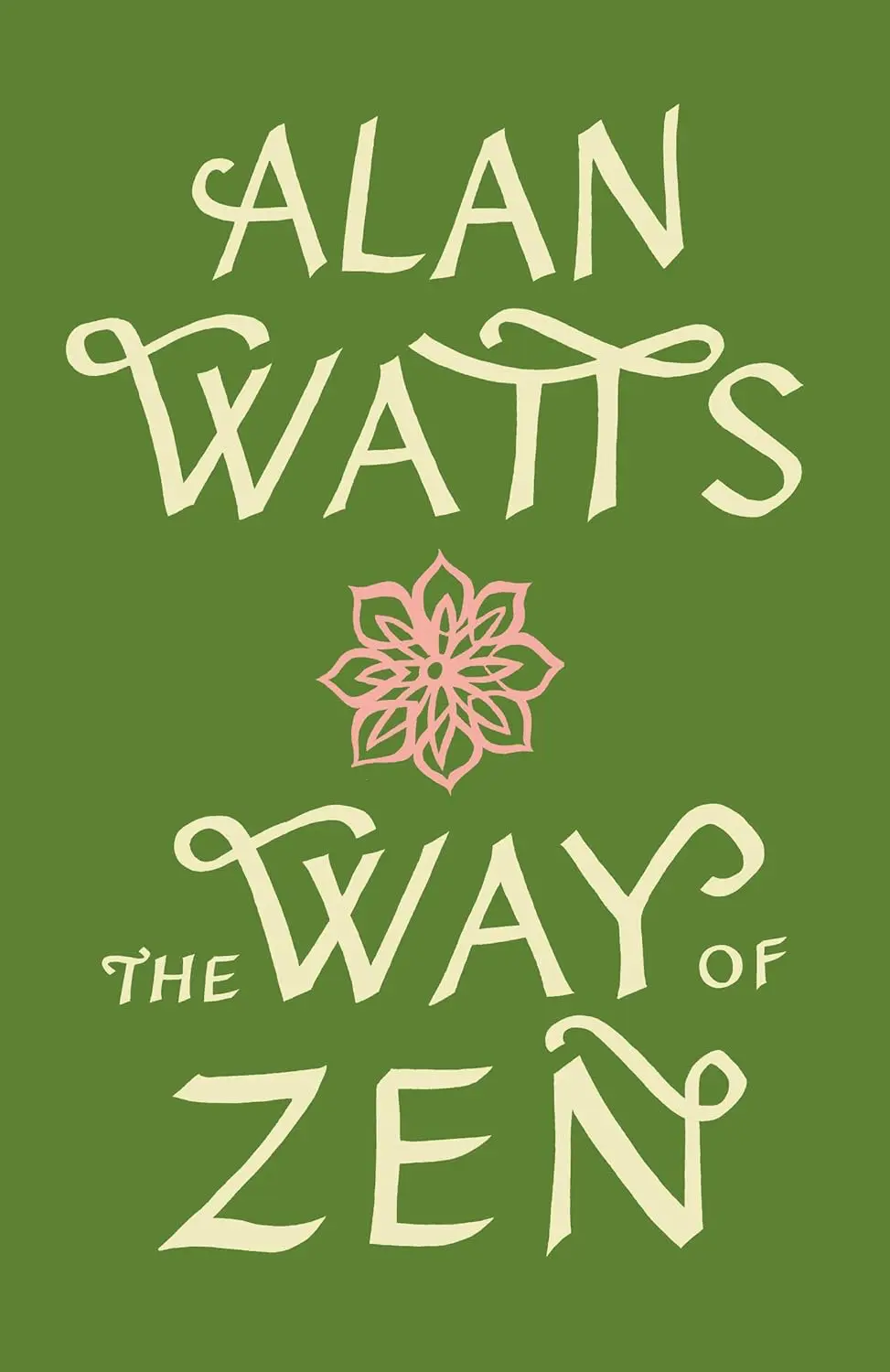
Alan Watts had a problem. He wanted to explain Zen Buddhism to Westerners. But Zen holds that its central insight cannot be communicated through language, logic, or explanation. Any attempt to describe it is already a departure from it. The Way of Zen is Watts’s attempt to do the impossible anyway, and the tension between the attempt and the impossibility gives the book its energy.
The first half is historical. Watts traces the development of Zen from its roots in Indian Buddhism through its transformation in China (where it absorbed Taoism and became Chan) and its flowering in Japan (where Chan became Zen). This is not a dry academic survey. Watts writes about the history the way he talks about everything: with intelligence, humor, and a gift for making complex ideas feel obvious once you hear them stated.
The second half is an attempt to describe Zen practice and the Zen way of seeing. Watts is careful to distinguish Zen from what Westerners often assume it is. It is not a system of beliefs. It does not require accepting any supernatural claims. It is not about achieving a special state through willpower or discipline. It is, as Watts describes it, about seeing what is already there: the immediate, uninterpreted experience of being alive, before the thinking mind adds its commentary.
Watts uses a technique throughout the book that mirrors the Zen method itself. He approaches the central insight from multiple angles, describes it in different terms, tells stories that point toward it, and then steps back, acknowledging that none of these approaches is the thing itself. This can be frustrating if you want a clear, propositional statement of what Zen is. Watts would argue that the frustration is the beginning of understanding.
The sections on Zen arts are some of the book’s best writing. Watts describes how Zen aesthetics show up in Japanese calligraphy, painting, gardening, archery, and the tea ceremony. In each case, the art form involves a kind of controlled spontaneity: training so thoroughly that the trained response becomes effortless and appears natural. A calligrapher who has practiced for decades produces a brushstroke that looks like it required no thought. That appearance of effortlessness is not accidental. It is the point.
Watts published The Way of Zen in 1957. He went on to write dozens more books and give hundreds of lectures, many of which are now widely available online. He died in 1973. His legacy is complicated: he brought Eastern philosophy to millions of Westerners, but some Buddhist teachers have argued that his understanding was more literary than experiential. Watts was a talker and a writer, not a monk. Whether that disqualifies him or makes him more relatable depends on what you expect from a teacher.
