
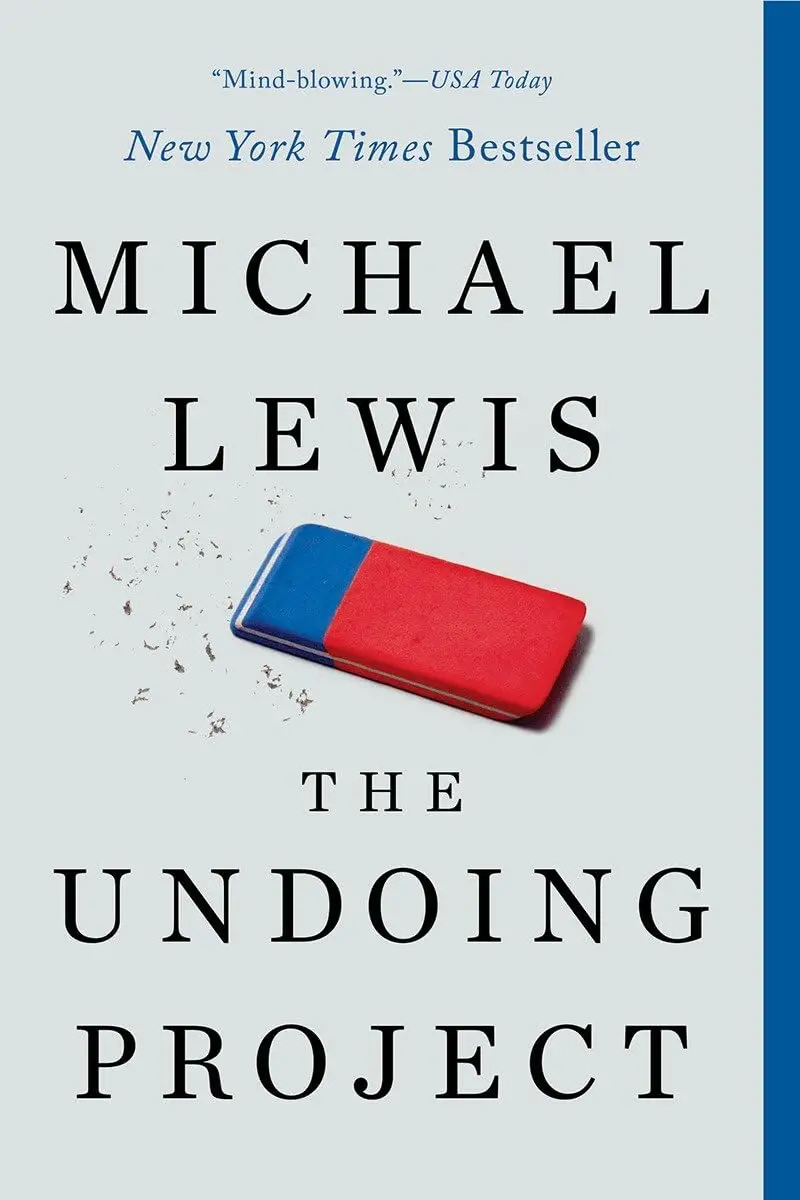
Lewis wrote Moneyball about how statistical analysis could outperform human judgment in baseball. After the book came out, he received a review from two University of Chicago academics arguing that this was not a new discovery: Kahneman and Tversky had been documenting the failures of human judgment since the 1970s. Lewis was embarrassed that he had not known their work, and The Undoing Project is his attempt to tell their story.
Kahneman and Tversky were both Israeli psychologists, but their personalities were opposite. Kahneman was anxious, self-doubting, and relentlessly self-critical. Tversky was confident, charismatic, and decisive. Together, they produced a body of work that challenged the foundation of economics: the assumption that people are rational.
Lewis traces their collaboration from its beginning in the late 1960s at Hebrew University through the research that produced prospect theory (for which Kahneman won the Nobel Prize; Tversky had died in 1996 and was therefore ineligible). He also traces the dissolution of the partnership, as Tversky received more credit and recognition than Kahneman, creating a rift that was never fully healed.
The book works on two levels. As an intellectual history, it explains how Kahneman and Tversky discovered the specific biases (anchoring, loss aversion, the availability heuristic, base rate neglect) that have since become standard vocabulary in business and investing. As a human story, it explores how creative partnerships work: the chemistry, the competition, the unequal distribution of credit, and the pain of a collaboration that was both the best and most difficult relationship in both men’s lives.
For founders, the intellectual content is useful (understanding cognitive biases helps with every decision you make). But the story of the partnership may be even more valuable. Many companies are built by pairs of cofounders whose complementary strengths produce something neither could achieve alone. The dynamics Lewis describes, the joy of creative collaboration and the strain of unequal recognition, are familiar to anyone who has worked closely with a cofounder.
At about 360 pages, the book is well-paced. Lewis is at his most literary here, taking time with the characters and the Israeli context in a way that gives the story depth beyond the research findings.
