
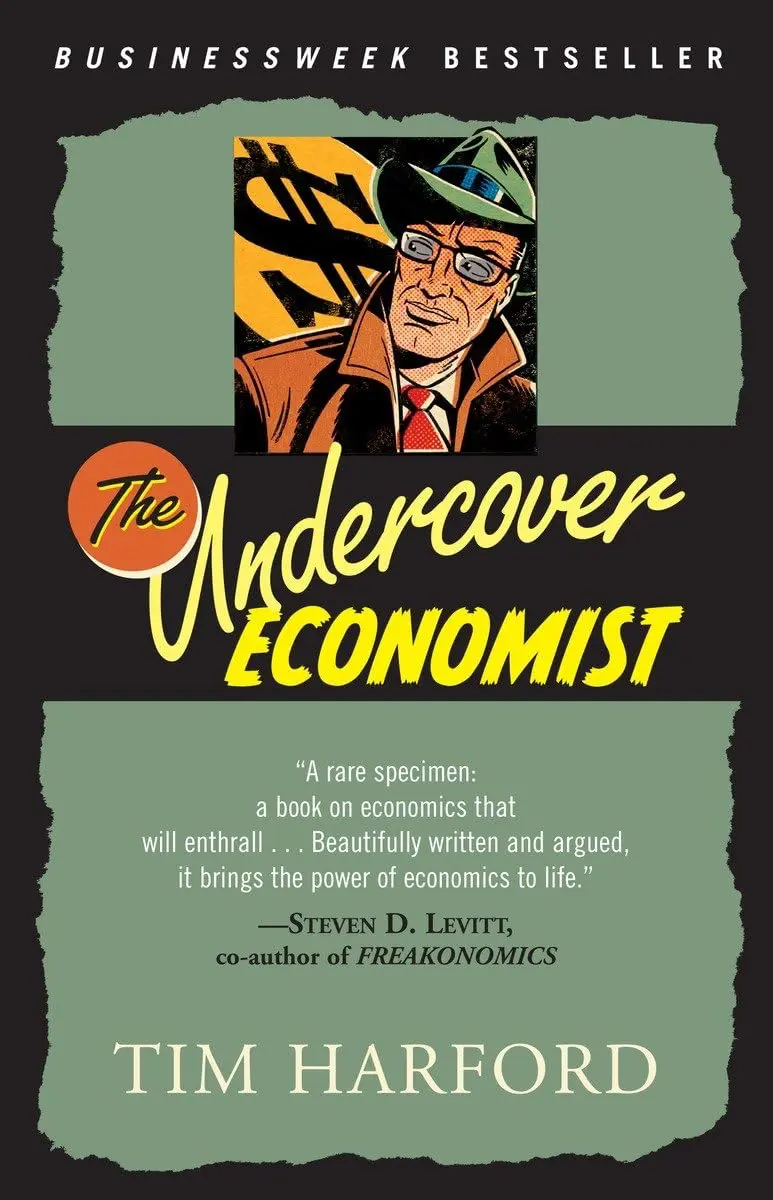
The Undercover Economist is Tim Harford’s attempt to explain the core principles of economics using ordinary situations that everyone encounters. Why does a cup of coffee cost what it does? Why are used cars so cheap? Why are some countries rich and others poor? Harford answers each question by walking through the underlying economics in clear, jargon-free language.
The opening chapter on coffee pricing is the book’s most famous section. Harford explains how the price of a latte in a train station is determined not by the cost of the beans but by the scarcity value of the location. He then uses this example to introduce broader concepts like bargaining power, price discrimination (why airlines charge different prices for the same seat), and the difference between what something costs to produce and what someone is willing to pay.
Later chapters cover more complex topics: how markets can fail (externalities, information asymmetry, and monopoly power), how China’s economy grew so rapidly, why some countries stay poor despite having natural resources, and how game theory applies to everyday decision-making. Harford keeps each chapter grounded in specific, observable phenomena rather than abstract theory.
For founders, the chapter on price discrimination alone is worth the read. Understanding how to charge different prices to different customers for the same product, and doing it in a way customers accept, is one of the more important pricing skills a business can develop. Harford explains the logic with enough clarity that you can apply it directly.
The writing is witty and well-paced. Harford was a columnist for the Financial Times, and his journalistic background shows in the clean prose and the ability to make dry material entertaining. The book was published in 2006, and some examples reflect that era’s economic conditions, but the principles haven’t changed. It works well as a first economics book for people who never studied the subject formally, and as a refresher for those who did but forgot most of it.
