
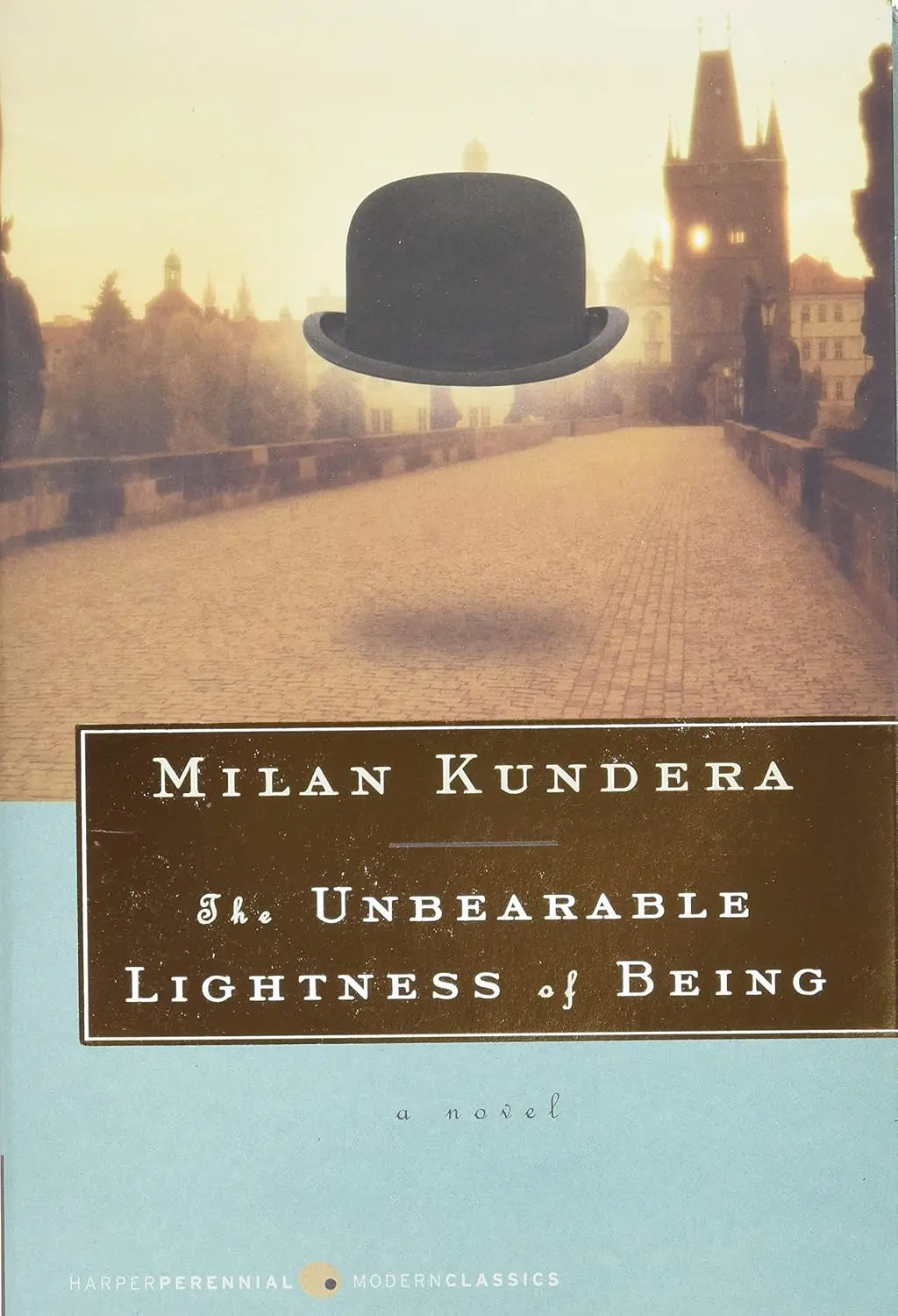
Kundera opens with a question borrowed from Nietzsche. If every moment of our lives recurred an infinite number of times, each decision would carry infinite weight. But we only live once. Nothing comes back. Every choice is weightless because it can never be compared to an alternative. This lightness, Kundera argues, is unbearable.
The novel follows Tomas, a Prague surgeon who cannot commit to any single woman, and Tereza, who falls in love with him and suffers for it. Their story plays out against the backdrop of the 1968 Soviet invasion of Czechoslovakia, which is both a political event and a private one. Tomas publishes an article critical of the regime. He is offered the chance to retract it. He refuses, and the refusal costs him his career and eventually his freedom.
Kundera interrupts the narrative constantly. He pauses to discuss Beethoven. He explains why kitsch is a political category. He meditates on the relationship between body and soul, which Tereza experiences as a conflict between the person she is and the flesh she inhabits. These interruptions would be annoying in a lesser writer. In Kundera’s hands they are the point. He is not pretending to write a conventional novel. He is thinking out loud on the page, using characters to test ideas the way a scientist uses experiments.
The writing style is clean and deceptively simple. Kundera writes in short sections, often only a page or two, that shift between characters, time periods, and levels of abstraction. The effect is more like reading a series of connected essays than a traditional plot-driven story.
A second couple, Sabina and Franz, provides the philosophical counterweight. Sabina is a painter who keeps betraying everyone and everything, not out of malice but out of an instinct to remain free. Franz is an academic who idealizes her. Their misunderstandings illustrate Kundera’s idea that every love story is built on a shared vocabulary, and that most couples are speaking different languages without knowing it.
Kundera was born in Czechoslovakia, had his books banned after the Soviet invasion, and eventually settled in France. The Unbearable Lightness of Being was written in Czech but first published in French in 1984. It has been translated into dozens of languages and adapted into a film starring Daniel Day-Lewis in 1988.
The novel is short enough to read quickly and dense enough to reward reading it again. It raises questions about loyalty, freedom, and the weight of decisions that it never fully resolves, which is part of the point.
