
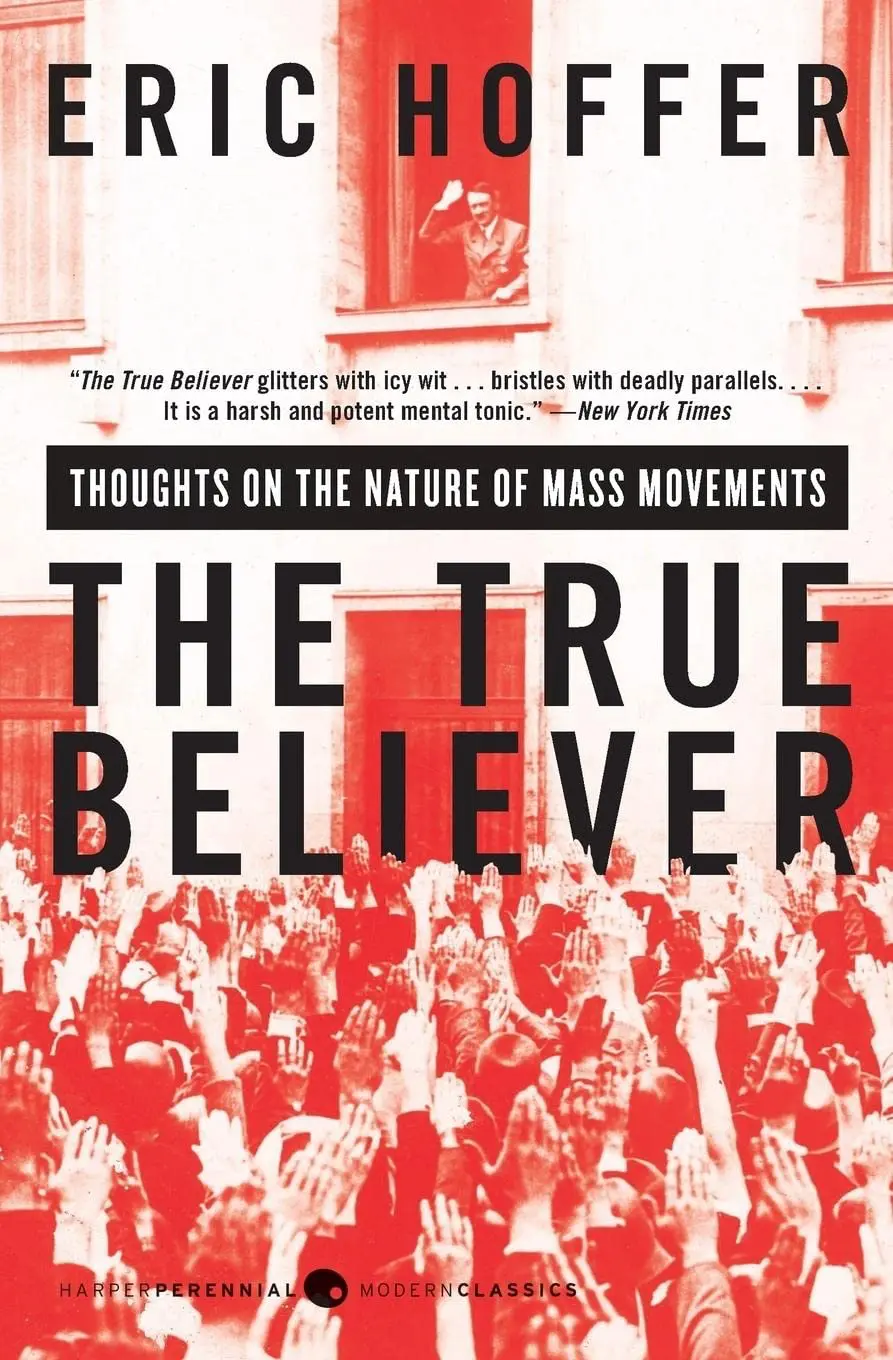
Eric Hoffer never went to college. He was a migrant worker in California during the Depression, then a longshoreman on the San Francisco waterfront for twenty-five years. He read constantly, thought independently, and in 1951 published The True Believer, a book that Dwight Eisenhower recommended to friends and that remains in print more than seventy years later.
Hoffer’s subject is mass movements. Not any particular movement, but the psychology that makes all of them possible. His central observation: the people who join mass movements, whether communist, fascist, nationalist, or religious, tend to share certain characteristics that have nothing to do with the specific cause. They are frustrated with their present lives. They feel that their individual identity has failed them. They are willing to trade personal freedom for a sense of belonging to something larger.
The book is structured as a series of short, numbered sections, each making a single point. This gives it the feel of a collection of aphorisms rather than a sustained argument. Hoffer writes sentences you can chew on for days. Some of the most quoted: “A mass movement attracts and holds a following not because it can satisfy the desire for self-advancement, but because it can satisfy the passion for self-renunciation.” And: “Hatred is the most accessible and comprehensive of all the unifying agents.”
Hoffer argues that the content of a movement’s ideology matters less than its emotional function. People do not join because they are persuaded by arguments. They join because the movement offers them a new identity, a group to belong to, and an enemy to blame for their problems. This is why the same person can shift between radically different movements without apparent contradiction. What stays constant is the need. What changes is the label.
The book has been read by presidents, business leaders, and military strategists. It was written during the early Cold War, with the horrors of fascism still fresh, and it aimed to understand how entire populations could be swept up in movements that, in hindsight, looked like obvious disasters. That question has not gone away.
Hoffer’s writing is terse, opinionated, and occasionally reductive. He generalizes freely and does not always back his claims with evidence. The book is better understood as the observations of a rigorous autodidact than as a work of social science. It does not explain everything about why movements succeed or fail. But it captures something true about the relationship between personal frustration and political extremism that has aged better than most works of political psychology from its era.
Hoffer received the Presidential Medal of Freedom in 1983. He died in 1983. The True Believer remains his most read work.
