
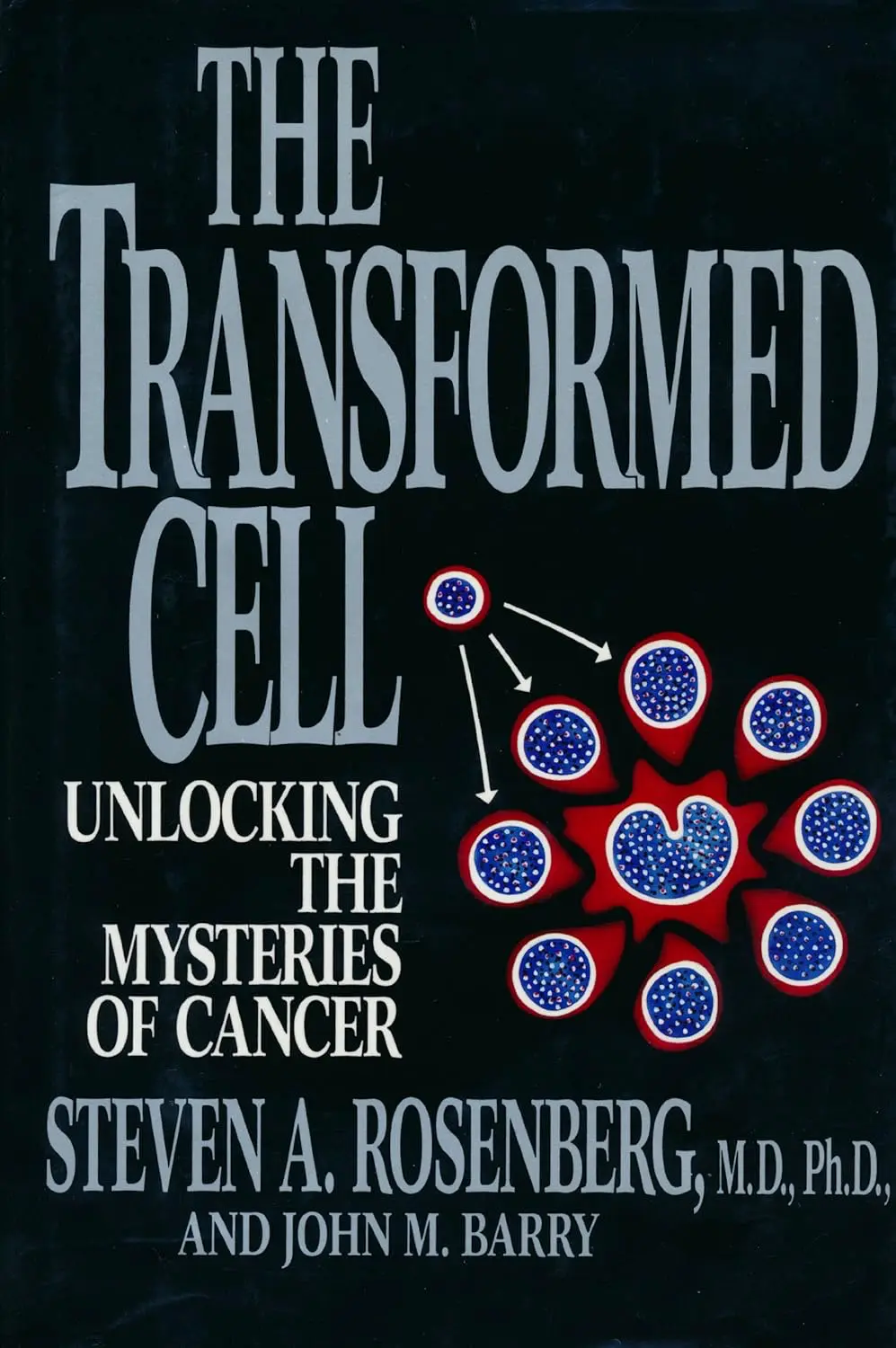
Steven Rosenberg became fixated on cancer immunotherapy in 1968, when he encountered a patient at a VA hospital whose metastatic stomach cancer had disappeared without treatment. Spontaneous remissions were known to occur in extremely rare cases, and Rosenberg wanted to know why. If the immune system could destroy cancer in one patient, maybe it could be made to do so in others. He spent the next several decades trying to prove it.
The Transformed Cell chronicles that effort. Rosenberg, who became chief of surgery at the National Cancer Institute, describes the development of interleukin-2 (IL-2) therapy, one of the first treatments that demonstrated the immune system could be activated to attack tumors. He describes the clinical trials, the patients who responded, and the many more who did not. He describes the toxicity of early immunotherapy treatments, which sometimes brought patients close to death before helping them. He describes the political and bureaucratic battles within the NIH and the FDA that delayed or complicated his work.
The book is part scientific autobiography and part medical narrative. Rosenberg writes about individual patients in detail: their diagnoses, their hopes, the decisions they made about experimental treatment, and what happened to them. Some of these stories end in recovery. Many end in death. Rosenberg does not smooth over the failures. The honesty about how many patients died in the pursuit of a treatment that eventually worked gives the book a moral seriousness that most medical narratives lack.
Rosenberg’s work laid the groundwork for what has become one of the most important developments in modern medicine. Immunotherapy, including checkpoint inhibitors and CAR-T cell therapy, has since become a standard treatment for several types of cancer. The field that Rosenberg spent decades building largely alone is now a multi-billion-dollar segment of oncology.
Peter Attia has recommended the book. Published in 1992, before most of the immunotherapy breakthroughs that validated Rosenberg’s approach, the book reads as a story about the nature of sustained scientific conviction. Rosenberg pursued his hypothesis through decades of mixed results, funding struggles, and skepticism from colleagues. That kind of long-term commitment to an idea that most people think will not work is something that translates directly outside of medicine.
