
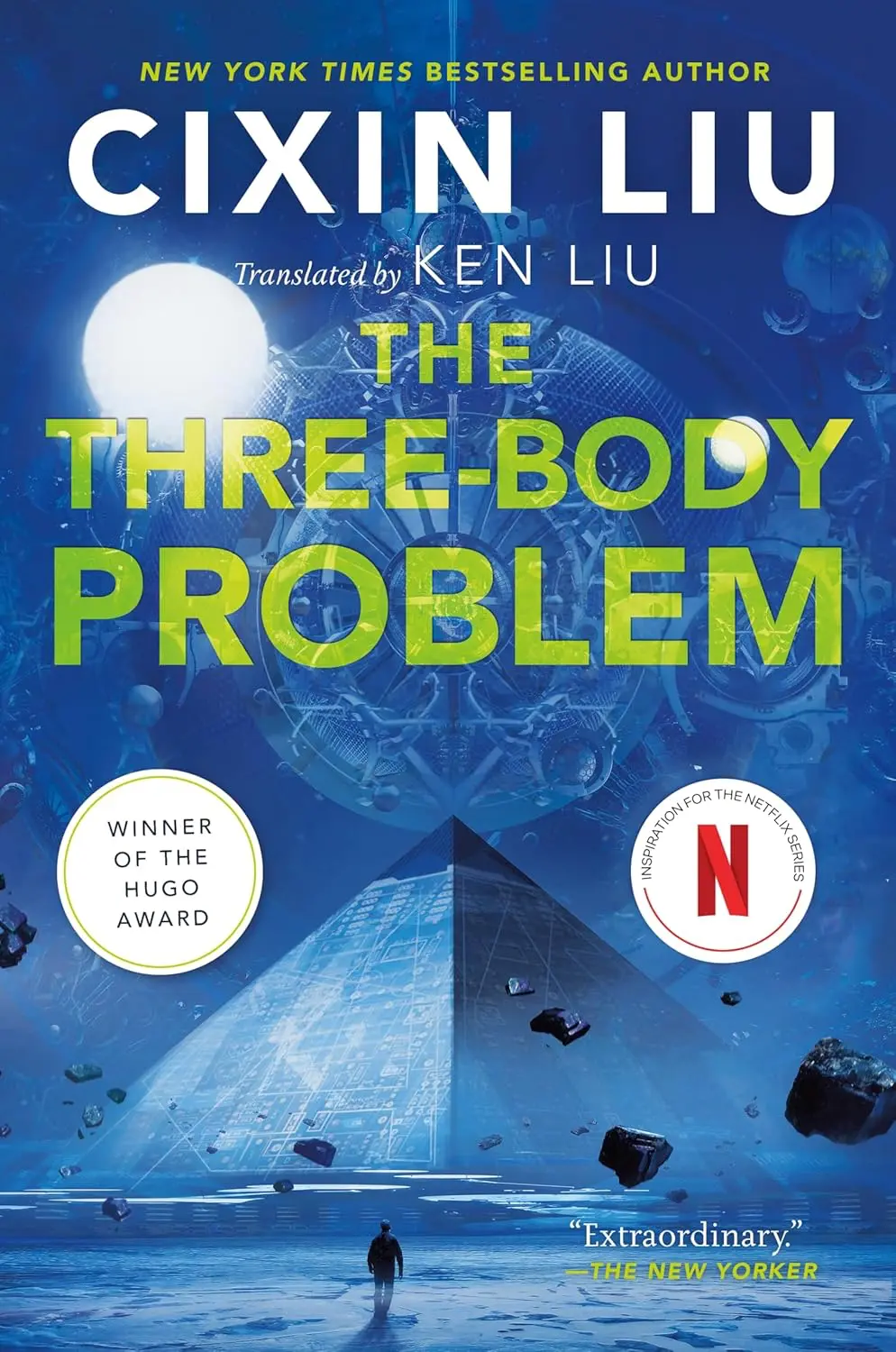
The Three-Body Problem is the first volume of Liu Cixin’s Remembrance of Earth’s Past trilogy, translated from Chinese by Ken Liu. The novel begins during the Cultural Revolution, where a young astrophysicist named Ye Wenjie, traumatized by her father’s death at the hands of Red Guards, makes a decision that changes the course of human history by sending a message into space and receiving a reply.
The book operates on two timescales. The historical sections cover Ye Wenjie’s experiences during and after the Cultural Revolution, explaining how she came to work at a secret military installation designed to contact extraterrestrial life. The present-day sections follow a nanotechnology researcher named Wang Miao, who gets drawn into a mysterious virtual-reality game that turns out to be connected to a real alien civilization.
Liu’s science fiction is “hard” in the technical sense. The three-body problem of the title is a real physics concept: the difficulty of predicting the motion of three gravitational bodies interacting with each other. Liu uses this as the basis for the alien civilization’s home planet, which orbits three suns in a system so chaotic that stable eras alternate unpredictably with catastrophic ones. The physics is explained clearly enough for non-scientists to follow, though some sections require patience.
The cultural perspective is what makes the book genuinely unusual for Western readers. Liu writes from a Chinese historical context, and the Cultural Revolution sections give the story an emotional weight and political complexity that Western science fiction rarely achieves. The idea that humanity’s response to an alien threat might be shaped by specific historical traumas is both original and disturbing.
For founders and readers interested in long-term thinking, the trilogy (which continues with The Dark Forest and Death’s End) explores questions about civilizational strategy, game theory, and the consequences of decisions that play out over centuries. The “dark forest” theory introduced in the second book has become widely referenced in technology and business circles as a metaphor for competitive strategy.
The translation by Ken Liu is excellent. The book requires more patience than a typical Western thriller, but the payoff is a story that thinks bigger than almost anything else in contemporary science fiction.
