
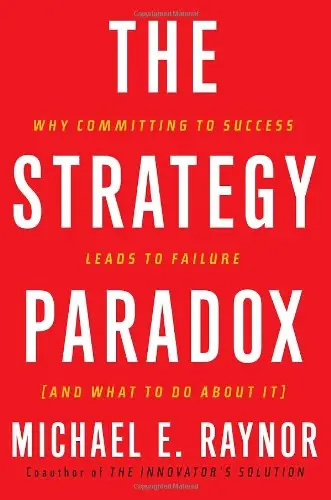
The Strategy Paradox starts with a puzzle: many of the greatest business failures followed strategies that were well-reasoned, well-executed, and widely praised at the time. Sony’s Betamax, Firestone’s radial tire delay, and countless others weren’t undone by bad strategy. They were undone by uncertainty. The same boldness that leads one company to dominate a market leads another to collapse, and the difference often comes down to factors that neither company could have predicted.
Raynor’s argument is that the conventional approach to strategy, which emphasizes commitment (pick a direction and go all in), creates a paradox. The most successful strategies require the biggest commitments, because half-measures produce mediocre results. But the biggest commitments also carry the biggest risks, because you’re betting heavily on a future you can’t know. Playing it safe protects you from catastrophic loss but guarantees you’ll never achieve breakout success either.
The solution Raynor proposes is to separate commitment from uncertainty management across organizational levels. Frontline managers should commit fully to executing the current strategy. Middle managers should manage near-term adaptations. Senior leaders and the board should focus on managing strategic uncertainty by maintaining real options: investments in multiple possible futures that can be exercised or abandoned as uncertainty resolves.
The “real options” concept is the book’s most practical contribution. Instead of choosing one strategy and betting everything on it, you invest enough in multiple possible directions to give you the right (but not the obligation) to pursue whichever one turns out to be viable. This is expensive and feels wasteful in the moment, but it’s much cheaper than committing fully to the wrong direction.
For founders, the paradox is real and personal. You’re told to focus, commit, go all in. And that advice works when you happen to be right about the future. When you’re wrong, the same advice destroys you. Raynor’s framework gives you a way to think about how much to commit versus how much optionality to preserve, which is one of the hardest judgment calls in building a company.
The writing is clear and analytical. Raynor uses detailed case studies to build his argument, and the logic is tight. Some readers find the real options framework too corporate for early-stage startups, and that’s a fair criticism. But the underlying insight about the relationship between commitment and uncertainty is relevant at any stage.
