
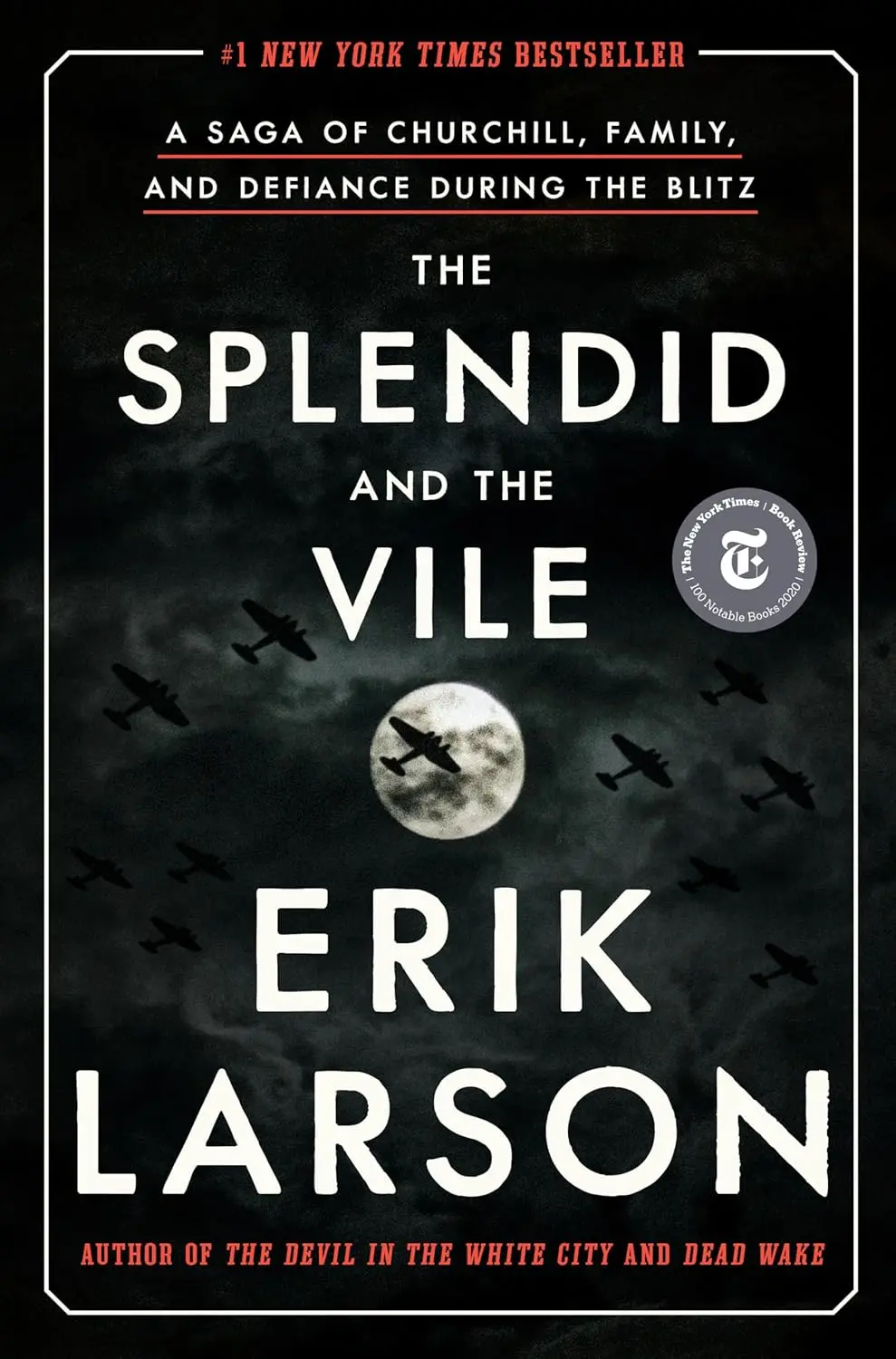
The Splendid and the Vile covers one specific year in Winston Churchill’s life: the twelve months beginning in May 1940, when he became Prime Minister as German forces swept through France, and ending in May 1941, when the worst of the Blitz was over but the war’s outcome was still deeply uncertain. Erik Larson chose this period because it captures both the grand strategic decisions and the intimate daily reality of leading a country through an existential crisis.
Larson draws from diaries, personal letters, and recently declassified intelligence documents to reconstruct what life was like inside Churchill’s circle. You get Churchill dictating memos from the bathtub, his daughter Mary worrying about her love life while bombs fall on London, and his private secretary John Colville recording the atmosphere at Downing Street with the specificity of a novelist. The domestic details are what make the book distinctive: this is not a military history but a story about how people lived and made decisions under extreme pressure.
Churchill’s leadership style comes through clearly. He was demanding, emotional, exhausting to work for, and capable of inspiring people who by all rational calculation should have been ready to give up. Larson shows how Churchill used rhetoric, humor, and sheer stubbornness to maintain morale during a period when Britain’s military position was genuinely desperate. He also covers Churchill’s private doubts, which he rarely expressed publicly, and the toll the crisis took on his health and his family.
For founders, the book is about leadership during a long, grinding crisis where the outcome is uncertain and the people around you need to believe things will be okay even when you’re not sure yourself. Churchill’s ability to project confidence while remaining privately realistic, and to maintain his own energy during months of relentless pressure, is a model worth studying, even if the context is very different.
The writing is Larson’s signature style: narrative nonfiction that reads like a novel. He uses the same scene-by-scene technique that worked in The Devil in the White City and Dead Wake, alternating between perspectives to build tension and maintain pace. The book is long but moves quickly, and the personal detail makes the wartime period feel immediate rather than historical.
