
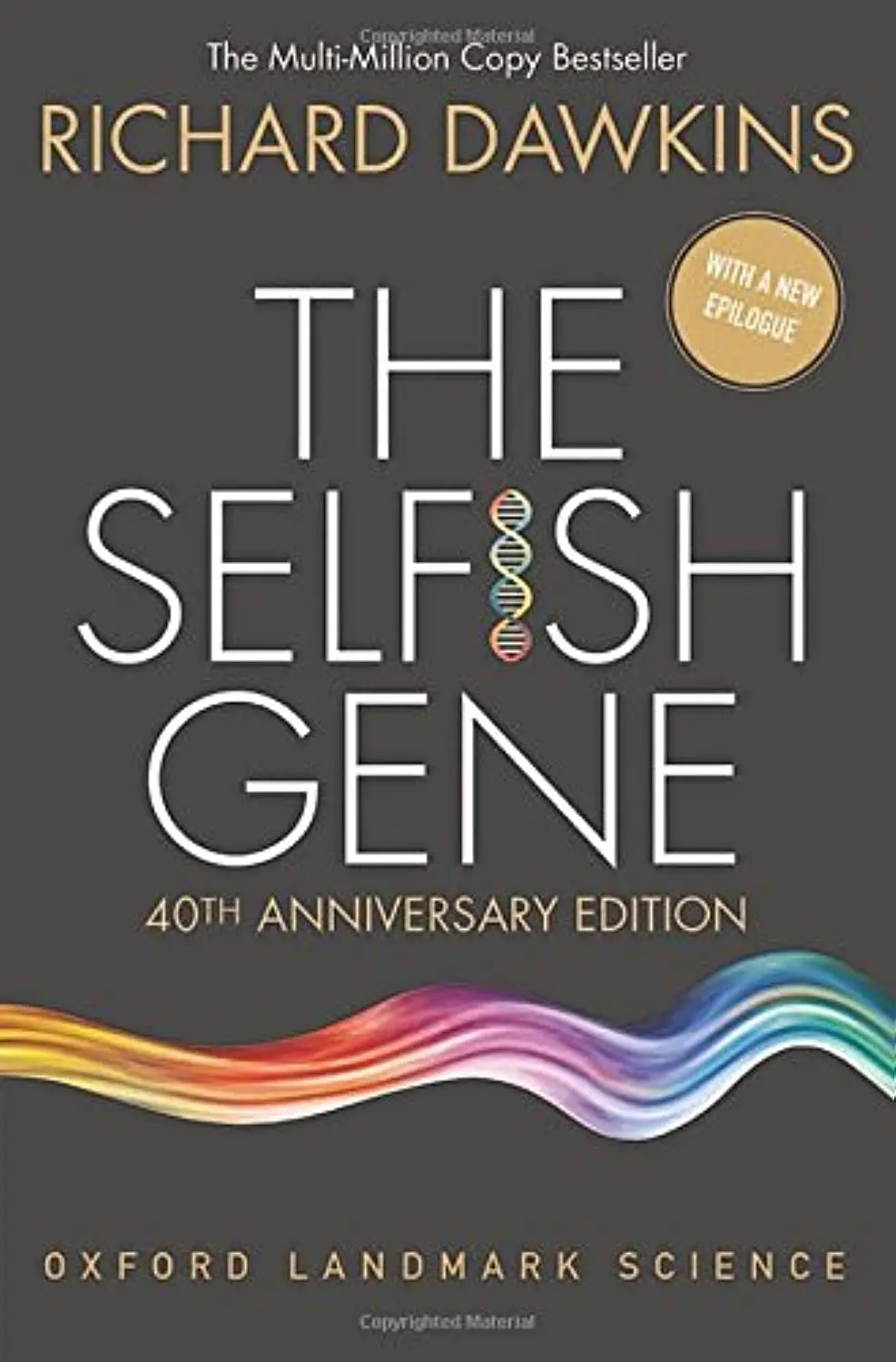
Published in 1976, The Selfish Gene changed how many people think about evolution. Dawkins’s central argument is that natural selection operates at the level of the gene, not the individual or the species. Genes that are good at getting themselves copied spread. Genes that are not, disappear. Organisms are the vehicles genes build to ensure their own survival and reproduction.
This gene-centered view explains behaviors that seem to contradict individual self-interest. A bird that warns the flock about a predator, attracting attention to itself, is not being altruistic in the human sense. It is carrying genes that promote flock-warning behavior, and those genes spread because the bird’s relatives (who share many of the same genes) survive at higher rates.
Dawkins also introduced the concept of the “meme” in this book, years before the internet gave the word its current meaning. A meme, as Dawkins defined it, is a unit of cultural information (a song, an idea, a catchphrase) that replicates from mind to mind, following selection dynamics similar to genes. Ideas that are good at spreading, spread, regardless of whether they are true or useful.
The book is written for a general audience, and Dawkins is a clear, often witty writer. He uses vivid analogies (genes as rowers in a boat, organisms as survival machines) to make complex biology accessible. The science has been refined in the decades since publication, but the core framework has held up well.
For founders, the relevant ideas are about incentives and replication. Dawkins’s framework maps onto how products spread, how company cultures evolve, and why incentive structures produce the behaviors they reward rather than the behaviors you intend. Understanding selection dynamics, whether in biology or business, helps you design systems that produce the outcomes you want.
Elon Musk, Ray Dalio, and Naval Ravikant have recommended it. At about 350 pages, the book is accessible but requires attention. The 40th anniversary edition includes updated endnotes that address criticisms and developments since the original publication.
