
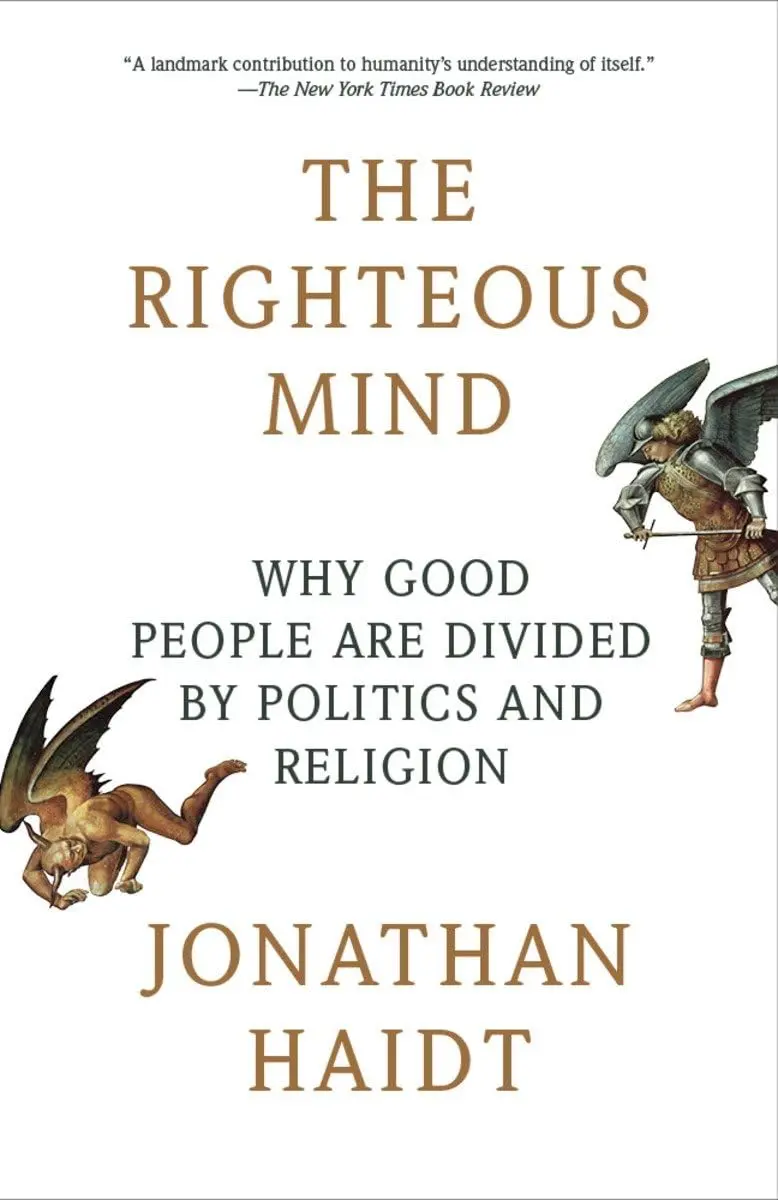
Haidt’s research identified six moral foundations that operate across cultures: Care/Harm, Fairness/Cheating, Loyalty/Betrayal, Authority/Subversion, Sanctity/Degradation, and Liberty/Oppression. People across the political spectrum draw on all six, but in different proportions. Liberals tend to emphasize Care and Fairness. Conservatives tend to weigh all six more equally.
This explains why political arguments feel like talking past each other. When a liberal makes a case based on harm reduction and a conservative responds with a case based on tradition or loyalty, neither side understands why the other is unmoved. They are not arguing about facts. They are prioritizing different moral dimensions.
Haidt uses the metaphor of a rider on an elephant. The rider is your conscious reasoning. The elephant is your intuitive moral judgment. The rider thinks it is in charge, but the elephant goes where it wants. Moral reasoning is mostly post-hoc justification for intuitions you already had. This does not mean reasoning is useless, but it means that if you want to change someone’s mind, you need to speak to the elephant (their intuitions and values) not just the rider (their logic).
The book draws on evolutionary psychology, anthropology, and cross-cultural research. Haidt is a careful writer who presents evidence before drawing conclusions, and he is honest about the limitations of his framework.
For founders, the applications go beyond politics. Understanding that people make decisions based on moral intuitions rather than logical analysis affects how you sell products, manage teams, and communicate with customers. If you are pitching a product and your message speaks to only one moral foundation while your audience cares about a different one, you will not connect regardless of how good your argument is.
Simon Sinek and Sam Harris have both engaged with Haidt’s work. At about 420 pages, the book is thorough. It rewards patient reading. The first third is the most directly useful; the later sections on religion and politics are interesting but less immediately applicable to business contexts.
