
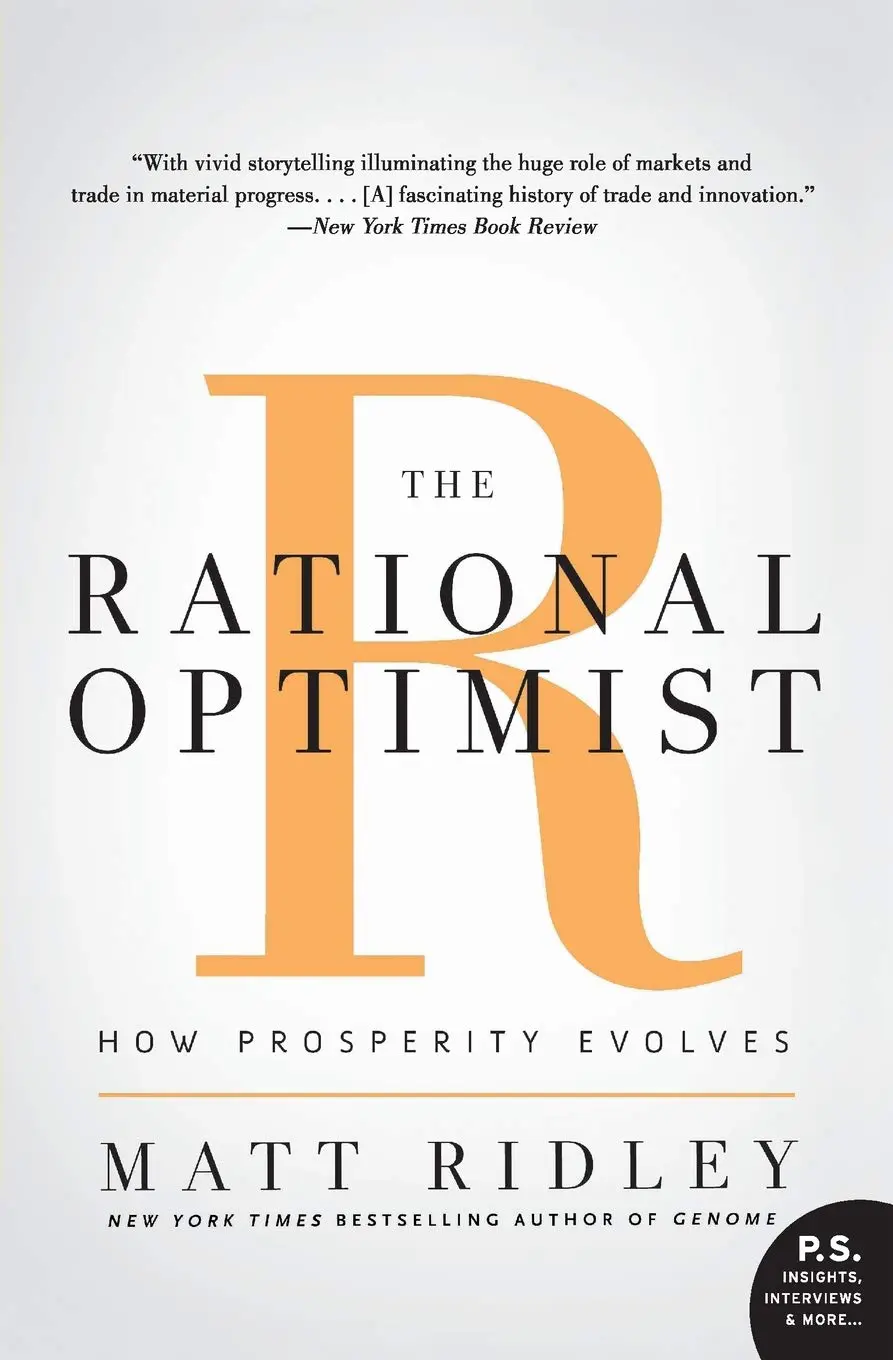
Ridley’s argument starts with a question: why are humans the only species that keeps getting better off? His answer is exchange. When two people trade, both end up with more than they started with. When groups specialize (one grows food, another builds tools), total output increases. This is not a new observation (Adam Smith made it in 1776), but Ridley traces the consequences across 100,000 years of human history.
The book is organized roughly chronologically. Early humans traded even before agriculture. The agricultural revolution accelerated specialization. Cities concentrated exchange. The industrial revolution was driven by ideas exchanging and recombining in new ways. Each phase produced more prosperity than the last, measured by any standard: caloric intake, life expectancy, infant mortality, leisure time, material comfort.
Ridley spends significant time attacking pessimism. He catalogues predictions of doom, from Malthus to the Club of Rome to modern environmentalists, and shows that they have been consistently wrong. Population was supposed to outstrip food supply. It did not. Resources were supposed to run out. They did not. Pollution was supposed to keep getting worse. In most rich countries, it reversed. Ridley does not argue that problems do not exist. He argues that human ingenuity, driven by exchange, has solved every major problem so far and is likely to continue.
Critics charge that Ridley underestimates environmental risks, particularly climate change, and that his optimism ignores the distributional consequences of growth (not everyone benefits equally). These are fair objections that Ridley addresses but does not fully resolve.
For founders, the book’s thesis is encouraging: the long-term trend is toward more opportunity, not less. Building a business is participating in the exchange and specialization process that has driven human prosperity for millennia.
Naval Ravikant, Bill Gates, and Elon Musk have recommended it. At about 370 pages, the book is well-written and covers enormous ground. Ridley has a talent for making economic history feel like storytelling rather than textbook material.
