
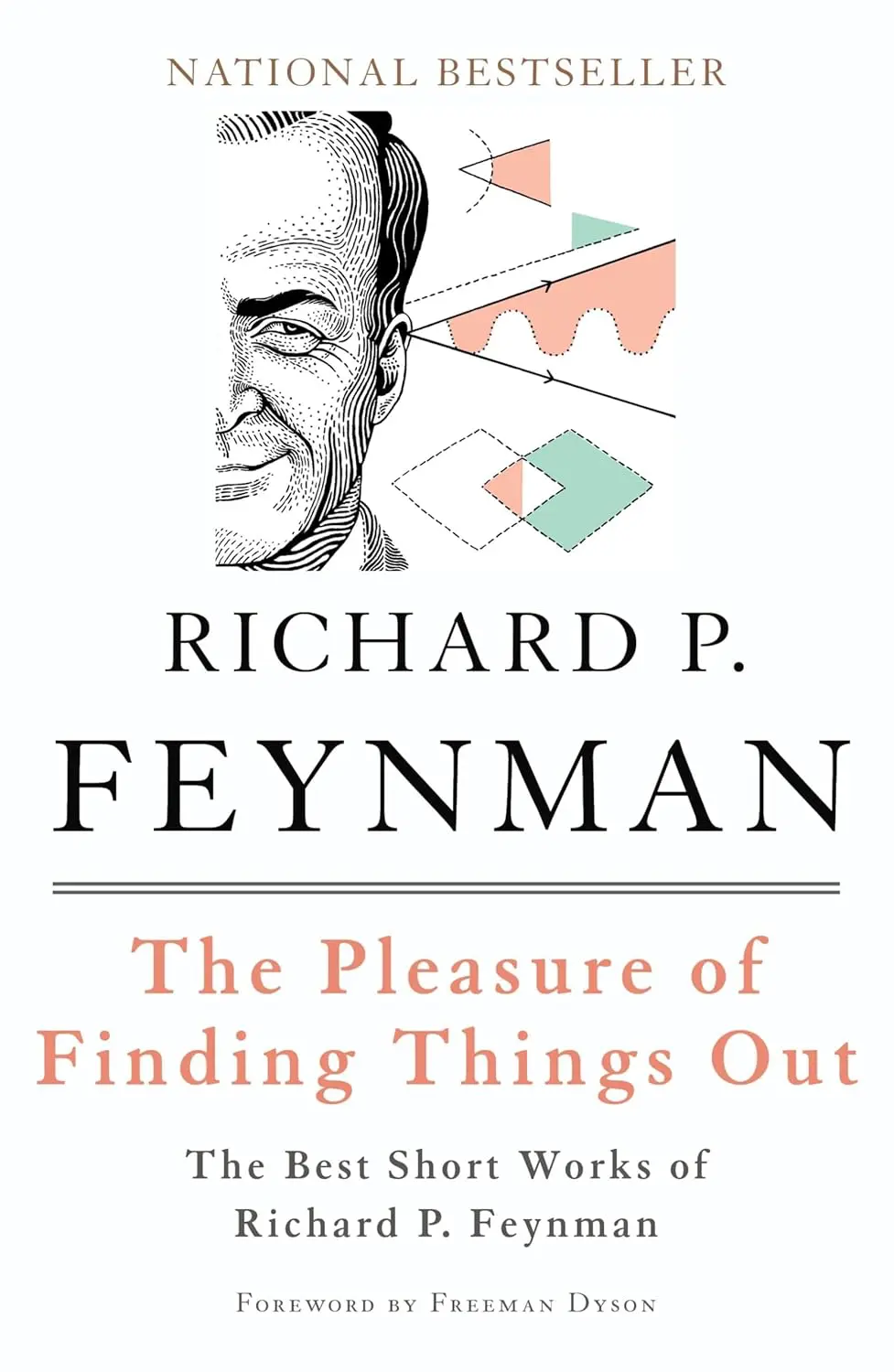
Richard Feynman won the Nobel Prize in Physics for his work on quantum electrodynamics. He also picked locks at Los Alamos during the Manhattan Project to prove that security was inadequate. He played bongo drums in a samba band. He painted nude models under a pseudonym. He testified before Congress about the Challenger disaster by dropping an O-ring into a glass of ice water to show it lost its flexibility in cold temperatures. He was, by most accounts, the most entertaining physicist who ever lived.
The Pleasure of Finding Things Out collects his best short-form work: interviews, lectures, commencement addresses, and articles spanning decades. The title piece, originally a BBC interview, captures Feynman’s approach to science as pure curiosity. He describes the joy of figuring out how things work, not for prizes or publications but because not knowing is unbearable and knowing is wonderful.
The collection includes his famous 1974 Caltech commencement address on cargo cult science, in which he describes how South Pacific islanders built imitation airstrips after World War II, hoping to attract the planes that had brought supplies. Feynman uses this as a metaphor for science that follows the forms of rigorous research without the substance. The speech is funny and devastating, and its point, that fooling yourself is the easiest thing in the world and the first thing a scientist must guard against, has only become more relevant.
Other pieces cover his experience on the Challenger investigation, his thoughts on the relationship between science and religion (he was not hostile to religion but found it unnecessary), his views on education (he was appalled by how science was taught in Brazilian schools, where students memorized definitions without understanding them), and his reflections on the Manhattan Project and the moral weight of having helped build the atomic bomb.
Feynman died in 1988 at age sixty-nine. He was a complicated figure. His treatment of women, described in his own earlier memoirs with casual sexism that would not pass today, has been fairly criticized. His scientific genius is not in dispute, nor is his gift for communication. He could explain quantum mechanics to a room full of non-physicists and make them feel like they understood it, which is a different kind of genius from the kind that does the physics.
The collection is edited by Jeffrey Robbins and includes a foreword by Freeman Dyson. It works as both an introduction to Feynman for people who have not read his longer memoirs (Surely You’re Joking, Mr. Feynman and What Do You Care What Other People Think?) and as a complement to them.
