
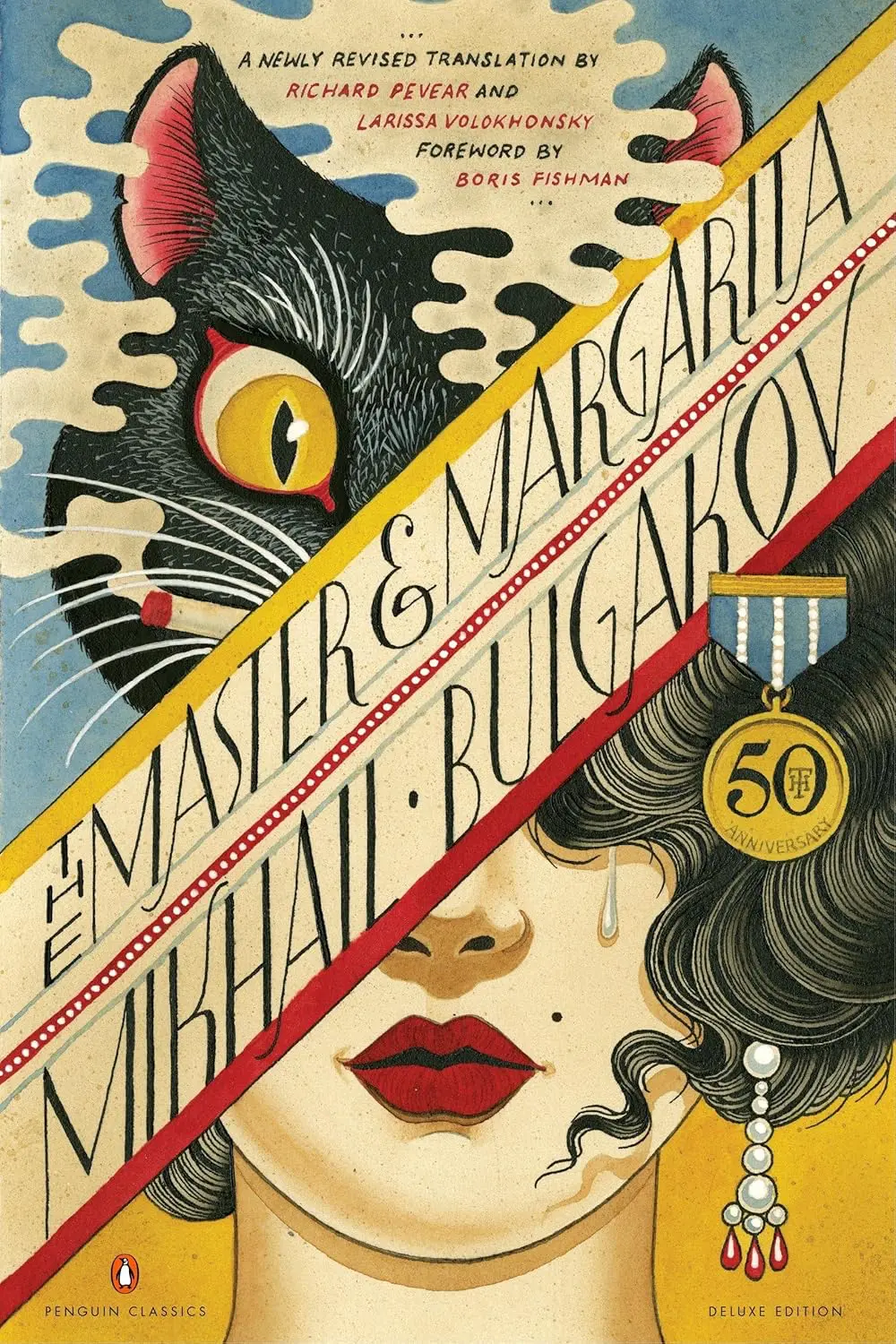
The Master and Margarita is Mikhail Bulgakov’s novel about the Devil arriving in Moscow in the 1930s, accompanied by a retinue that includes a giant talking cat, a fanged assassin, and a naked witch. The Devil, who calls himself Woland, proceeds to wreak havoc on the city’s literary establishment, its bureaucracy, and its smug certainties, exposing greed, cowardice, and dishonesty wherever he goes. The satire is aimed at Soviet society under Stalin, though the novel was written in secret and not published until 1966, decades after Bulgakov’s death.
Intercut with the Moscow chapters are chapters set in ancient Jerusalem, retelling the story of Pontius Pilate’s interrogation of Yeshua Ha-Notsri (Jesus). These chapters, which are presented as a novel written by “the Master,” a broken writer confined to a psychiatric hospital, are written in a completely different register: solemn, spare, and concerned with questions of truth, power, and moral cowardice. Pilate knows Yeshua is innocent but sentences him anyway because he fears the consequences of doing the right thing.
The third thread is the love story. Margarita, the Master’s devoted companion, makes a deal with the Devil to rescue the Master from the hospital and to retrieve his destroyed manuscript. Her willingness to sacrifice everything for the person she loves gives the novel its emotional center and provides the resolution that ties all three threads together.
The novel operates on multiple levels simultaneously. It’s a comedy (the Moscow scenes are genuinely funny, full of absurd situations and sharp satirical observations). It’s a philosophical exploration of good, evil, and the nature of truth. And it’s a story about art, love, and the courage required to create honest work in a system designed to suppress it.
For founders, the book is not relevant in any direct business sense. It’s relevant because it’s one of the great novels of the 20th century, and reading great literature is one of the best ways to develop the empathy, moral imagination, and tolerance for ambiguity that leadership requires. Bulgakov wrote it knowing it might never be published and that possessing it could be dangerous. That kind of commitment to honest work, regardless of consequences, is worth sitting with.
The translation matters significantly. The Pevear and Volokhonsky translation is the most widely recommended for contemporary readers. The novel rewards rereading; the layers of meaning become clearer with each pass.
