
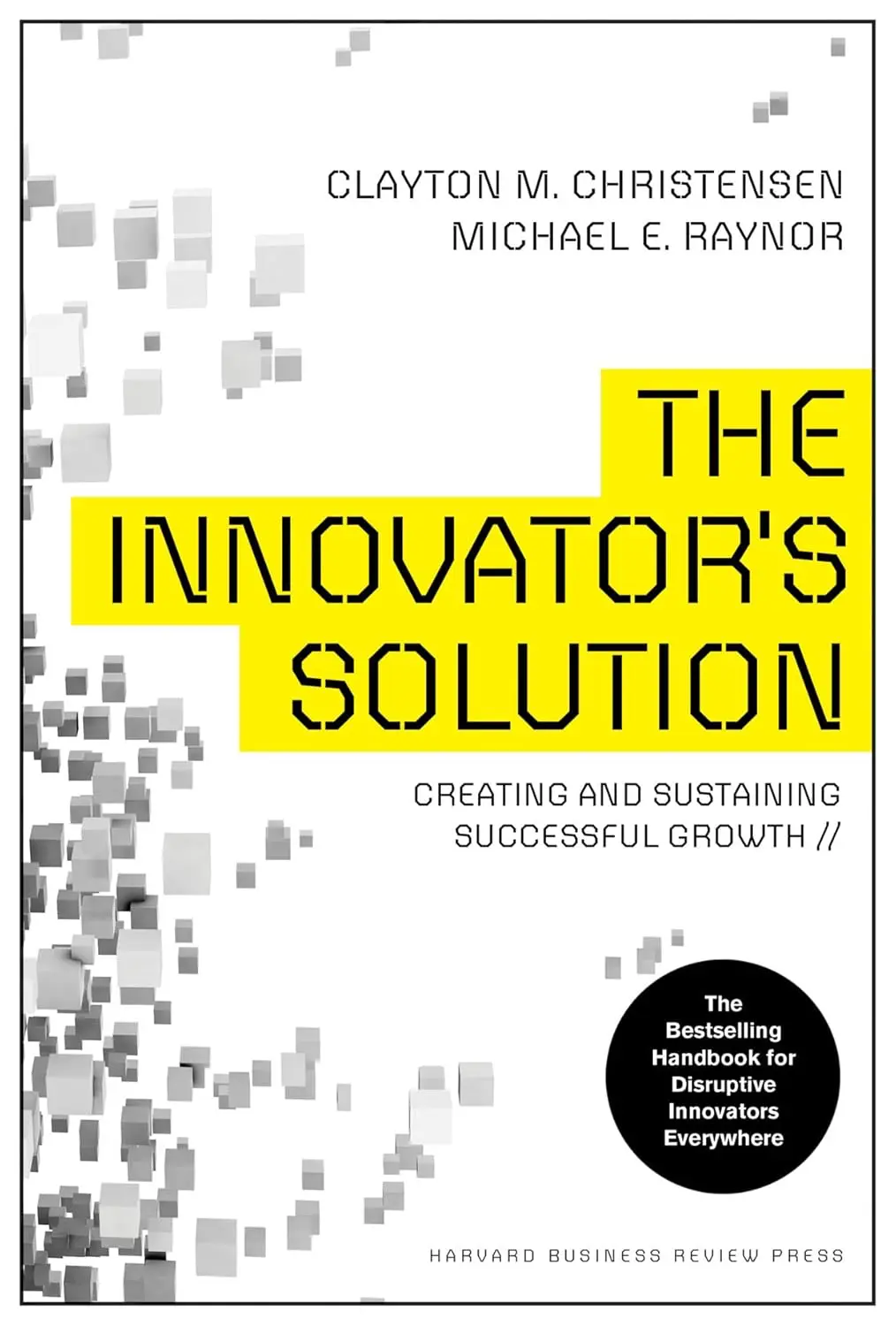
Where The Innovator’s Dilemma explained why established companies fail when disruptive technologies appear, The Innovator’s Solution tells managers what to do about it. Christensen and Raynor provide frameworks for both the disruptor (how to build a disruptive business) and the incumbent (how to respond to disruption without destroying your core business).
The book introduces several new concepts. “Jobs to be done” (which Christensen later expanded into Competing Against Luck) first appears here as a framework for identifying market opportunities. Instead of segmenting markets by demographics, segment them by the job customers are trying to get done. “Good enough” products that are cheaper, simpler, or more accessible can disrupt markets where the existing products overshoot most customers’ needs.
Christensen also covers organizational strategy. New disruptive businesses need different metrics, different timelines, and different organizational structures than the core business. Companies that try to incubate disruptive innovations inside their existing P&L structure inevitably kill them because the new business looks small and unprofitable compared to the core. The solution is to create separate teams with their own resources and success metrics.
The book is more prescriptive and more academic than The Innovator’s Dilemma. Christensen uses theory-building language (hypotheses, anomalies, causal mechanisms) that can feel dry compared to the case-study-driven first book. But the frameworks are useful for founders deciding where to compete and how to structure their approach.
For founders, the most actionable ideas are about targeting “nonconsumption” (people who are not using any solution because existing options are too expensive or too complex) and about building products that are “good enough” for an underserved segment rather than competing head-to-head with established players.
Marc Andreessen has cited Christensen’s work extensively. At about 300 pages, the book is manageable. It reads best after The Innovator’s Dilemma because it assumes familiarity with the disruption framework. Together, the two books provide a complete theory of how industries change and what to do about it.
