
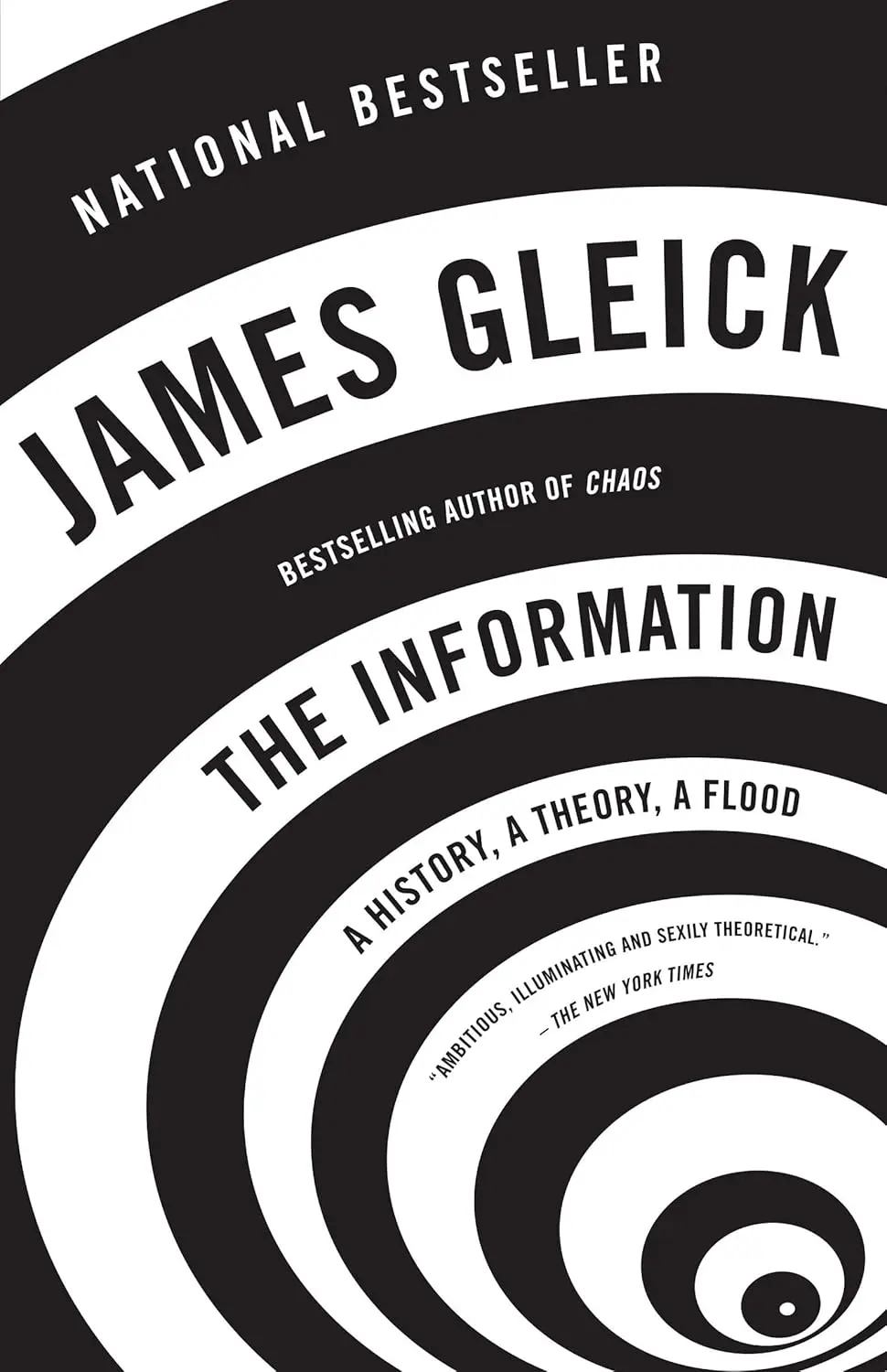
The Information is James Gleick’s attempt to tell the story of information itself, from its earliest forms to its current flood. The book spans centuries and disciplines, connecting African drum languages, Charles Babbage’s mechanical computers, Ada Lovelace’s theoretical insights, the telegraph, the telephone, Alan Turing’s work, Claude Shannon’s information theory, and the DNA code into a single narrative about how humans have learned to encode, transmit, and process meaning.
The Claude Shannon sections are the book’s intellectual center. Shannon, working at Bell Labs in the 1940s, essentially invented the field of information theory by figuring out how to measure information mathematically. His insight that information could be reduced to binary digits (bits) and that the capacity of any channel could be precisely calculated was the foundation for everything from data compression to error correction to the internet.
Gleick is skilled at making abstract concepts tangible. He explains entropy, redundancy, and noise in ways that make the underlying math accessible without dumbing it down. The historical sections on the telegraph and the early days of long-distance communication are some of the most engaging, showing how the challenge of sending messages across distances forced people to think carefully about what information actually is.
For founders and tech-oriented readers, the book offers something unusual: perspective on the thing your industry is built on. Most people who work with information daily, whether in software, media, or communications, have a working understanding of bits and bandwidth but very little knowledge of the intellectual history behind those concepts. Gleick fills that gap.
The book is long and occasionally dense, especially in the later chapters on genetics and quantum information. Some readers find these sections less compelling than the historical narrative. But the core of the book, from talking drums to Shannon, is one of the better popular science narratives available about a subject that most of us take for granted.
