
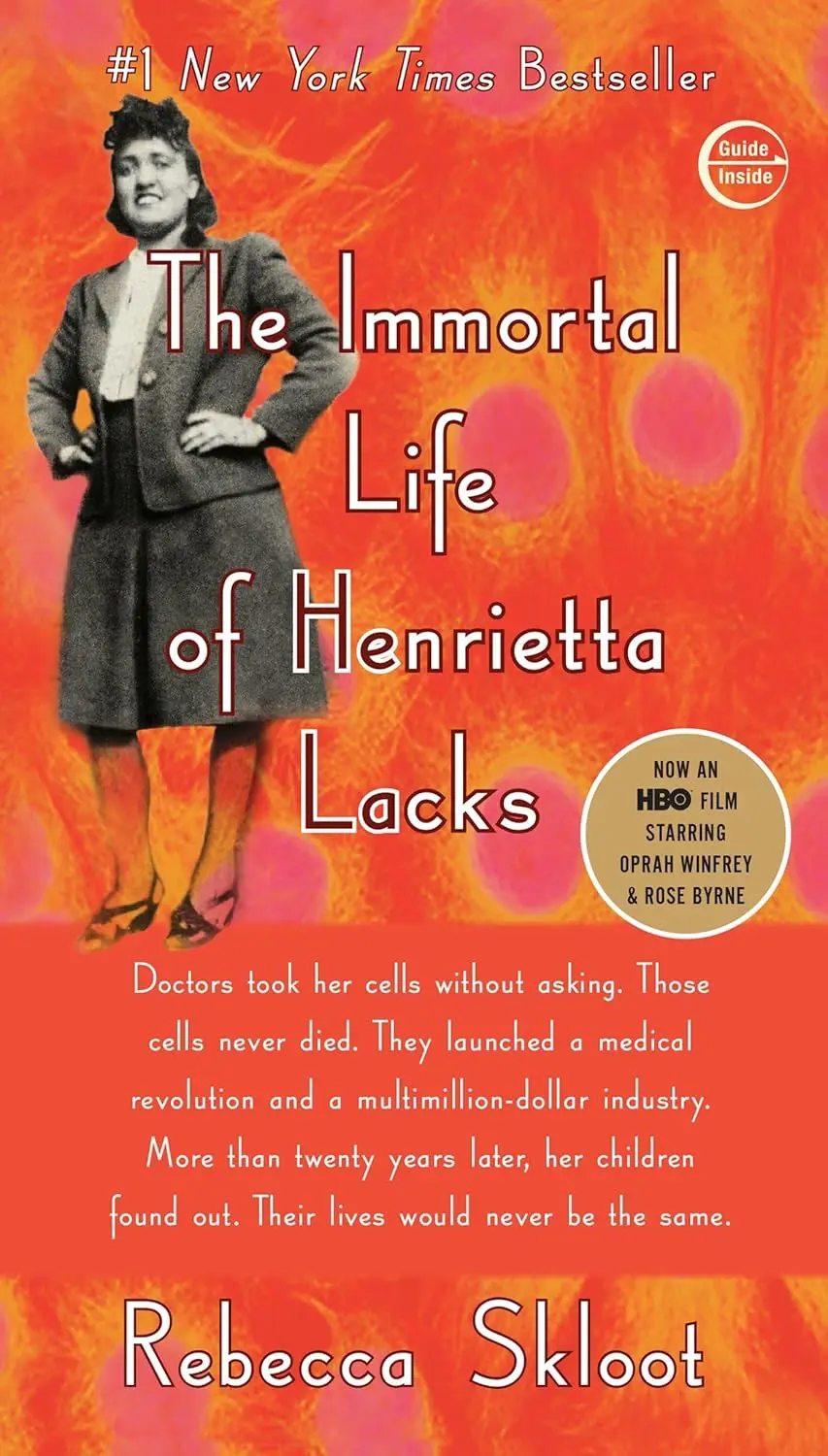
In 1951, Henrietta Lacks was treated for cervical cancer at Johns Hopkins Hospital. A sample of her tumor cells was taken without her consent (which was standard practice at the time) and sent to a researcher. Unlike every other cell sample that had been collected, Lacks’s cells did not die. They kept dividing, indefinitely. They became the HeLa cell line, which has been used in research that led to the polio vaccine, advances in cancer treatment, in vitro fertilization, and thousands of other medical breakthroughs.
Lacks died of her cancer in 1951 at age 31. Her family did not know her cells had been taken or that they were being used in research worldwide. When they eventually learned about HeLa cells decades later, they could not afford health insurance while corporations were selling vials of Henrietta’s cells for profit.
Skloot spent over a decade researching the book, building a relationship with the Lacks family (particularly Henrietta’s daughter Deborah) while tracing the scientific and commercial history of HeLa cells. The result is a book that operates on three levels: the science of cell biology, the story of a family dealing with an extraordinary situation, and the ethics of medical research conducted on vulnerable populations.
The writing is careful and empathetic. Skloot does not villainize the researchers who used HeLa cells (many did not know the full story) or sentimentalize the Lacks family (who are presented as complex, flawed people rather than symbols). She lets the contradictions stand: the cells that have saved millions of lives were taken from a woman who never consented, and her family received nothing.
For business readers, the book raises questions about consent, ownership, and the gap between value creation and value capture that are relevant far beyond medicine. Who owns data that was collected without explicit consent? Who profits when a resource taken from one person generates value for millions?
Bill Gates and Anne Wojcicki have recommended it. At about 380 pages, the book reads like a novel. Skloot’s reporting is thorough and her narrative skill keeps the science, history, and family story woven together without losing any of them.
