
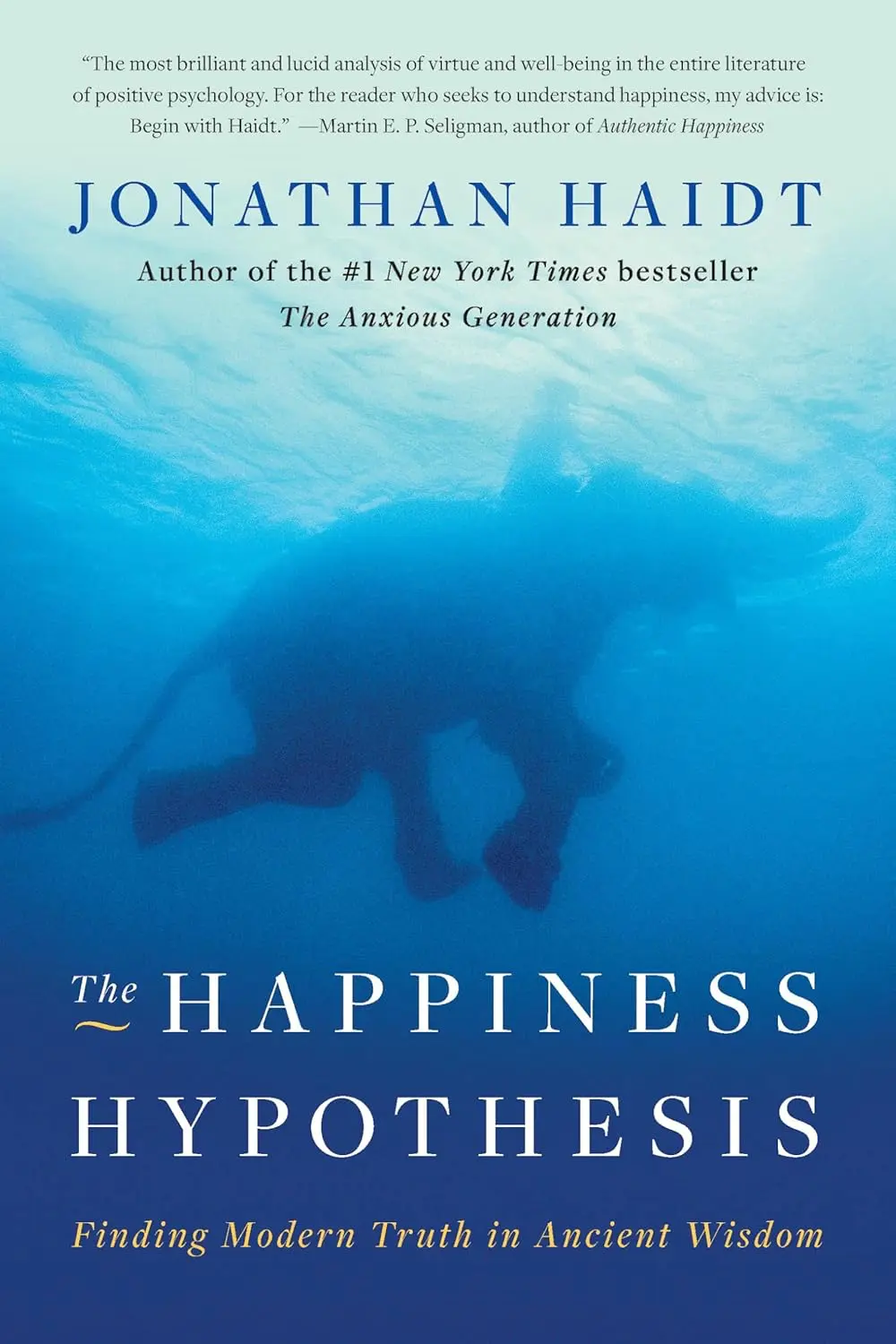
The Happiness Hypothesis is Jonathan Haidt’s experiment in testing ancient wisdom against modern science. Haidt, a social psychologist who would later write The Righteous Mind, takes ten ideas about happiness from ancient philosophy (Buddhist, Stoic, Christian, Confucian, and others) and examines what contemporary psychology has to say about each one.
The most famous metaphor in the book is the elephant and the rider. Haidt describes the mind as a rider (conscious, rational thought) sitting on an elephant (automatic, emotional processes). The rider can steer to some degree, but the elephant is far more powerful, and when they disagree, the elephant usually wins. This explains why knowing what you should do (eat less, exercise more, be patient) doesn’t automatically translate into doing it. The rider can plan, but the elephant moves based on habit, emotion, and instinct.
The chapters on happiness research are the book’s most practically useful. Haidt reviews the evidence on what actually contributes to long-term happiness. Strong relationships are the single biggest factor. Having meaningful work (what Haidt calls “deep engagement”) matters more than income beyond a modest threshold. Conditions you can control (like your social connections and your commute) matter more than conditions you’d expect to matter (like climate or physical attractiveness). And the hedonic treadmill, which causes people to return to a baseline level of happiness regardless of positive or negative life events, is real but not absolute: some things (chronic noise, long commutes, caregiving for a severely ill person) reduce happiness permanently.
For founders, the book provides a science-based framework for thinking about well-being during the stressful process of building a company. The finding that relationships matter more than income is relevant for anyone who is sacrificing social connections in pursuit of business goals. The elephant-and-rider model is useful for understanding why changing your own behavior (or your team’s behavior) is so difficult even when everyone agrees on what should change.
The writing is excellent. Haidt is one of the best communicators in psychology, and the book balances research, philosophy, and personal reflection without becoming dry or preachy. It was published in 2006 and some of the specific studies cited have been challenged by the replication crisis, but the broad conclusions have held up well.
