
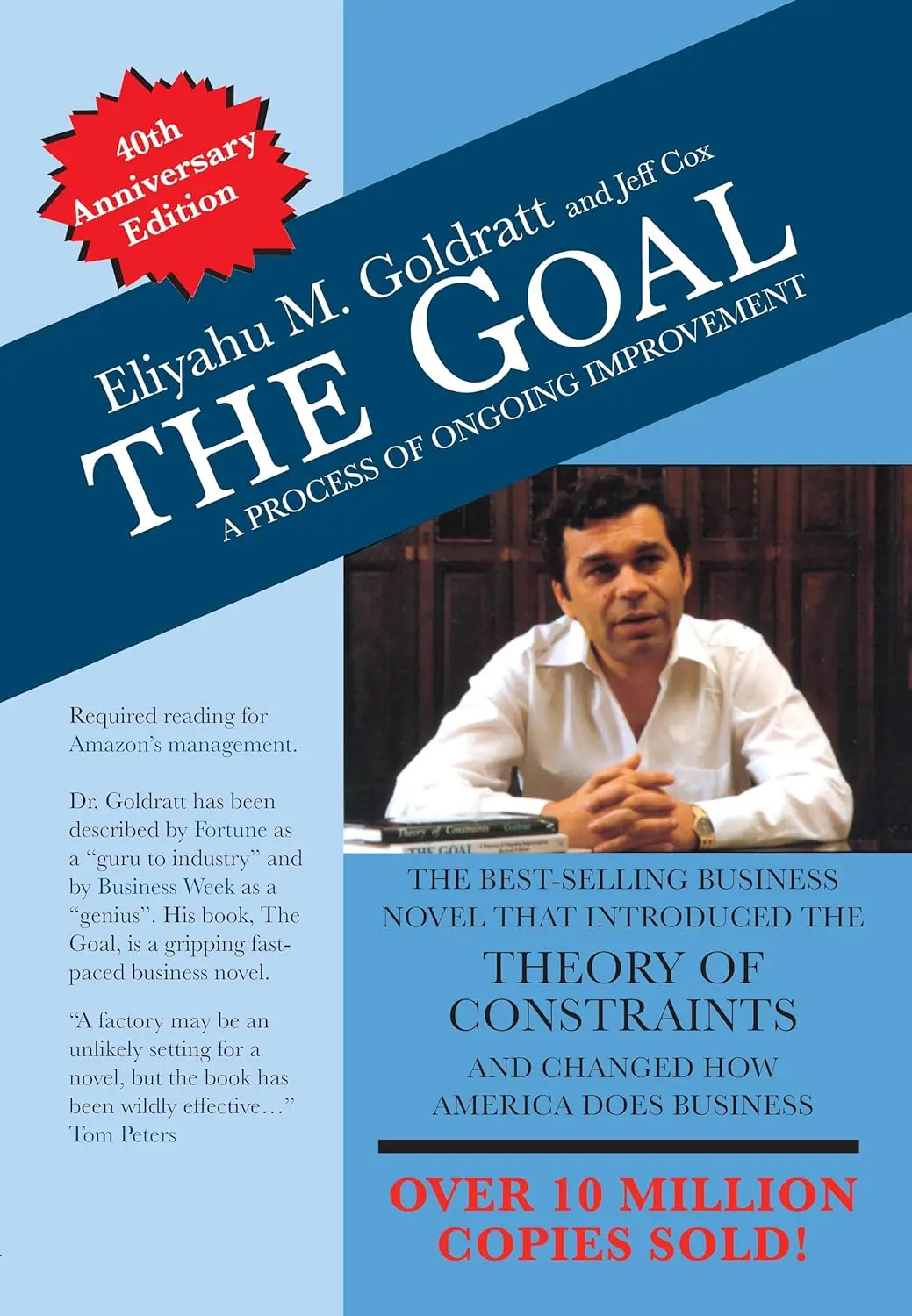
The Goal is unusual in business literature because it is a novel. Alex Rogo is a plant manager whose factory is losing money, whose shipments are late, and whose boss has given him three months to turn things around or the plant closes. His marriage is also falling apart, partly because he is never home.
Rogo encounters his old physics professor, Jonah, who asks him a series of Socratic questions that gradually reveal the Theory of Constraints. The theory’s core insight is that every system has a single constraint (bottleneck) that limits total output. Improving efficiency anywhere other than the bottleneck does not improve the system; it just creates inventory pileups. Only by identifying and addressing the bottleneck can you increase throughput.
Jonah guides Rogo through the five focusing steps: identify the constraint, decide how to exploit the constraint (get the most out of it), subordinate everything else to the constraint (align all other processes to support it), elevate the constraint (invest in removing it), and repeat (because once you fix one bottleneck, a new one appears).
The novel format works because it makes the theory concrete. You watch Rogo apply each concept to specific problems in his factory: machines that run at full capacity but produce parts nobody needs yet, quality checks that happen in the wrong place, batch sizes that are too large. Each insight clicks as you read it.
For founders, the Theory of Constraints applies far beyond manufacturing. In a startup, the bottleneck might be lead generation, engineering capacity, onboarding speed, or the founder’s own time. The discipline of asking “what is the one thing that, if improved, would improve everything else?” is one of the most useful questions in business.
Jeff Bezos, Tobi Lutke, and Tim Cook have recommended this book. At about 360 pages, it reads like a thriller with an education embedded in it. The ideas have been applied in software development (where they influenced agile methodologies), healthcare, and project management. Goldratt wrote several sequels, but the original remains the clearest statement of the theory.
