
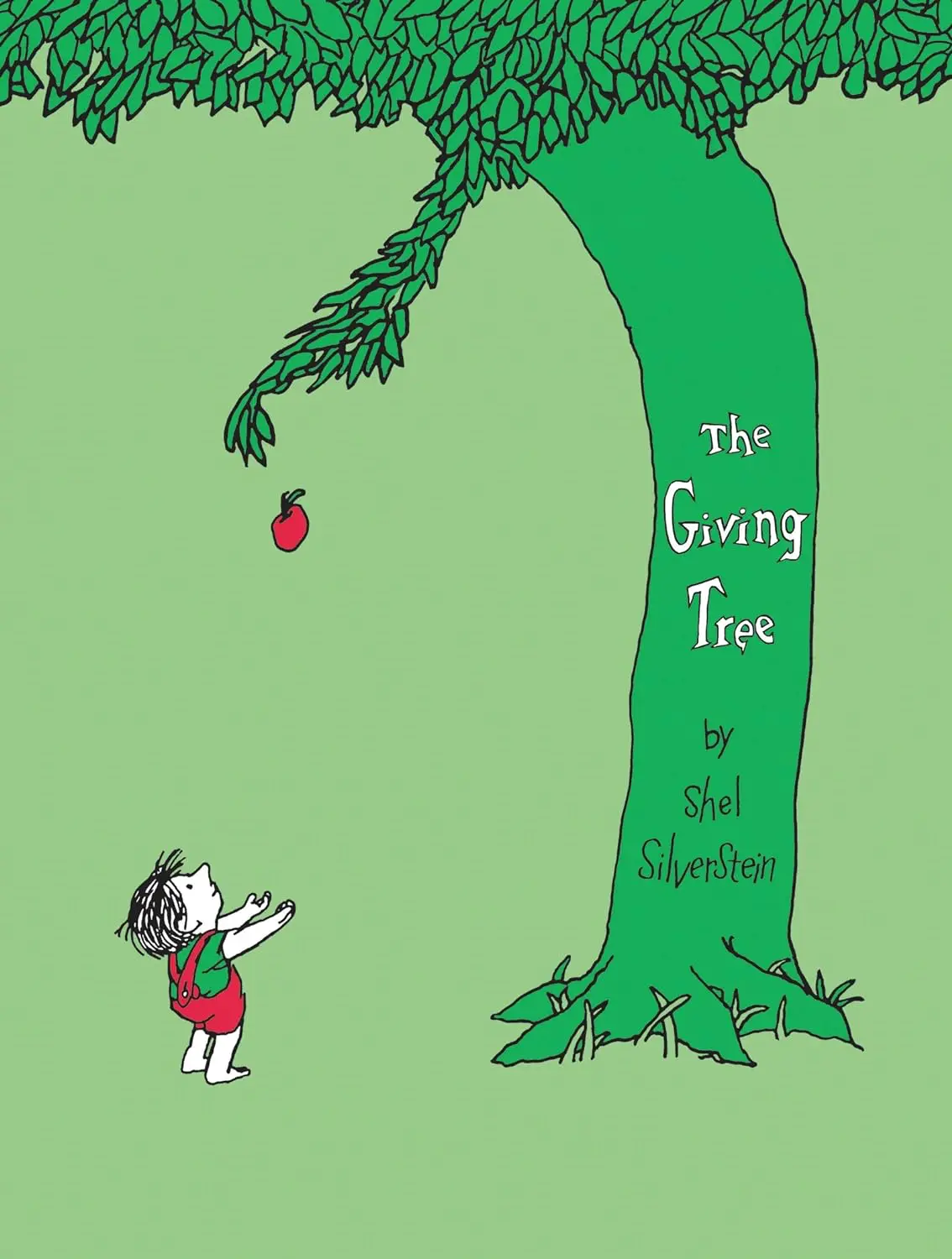
A tree loves a boy. The boy climbs her trunk, swings from her branches, eats her apples, and rests in her shade. She is happy. As the boy grows older, he comes to the tree less often and asks for more. He wants money, so she gives him her apples to sell. He wants a house, so she gives him her branches to build with. He wants a boat, so she gives him her trunk. In the end, she is nothing but a stump. The boy, now an old man, comes back one last time. He needs nothing now except a quiet place to sit. The stump can offer that. She is happy.
The book takes about five minutes to read. It has occupied readers for sixty years.
The debate is the point. Is the tree a model of selfless love, giving everything without resentment or expectation? Or is the tree an enabler, teaching children that love means sacrificing yourself completely for someone who never gives anything back? Is the boy a normal human being who grows up and moves on from childhood attachments? Or is he a parasite who strips the tree bare and returns only when he has nowhere else to go?
Silverstein never answered the question. He said the book was about a relationship between two people, and that the reader could decide what kind of relationship it was. This refusal to interpret his own work is probably why the book has lasted. It functions as a Rorschach test. Parents who read it to their children often find themselves reading it differently at thirty-five than they did at twenty-five, and differently again at fifty.
The illustrations are spare: black ink on white paper, with no color. The tree has a face in some panels, expressive and sad. The boy has no distinguishing features. The simplicity of the images matches the simplicity of the prose, which uses short sentences and plain words throughout.
The Giving Tree has sold over ten million copies and been translated into more than thirty languages. It is one of the bestselling children’s books in history, though whether it is actually a children’s book is another question the text does not answer. Silverstein, who also wrote Where the Sidewalk Ends and A Light in the Attic, died in 1999. He was a poet, cartoonist, songwriter, and screenwriter who resisted being categorized as a children’s author.
Five minutes to read. A lifetime to argue about.
