
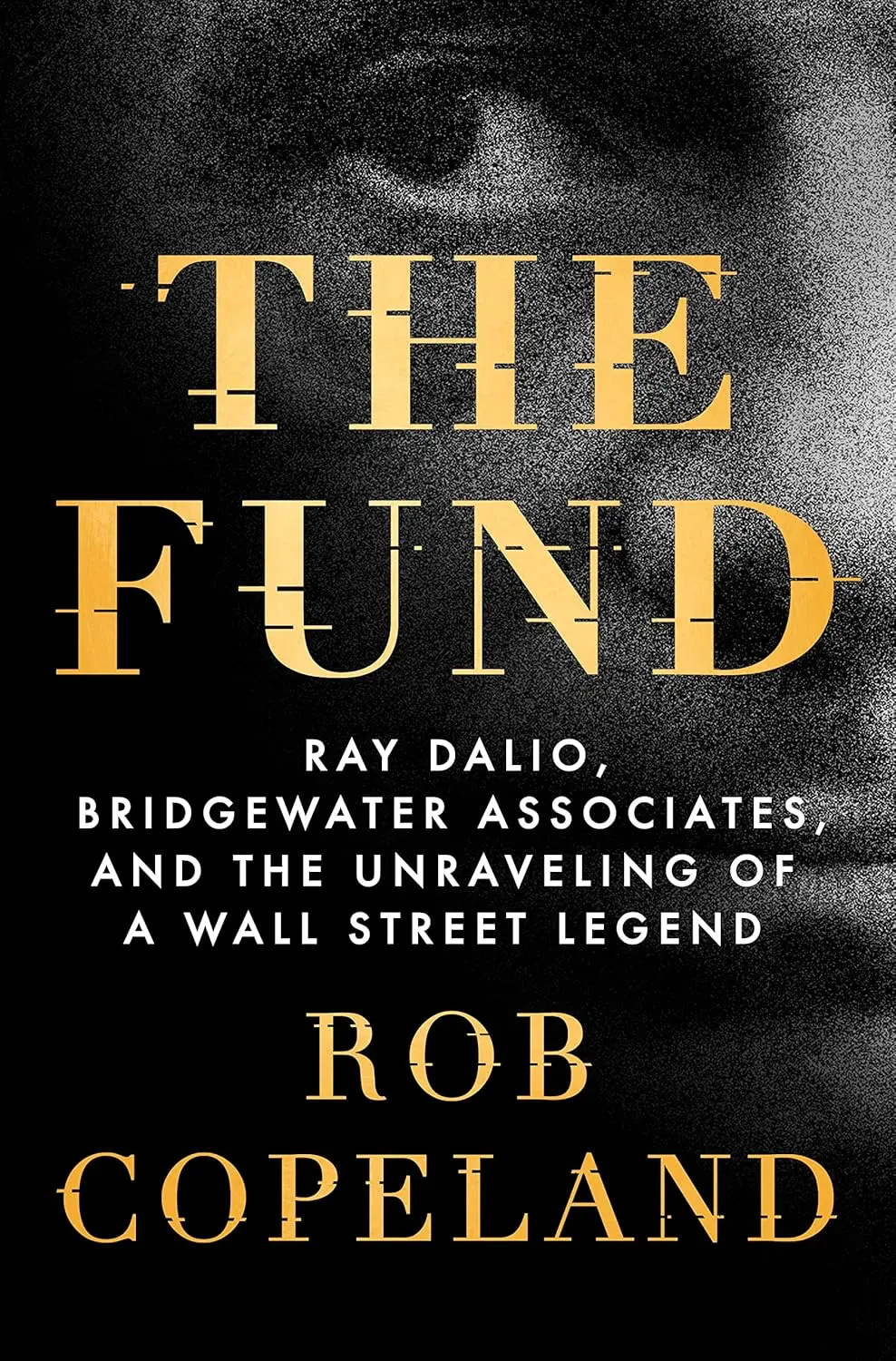
The Fund is Rob Copeland’s reported account of life inside Bridgewater Associates, the world’s largest hedge fund, and a challenge to the public persona of its founder, Ray Dalio. While Dalio presented himself in his bestselling book Principles as a thoughtful leader who built a culture of “radical transparency” and “idea meritocracy,” Copeland’s reporting paints a different picture: a workplace driven by surveillance, personal loyalty tests, and a culture where challenging the founder was far more dangerous than Principles suggested.
Copeland, a Wall Street Journal reporter, spent years interviewing current and former Bridgewater employees. The stories they tell describe a company where every meeting was recorded, where employees were rated on hundreds of personality and performance metrics, and where “radical transparency” often meant public humiliation. Employees who disagreed with Dalio didn’t get a meritocratic debate; they got a system designed to prove them wrong. The “dot collector” tool, which Dalio promoted as a way to crowdsource honest feedback, is described by insiders as a mechanism for enforcing conformity.
The book also covers Bridgewater’s investment performance and questions whether its returns justified the mythology. Copeland presents evidence that Bridgewater’s flagship fund performed well in certain periods but inconsistently over time, and that the firm’s main advantage was its ability to attract and retain assets through Dalio’s reputation rather than through consistently superior returns.
For founders who have read Principles and found it compelling, The Fund is a necessary counterweight. It raises the question of how much any leader’s public philosophy matches their actual behavior, and how “transparency” and “meritocracy” can be co-opted into tools of control when there’s a large power imbalance between the person defining those terms and the people living under them.
The writing is well-paced and the reporting is detailed. Copeland lets the anecdotes and insider accounts carry the argument rather than inserting his own conclusions, which makes the book persuasive. Dalio disputed many of the book’s claims, and readers should consider both perspectives. But as a corrective to the uncritical reception of Principles, The Fund is valuable.
