
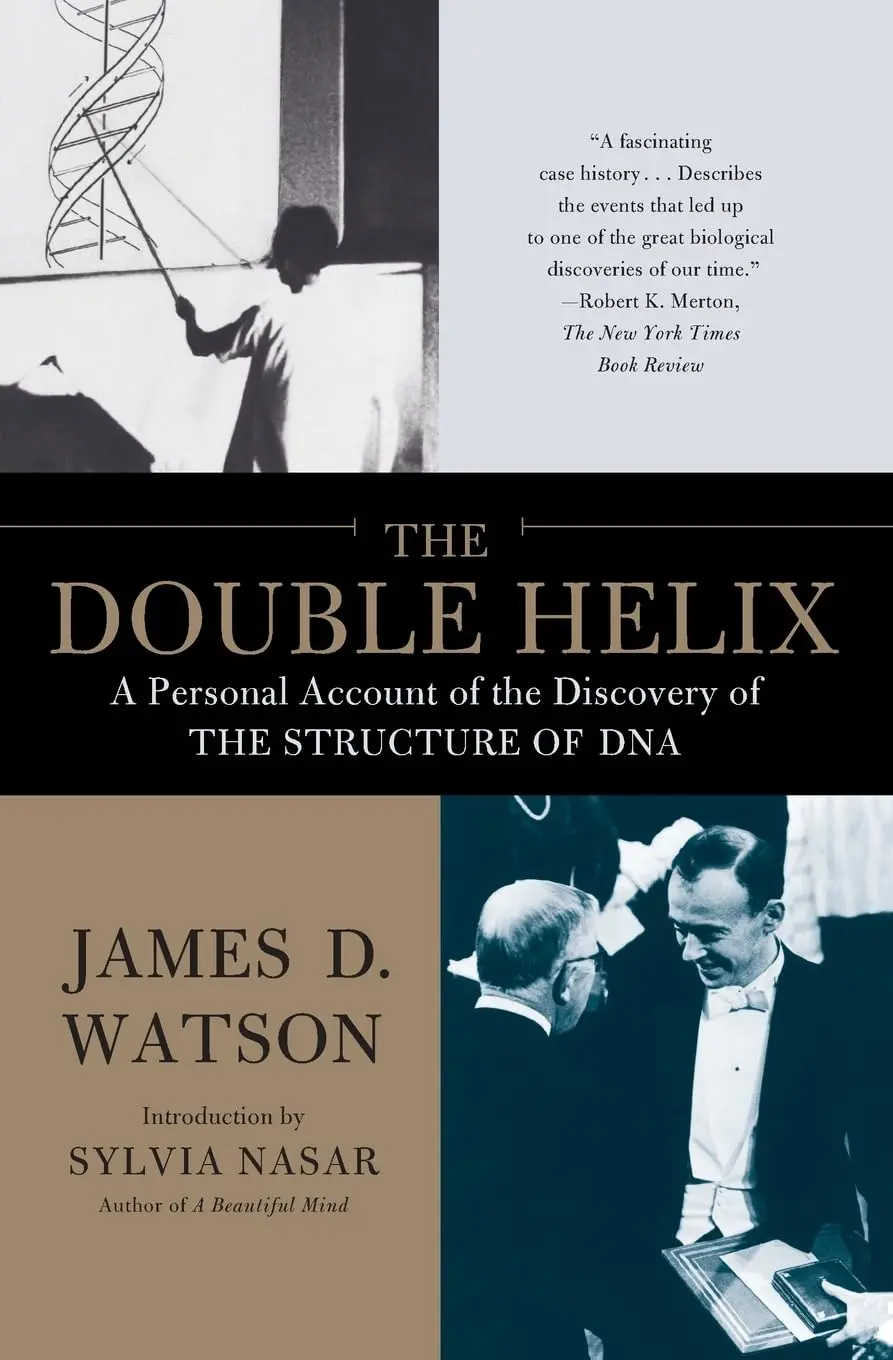
Watson wrote The Double Helix in 1968, fifteen years after the discovery, and it caused a scandal. Instead of writing a measured scientific history, he wrote a gossipy, competitive, self-aware account of two young men racing to solve the biggest puzzle in biology before anyone else did.
The story is a race. Watson and Crick, working at the Cavendish Laboratory in Cambridge, were competing against Linus Pauling at Caltech (who had already solved the structure of proteins) and Rosalind Franklin and Maurice Wilkins at King’s College London (who had the best X-ray crystallography data of DNA). Watson and Crick had almost no original data of their own. What they had was model-building skill, competitive drive, and access to Franklin’s data, which they obtained through Wilkins without her knowledge.
The treatment of Rosalind Franklin is the book’s most criticized element. Watson portrays her dismissively, focusing on her appearance and temperament rather than her scientific contributions. Franklin’s X-ray photograph (Photo 51) was the critical piece of evidence that confirmed the helical structure, and she was not credited fairly at the time. Watson added a somewhat apologetic epilogue in later editions, but the original text reveals the sexism of the era in ways that Watson may not have intended.
For all its flaws, the book is a remarkably honest account of how scientific discovery actually works. It is competitive, messy, political, and partly dependent on luck and timing. Watson and Crick were not necessarily the most qualified people to solve the problem. They were the ones who built the right model at the right time.
For founders, the parallel to startup competition is direct. The first team to assemble the right combination of insight, information, and execution wins, even if other teams have more resources or more expertise.
At about 230 pages, the book is short and fast. Watson writes with the impatience of someone who prefers action to reflection. The science is explained clearly enough for non-biologists. Anne Wojcicki has cited it as an influence.
