
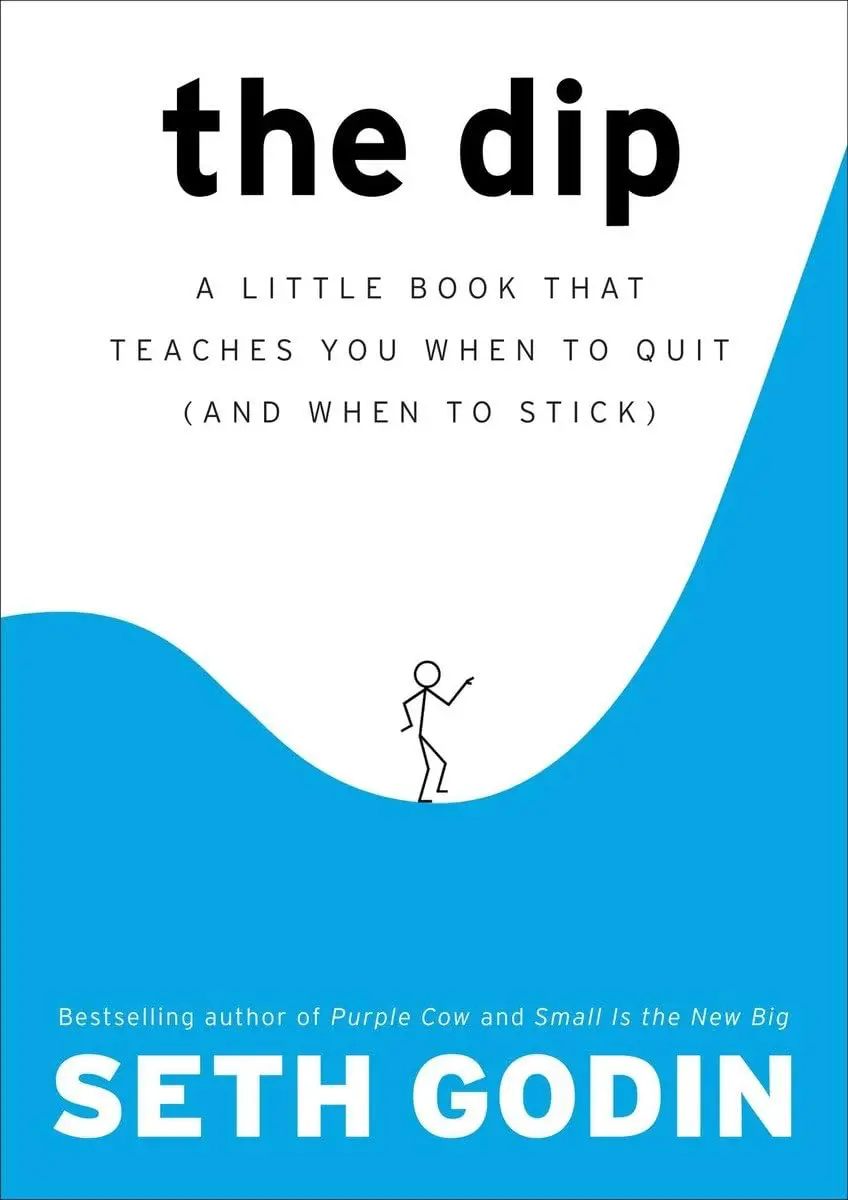
The Dip is Seth Godin’s argument about quitting. The conventional wisdom says winners never quit, but Godin points out that this is obviously wrong. Winners quit all the time. They just quit the right things. The skill that separates successful people from unsuccessful ones is not persistence in general but the ability to tell the difference between a dip and a dead end, and to act accordingly.
The dip is Godin’s name for the long, hard slog between starting something and being good at it. Every worthwhile pursuit has one. Learning to code has a dip. Building a business has a dip. Getting fit has a dip. The dip is where most people quit, which is exactly why pushing through it is so valuable: the people who make it through the dip face much less competition on the other side.
A dead end (which Godin calls a “cul-de-sac”) is different. It’s a situation where no amount of effort will produce a breakthrough. You’re stuck, and more work just means more stuckness. The ability to recognize a dead end and quit quickly is just as important as the ability to push through a dip. The tragedy is not quitting a dead end; it’s staying in one for years because you’ve confused persistence with strategy.
Godin also introduces the concept of the cliff: a situation where things seem to be going fine but you’re heading for a sudden, catastrophic drop. Smoking is his example: it feels fine for years and then it destroys you. Some business models work the same way.
For founders, the book is useful because the startup experience is almost entirely dips, dead ends, and cliffs, and the ability to tell them apart is worth more than any business framework. Is this product struggling because we haven’t found product-market fit yet (dip) or because the market doesn’t exist (dead end)? Is this marketing channel slow to build (dip) or fundamentally wrong for our audience (dead end)?
The book is tiny, under 80 pages, and reads in under an hour. The brevity is a strength: Godin makes his point and stops. Some readers wish for more depth, more examples, more nuance. But the core framework, dip versus dead end, is genuinely useful and easy to remember, which is more than most longer books achieve.
