
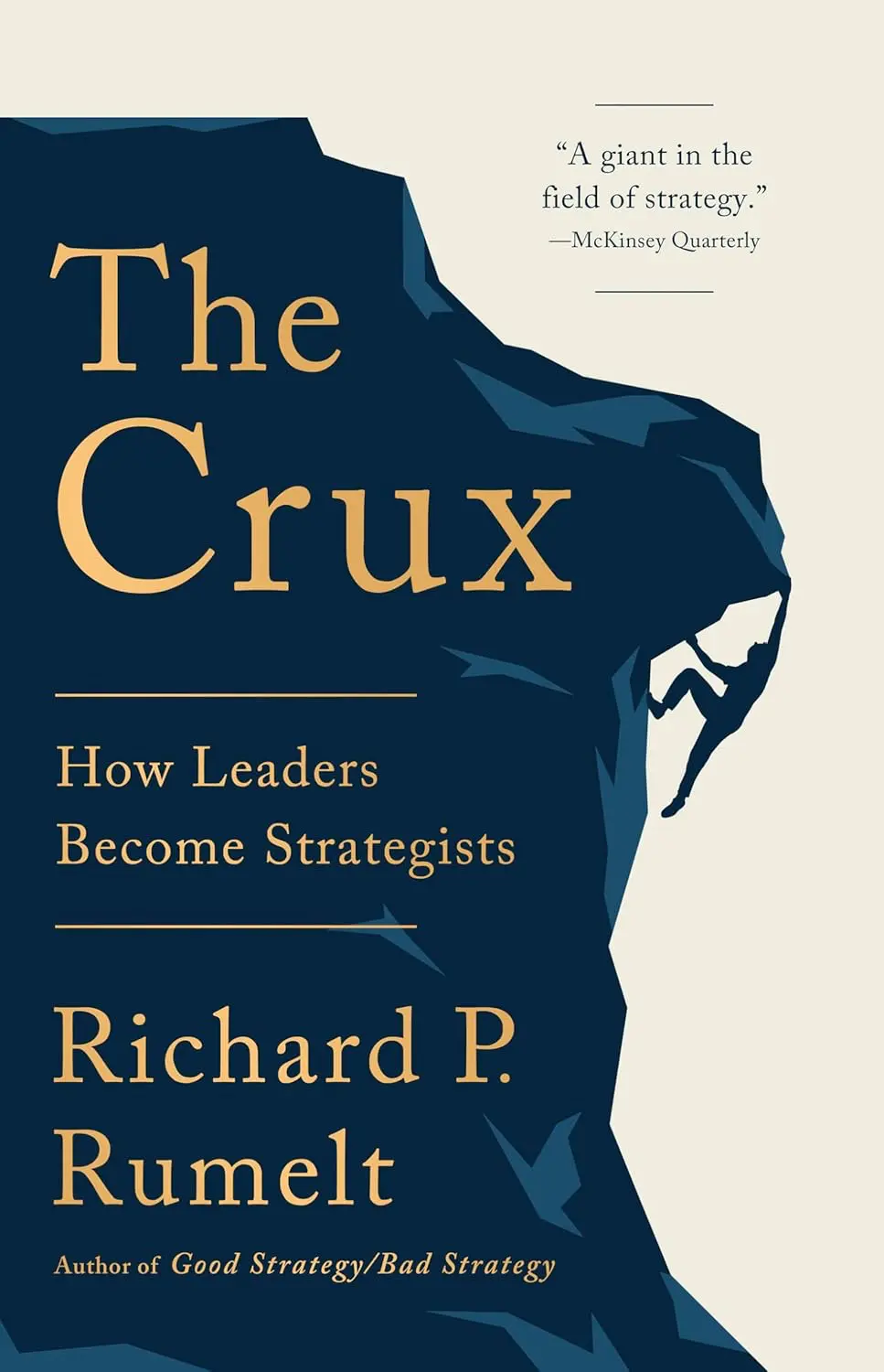
The Crux is Richard Rumelt’s follow-up to Good Strategy Bad Strategy, and it zeroes in on the single most important skill in strategic thinking: the ability to identify the crux. The crux is the one challenge that, if you address it successfully, makes everything else either easier or irrelevant. Most organizations fail at strategy not because they lack plans or frameworks but because they spread their effort across dozens of challenges instead of concentrating on the one that matters most.
Rumelt draws from a wide range of examples: military campaigns, business turnarounds, technology competitions, and scientific discoveries. In each case, he shows that the people who succeeded were the ones who correctly identified the crux of their situation, while those who failed were either working on the wrong problem or working on too many problems at once.
The diagnostic process Rumelt describes is specific. He teaches how to distinguish between symptoms and root causes, how to identify which challenges are genuinely addressable (versus which are just complaints about reality), and how to test whether you’ve found the crux by asking: “If we solved this one thing, would the rest of our problems become manageable?” If the answer is no, you haven’t found the crux yet.
The book also covers the cognitive biases that prevent leaders from seeing the crux clearly. Anchoring on the first problem identified rather than searching for the most important one. Confusing urgency with importance. Treating consensus as evidence that the group has identified the right problem, when often it just means everyone is anchored on the same wrong answer.
For founders, the crux concept is a powerful decision-making tool. At any given moment, your company faces dozens of problems. The natural response is to try to address all of them. Rumelt’s argument is that this is exactly wrong: you should identify the one problem that, if solved, creates the most forward progress, and put your best resources there. Everything else should wait or get minimal attention.
The writing is clear and precise, reflecting Rumelt’s background as both a strategy professor and a consultant. The book is less anecdote-heavy than Good Strategy Bad Strategy and more focused on the thinking process itself. Some readers will miss the storytelling; others will appreciate the increased density of ideas.
