
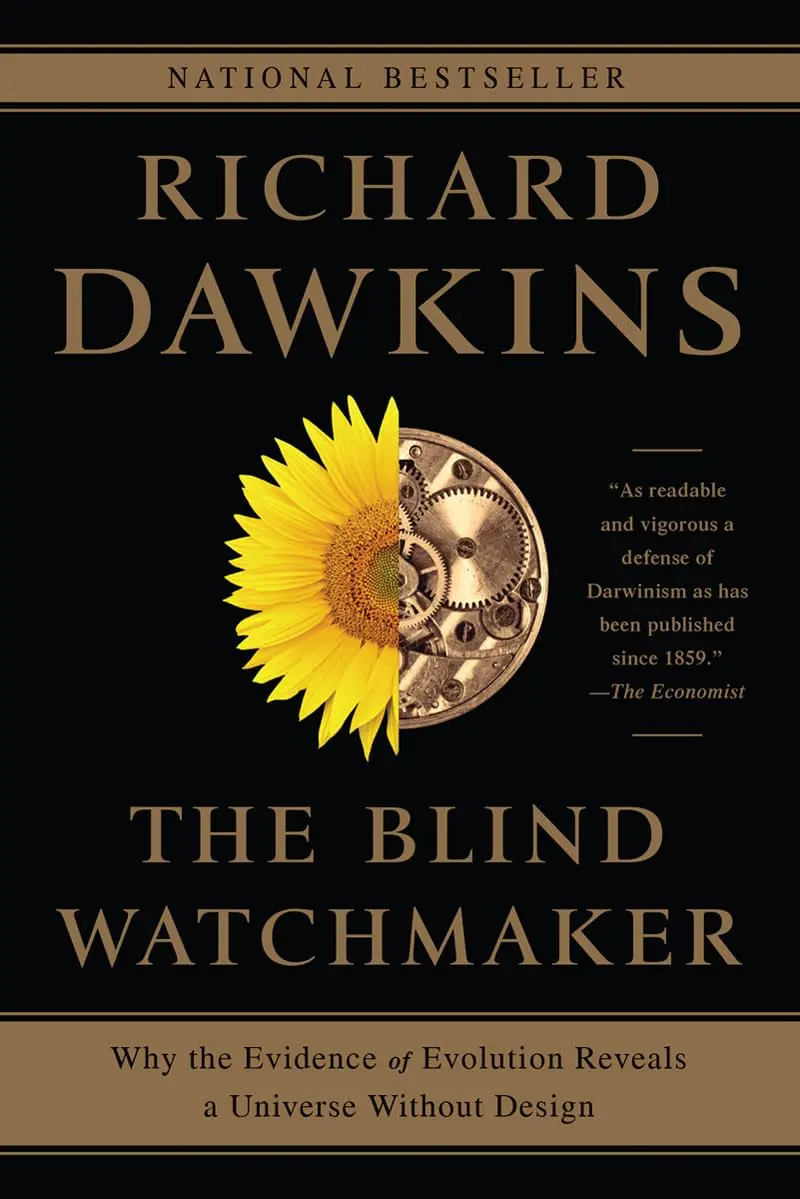
The Blind Watchmaker is Richard Dawkins’s extended argument that the appearance of design in nature is the result of natural selection, not intelligent design. The title refers to William Paley’s famous watchmaker analogy: just as finding a watch on a heath implies a watchmaker, finding complex biological structures implies a designer. Dawkins argues that the analogy is wrong because it overlooks the power of cumulative selection, which can build complexity gradually over millions of generations without any plan or intention.
The key distinction Dawkins makes is between single-step selection and cumulative selection. Single-step selection is like shaking a box of watch parts and hoping they land assembled. That really would be impossibly improbable. Cumulative selection is different: each generation inherits the successful variations of the previous generation and adds small new variations of its own. Over enough generations, this process can produce structures of staggering complexity, from eyes to immune systems to brains.
Dawkins illustrates cumulative selection with a computer program called “biomorphs,” where simple branching shapes are randomly varied and then “selected” by the user (or by a fitness function). Starting from a simple cross shape, the process produces insects, bats, trees, and other recognizable forms within a surprisingly small number of generations. The biomorph demonstration is one of the most effective pedagogical tools in popular science writing.
The later chapters address specific challenges to evolutionary theory: the evolution of the eye (which seems too complex to evolve gradually but actually follows a well-documented path), the evolution of echolocation in bats (a case study in how complex systems can be built from simple precursors), and the “Cambrian explosion” (a period of rapid diversification that critics sometimes cite as evidence against gradual evolution).
For founders, the book’s relevance is by analogy. Building a company is a process of cumulative selection: small experiments, feedback, retention of what works, and gradual improvement. Understanding how complexity emerges from simple iterative processes changes how you think about product development, strategy, and organizational growth.
The writing is clear and elegant. Dawkins is one of the best science communicators of the 20th century, and the book holds up well decades after its 1986 publication. It requires no biology background beyond high school level.
