
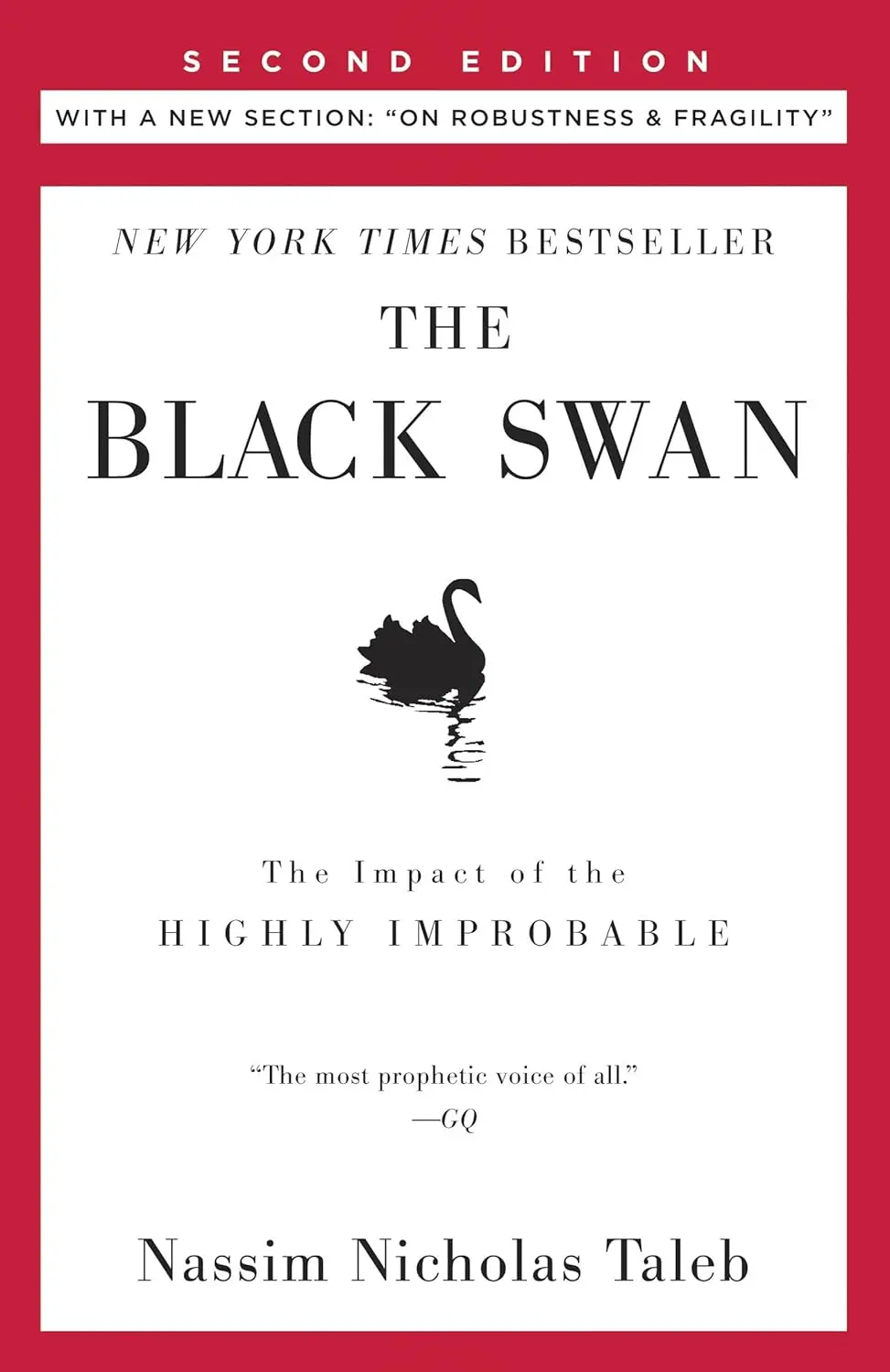
Before the discovery of Australia, Europeans assumed all swans were white. A single black swan observation destroyed that certainty. Taleb uses this metaphor to describe events that are rare, have extreme consequences, and are rationalized after the fact as if they were predictable.
The book’s central claim is that Black Swan events, things like the internet, 9/11, the 2008 financial crisis, and the success of Google, drive most of the important changes in the world. Yet our mental models, forecasting tools, and risk management systems are built to handle ordinary, predictable events. We plan for the average and get blindsided by the outlier.
Taleb explains several reasons for this blindness. The narrative fallacy causes people to construct stories after the fact that make Black Swans look predictable. The ludic fallacy makes people confuse real-world uncertainty with the well-defined uncertainty of games and models. Confirmation bias leads us to look for evidence that supports what we already believe while ignoring evidence that contradicts it.
The practical advice is not about trying to predict Black Swans (you cannot). It is about positioning yourself to benefit from positive ones and survive negative ones. Taleb advocates having “barbell” exposure: keeping most of your resources safe while making small bets with large potential upside. He argues against the middle-ground strategies that look reasonable in normal times but collapse during extreme events.
For founders, the book reframes risk. Startups are essentially bets on low-probability, high-impact outcomes. Understanding Taleb’s framework helps clarify why most startups fail while a few become enormous: the distribution of outcomes in entrepreneurship is a Black Swan distribution, not a bell curve.
The writing is dense, opinionated, and sprinkled with personal anecdotes from Taleb’s career as a Wall Street trader. He can be combative toward economists and forecasters, which some readers enjoy and others find grating. At around 400 pages, the book requires commitment. Daniel Kahneman, Ray Dalio, and Naval Ravikant have all cited it as influential in how they think about uncertainty.
