
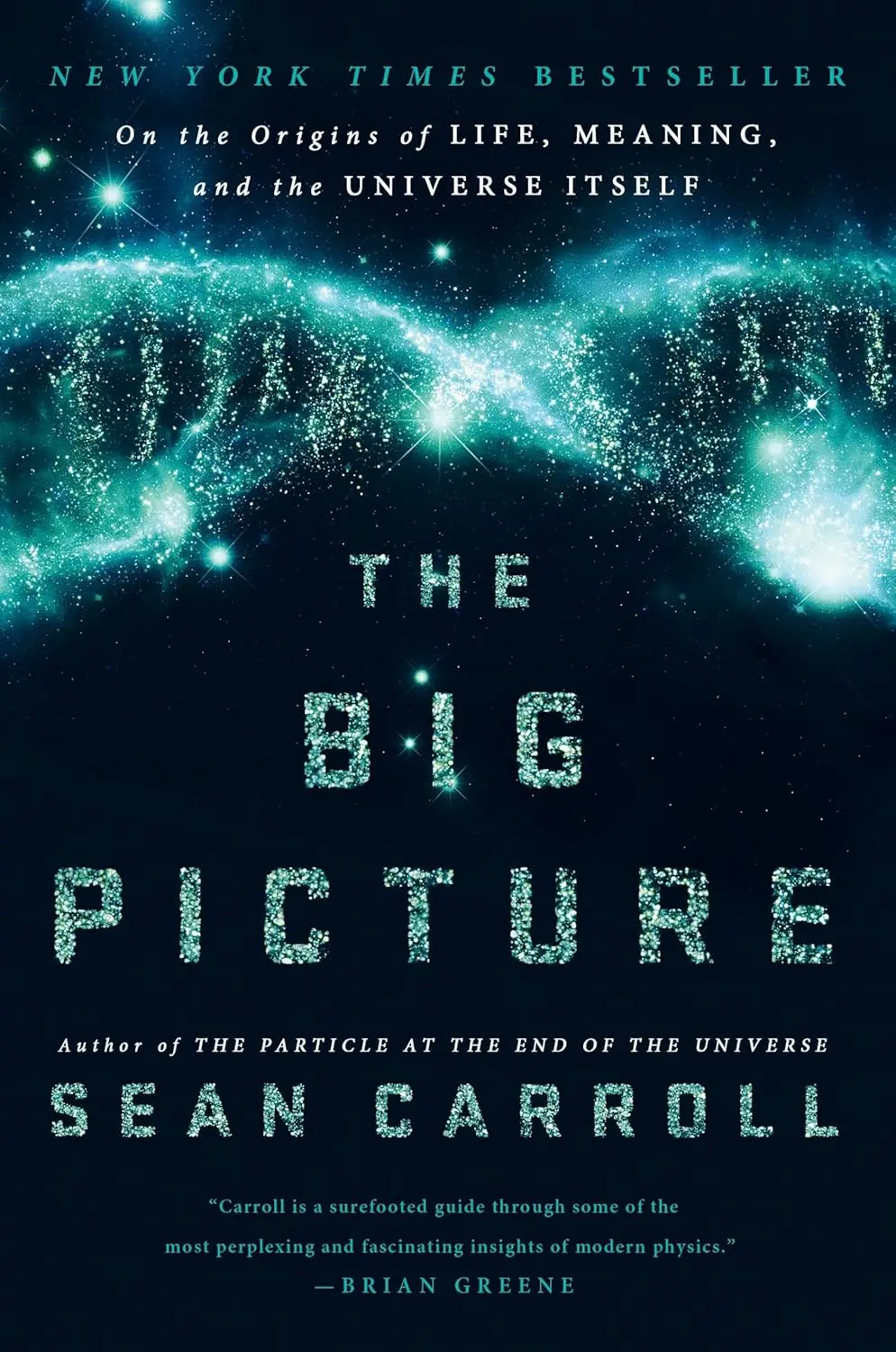
Sean Carroll is a theoretical physicist at Caltech who studies quantum mechanics and cosmology. He is also one of the few working physicists willing to engage seriously with philosophical questions that most of his colleagues dismiss as outside their jurisdiction. What is consciousness? Does life have meaning? Is there free will? Carroll thinks physics has something to say about all of these, and The Big Picture is his attempt to say it.
The book is organized around a philosophical position Carroll calls poetic naturalism. Naturalism means that the fundamental laws of physics describe everything that exists. There is no supernatural layer. Poetic means that we are free to describe the world in multiple ways at different scales. The language of atoms is true. The language of tables and chairs is also true. The language of love, purpose, and beauty is also true. These descriptions are not competing. They are addressing different levels of the same reality.
Carroll builds the argument from the ground up. He starts with Bayesian reasoning, explaining how we should update our beliefs when new evidence arrives. He moves through quantum field theory, explaining what matter actually is at the most fundamental level (fields, not particles, though particles are what we observe). He covers the arrow of time, entropy, and the origin of the universe. He addresses the emergence of complexity, life, and consciousness.
The consciousness sections are some of the most interesting. Carroll is a physicalist: he believes that consciousness is what certain physical processes feel like from the inside. There is no hard problem of consciousness in his view, or rather, the hard problem dissolves once you accept that subjective experience is what it is like to be a particular arrangement of matter. This is a position. Not everyone will find it satisfying. Carroll knows this and engages with the disagreements honestly.
The book’s last sections tackle meaning and ethics. If the universe has no built-in purpose, where does purpose come from? Carroll’s answer: we create it. This is not a novel position, but Carroll arrives at it through hundreds of pages of careful argument rather than simply asserting it, which gives it more weight than the usual formulation.
Carroll writes with unusual clarity for a physicist. He avoids jargon, explains concepts with analogies rather than equations, and maintains a warm, conversational tone throughout a book that covers some of the hardest questions humans have asked. The Big Picture is not light reading, but it is accessible to anyone willing to think carefully about what reality actually is.
